

Courses
Discover thousands of courses from top institutions and platforms worldwide
Level
Course Type
Duration

Udemy
Aerospace and Aeronautical Engineering: Master the Mechanics of Airplanes - Aerodynamics, Flight Maneuvers, JET Engines What you'll learn: Understand the basics of Aerospace EngineeringIdentify the components of an Aircraft and their purposesUnderstand how Airplanes Fly and their key parametersIdentify the type of Aircraft suited for each missionDefine and propose your own AircraftUnderstand the basics of stability and Aircraft Design The Aerospace Engineering: Aircraft Fundamentals Course is a multidisciplinary course where you will study the aerodynamics, mechanics and engineering of Airplanes and Aircraft. My intention is that you fully understand the main topics regarding Design and Engineering of Aircraft and Airplanes. The structure of the Course is the following: IntroductionClassification of AirplanesAerodynamicsJET EnginesFlight MechanicsPerformanceWe will discuss topics such as Stability, Mechanics and Rigid-Body Physics, Aircraft types and history, Flight Mechanics and Maneuvers, Control Surfaces, TurboFans and much more!The objectives of the Course are for you to understand how Airplanes generate Lift, how the Lift is related to the Drag and how the Drag requires a constant Thrust provided by the engines. Engine types and comparison, which one is more efficient and why? Flight Mechanics and control surfaces and Performance of the Aircraft depending on the Range and Weights. I encourage you to begin this journey to Aerospace Engineering, you won't regret it! If you have any doubts during the course feel free to contact me, I will answer as quick as possible! The course was included in the Udemy for Business. This inclusion is a guarantee of the quality of the content, being provided to companies around the globe. Most reviewed Aerospace Engineering courseon Udemy.

Udemy
Have the knowledge of a rocket scientist and learn how to deal with complex equations critical to rocket propulsion! What you'll learn: Discover Rockets and Their ComponentsDerive and Understand The Rocket Thrust EquationFull Understanding of Specific ImpulseDerive and Understand Tsiolkovsky’s Rocket EquationDiscover The Aerodynamic Forces on a RocketThorough Thermodynamic AnalysisUnderstand The Meaning of An Ideal RocketDerive, Develop and Understand Complex Rocket Design Equations in A Simple MannerDesign a Rocket Engine For a Specific Orbit/AltitudeDerive and Understand Performance Key ParametersFull Understanding Of How Liquid-Propellant Rocket Engines Work And Their ComponentsDiscover The Different Engine Cooling TechniquesHeat Transfer AnalysisFull Understanding Of How Solid-Propellant Rocket Engines Work And Their ComponentsDiscover The Different Electric Propulsion Systems, The Difference Between Them And How They Work HAVE THE KNOWLEDGE OF A ROCKET SCIENTIST!First of all, if you're looking for a course that contains basic knowledge about rocket science, just skip ahead because this course is NOT for you! This course is more mathematics oriented. Think of it as rocket propulsion university lectures compressed into 4.5 hours, that's why high school/basic mathematics and physics are recommended. You can always check my AP/College Physics course, your call! PLEASE DO TAKE A LOOK AT THE VIDEOS PROVIDED FOR FREE BEFORE ENROLLING IN THIS COURSE! I assure you, this is the only online course that focuses this much on rocket propulsion! Go ahead, do your research!NO YOU WILL NOT BECOME A ROCKET SCIENTIST! You will however, understand the concepts behind rocket science and engineering and you will never say "IT'S NOT ROCKET SCIENCE!" again, because as it turns out, it's not that hard. This course contains 4.5 hours of content containing clear course videos and examples to help you better understand the concepts of rocket propulsion, and you will also find quiz questions at the end of each section so you can test your knowledge!This course contains crystal clear explanation of rocket propulsion, how to deal with complex equations which are critical to rocket design and how to use these equations to design a rocket engine for a specific mission. This course is made using Microsoft PowerPoint which I Provided in the form of a PDF so you can keep up while watching the course videos. You will find it included as a resource in the first course video, so you can easily download it. YOU SHOULD KNOW THAT THIS COURSE DOES NOT CONTAIN ORBITAL MECHANICS (Kepler's laws and all that) PLEASE DO TAKE A LOOK AT THE COURSE CONTENT BEFORE ENROLLING IN THIS COURSE! "We choose to go to the moon not because they are easy but because they are hard". JFK What students say about this course: "I honestly never thought it would be this detailed! The way the instructor presents such complex concepts, so simple, so elegant. The examples and the quiz questions helped a lot!Whether you're a total beginner or a Ph.D. student, this course is PERFECT for you!Thank you so much, really enjoyed it!"

Swayam
ABOUT THE COURSE:The aim of this course is to provide a general overview of the field of Aeronautical Engineering to interested students. The course will consist of ten Capsules, each consisting of two Lectures. Each Lecture will cover a specific concept or area relevant to the subject. An attempt will be made to cover the contents in an interesting manner, by a judicious use of a mix of powerpoint presentations, in-class activities, quizzes, innovative and hands on assignments that will not only increase the awareness of the students, but also satiate their curiosity and desire to know more about the various concepts related to the subject.INTENDED AUDIENCE : Any discipline of Engineering, who are interested in the subjectINDUSTRY SUPPORT : DRDO, HAL, NAL, IAF

Udemy
Master the Mechanics of Structural Design, the Structure of Aircraft Components and Aerospace Materials Science What you'll learn: Understand the basics of Aerospace EngineeringIdentify the components of an Aircraft and their purposesUnderstand the role of Materials Science in Aerospace EngineeringLearn how to Design the Structure of an Aircraft The Aerospace Engineering: Aircraft Structures and Materials Course is a multidisciplinary course where you will study the engineering and design of the structures and materials of aircraft. My intention is that you fully understand the main topics regarding Materials Science as well as Structural Design of Aircraft and Airplanes. The structure of the Course is the following: Introduction to Aerospace Structures and MaterialsAircraft LoadsMechanical StressesAircraft StructuresMaterials ScienceAerospace MaterialsStructures Design and Material SelectionWe will discuss the typical loads which may be encountered on Aircraft, as well as a comprehensive description of mechanical stresses that may emerge due to such loads, and how they define the need for specific structures in aircraft. The objective of the Course are for you tu understand why Aircraft require specific structural designs as well as light-weight and strong materials in order to operate at normal conditions. Also, we will study in depth Material Science, Mechanical Properties and how to select the correct Aerospace Material.I encourage you to begin this journey to Aerospace Engineering:Aircraft Structures and Materials, you won't regret it! If you have any doubts during the course feel free to contact me, I will answer as quick as possible!

Udemy
Aerospace and Aeronautical Engineering: Master the Systems of Airplanes - Hydraulics, Avionics, Electric, Propulsion What you'll learn: Understand the basics of Aerospace EngineeringIdentify the components of an Aircraft and their purposesUnderstand the role of Aircraft Systems in the operation of AircraftKnow the physics of how Aircraft Systems work The Aerospace Engineering: Aircraft Systems and Avionics Course is a multidisciplinary course where you will study the engineering of the many systems onboard of Airplanes and Aircraft. My intention is that you fully understand the main topics regarding Systems Engineering of Aircraft and Airplanes. The structure of the Course is the following: IntroductionFlight InstrumentsElectrical SystemPneumatic SystemHydraulic SystemAvionicsCockpitWe will discuss topics such as Flight Instruments on Civil Aircraft, the generators used to produce electricity on board, the Key differences between Pneumatic and Hydraulic Systems and more!The objective of the Course are for you tu understand why Aircraft require a specific set of systems in order to operate at normal conditions. Why the hydraulic system is essential to move the control surfaces on the aircraft and how it is linked to the Landing Gear. Cockpit main instruments and their relation to the conditions of flight. I highly recommend having taken the course on Aerospace Engineering: Aircraft Fundamentals and Advanced in order to clearly grasp the concepts mentioned in this course!I encourage you to begin this journey to Aerospace Engineering, you won't regret it! If you have any doubts during the course feel free to contact me, I will answer as quick as possible!

Udemy
Understand how Airplanes generate Lift, how Airlines and Airports operate and what is Aerospace Engineering today. What you'll learn: Understand the Basics of Aerospace EngineeringUnderstand how Airplines Fly and key parametersIdentify the type of Aircraft suited for each missionComprehend the complexities of a Airline Economic ModelVisualize the key design elements for AirportsDistinguish Commercial Aircraft The Aerospace Engineering: Airplanes, Airlines and Airports Course is a multidisciplinary course where you will study aerodynamics, mechanics and engineering of Airplanes, the Operation of Airlines and Airports and what Aerospace Engineering looks like Today. My intention is that you get a good overview to what Aerospace Engineering is Today, focusing on Aircraft Design and Dynamics but also getting a complete insight into Airlines and Airports.The structure of the Course is the following: IntroductionClassification of AirplanesAirplane EngineeringAirline ModelsAirportsWe will discuss topics such as Aircraft types, Flight Mechanics and Maneuvers, Aerodynamics concepts, TurboFan Engines, Airline Models and Businesses, Airport Operation as a function of the number of passengers per year and much more!I want you to fully grasp and comprehend Aerospace Engineering and to break it down from Complex and Broad to Simple Key Ideas. I want you to feel confident when working with Aerospace Engineering projects in the future or when discussing topics with other people.I deeply encourage you to begin this journey into the fascinating world of Aerospace Engineering, you won't regret it! If you have any doubts during the course contact me and we will solve any questions that may arise!

Udemy
Master aircraft and engine designs, parts and components, aerodynamics and classification What you'll learn: Aircraft and airplane classification by various parameters.Most of airplane designs and configurations and how these impacts its spectrum of use.General aerodynamics of airplanes: forces of a flight, laminar and turbulent flows, stalls, supersonic flights, airplane stability, etc.Airplane airframe and flight controls.Turbojet, turbofan, turboprop and piston engines.Types of aviation fuel. Aerospace Engineering: Airplane design and Aerodynamic basics course is aviation and airline related course where you will study most modern airplane designs and engine work principles. My intention is that you, in terms of aerodynamics, learn and understand how different airplane components including its engines make the airplane to fly in the most efficient way. The course is concentrated on civil commercial airplanes but also explains essential designs used in military aviation.The structure of the course is following:IntroductionAircraft and airplane classificationAerodynamics basicsAirframe, flight controls and enginesYou will learn such topics as Aircraft classification, Flight Performance classes, Airplane spectrum of use, Commercial airplane classification, Aerodynamic forces of an airplane, Laminar and turbulent flows, stall, Airframe, Flight controls and high lift devices, Jet engines, Aviation fuel types, ICAO noise categories and much more!The objectives of this course for you are to be well oriented in Aerospace engineering and in Aviation in general, and get deep theoretical and practical knowledge on the subjects. For better understanding the course contains a lot of graphical information, practical examples, around 2 hours of specially prepared reading materials and quizzes after each theoretical section.I encourage you to begin this journey to Aviation and Aerospace engineering and you will not regret it! If you have any questions during the course feel free to contact me, I will answer as quick as possible!

YouTube
Explore the applications of Go in aerospace engineering through this GopherCon 2022 talk by Patricio Whittingslow. Discover how a small Argentinian startup leverages Go for rigid-body simulation of orbital vehicles, 3D visualization of orbital maneuvers, embedded systems, and rocket motor testing. Learn about the high-level experiences of applying Go to solve common aerospace industry problems, including orbital trajectory optimization using unsupervised machine learning and industrial control/automation for rocket engine testing. Gain insights into Go's impact on the company and its fit within the aerospace industry. The talk covers topics such as ideal gas laws, rewriting Python programs, the Zonda Sounding Rocket, embedded systems, flight software, WebAssembly, and machine learning applications in aerospace.

YouTube
Explore the journey of a Stanford Engineering professor who engineered a startup in this insightful webinar. Discover how Amin Saberi, Founder and CEO of NovoEd and Associate Professor of Engineering at Stanford, created a new learning platform and contributed to the digital future of education. Gain valuable insights into startup launches, online education, and the development of innovative learning solutions. Learn about the clustering algorithm, empowered e-patients, and the NovoEd platform's features. Delve into topics such as entrepreneurship, team building, company growth, and fundraising. Understand the importance of raw talent, commitment, and intellectual stimulation in the startup world. Explore the four key skills and the role of social interaction in online education. Gain knowledge about big data applications and new solutions in the field of educational technology. Benefit from the lessons learned and future steps shared by Professor Saberi as he discusses his experiences in both academia and the startup ecosystem.

YouTube
Dive into the world of aerospace propulsion through this comprehensive course. Explore air-breathing engines like turbojets, turboprops, turbofans, ramjets, and scramjets, as well as non-air-breathing engines. Analyze general performance parameters and conduct cycle analyses for various engine types. Study rocket nozzles, including 1D analysis, real effects, and thrust vectoring. Delve into solid rockets, examining propellants, burn rates, performance, grain design, ignition, and quenching. Investigate liquid rockets, covering propellants, nozzle cooling, feed systems, pumps, and fuel injection. Learn about hybrid rockets and their performance characteristics. Conclude with an introduction to chemical equilibrium analysis using SP 273.

XuetangX
Aerospace Technology is a course with strong Aerospace characteristics. It is a basic course of specialized general education being geared to middle and senior undergraduates and junior postgraduates. It focuses on motivating students’ interests on aerospace science, broadening their horizon, improving their awareness of aerospace engineering and enhancing their creative abilities from the aspects of knowledge and technology.To ensure the teaching quality, the course teaching team is composed of many first-class teachers. With abundant content and detailed examples, the course emphasizes on the combination of theory and practice, aiming at laying a good foundation for further improvement on students’ awareness of aerospace and their technical skills.

YouTube
Explore the whimsical world of Rube Goldberg machines in this entertaining 38-minute video lecture. Dive into the counterintuitive side of engineering as Professor Stephen J. Ressler demonstrates the art of creating wildly inefficient yet hilarious contraptions. Learn about Goldberg's famous self-operating napkin and discover the educational value behind these impractical inventions. Follow along as Ressler guides you through a DIY engineering project to create a mouse-click device, complete with hydraulic systems, rocket pendulums, and balloon switches. Witness the professor's own Rube Goldberg machine in action and enjoy behind-the-scenes outtakes. Gain insights into the creative problem-solving and engineering principles that make these complex, multi-step machines both entertaining and educational.

Coursera
The course aims to provide the knowledge needed to design and develop efficient driving and navigation solutions for autonomous vehicles. Driving can be strategic or tactical while navigation is the function that provides information about the position, speed and orientation of the vehicle. It is made by integrating measurement from different sources, such as sensors and receivers.

YouTube
Explore the fascinating world of space engineering in this 50-minute talk by an Aerospace Engineer from NASA's Goddard Space Flight Center. Gain insights into the role of a Contamination Control Engineer for the James Webb Space Telescope and learn about the challenges and intricacies involved in maintaining the telescope's pristine condition. Discover the upcoming Roman Space Telescope project, scheduled for launch in 2027, and understand its potential contributions to space exploration and scientific discovery. Delve into the cutting-edge technologies and meticulous processes employed by NASA in their quest to unravel the mysteries of the universe.
Independent
Would you like to use the latest aerospace resources and best practices in your STEM lessons with students? Join our Aerospace in Class MOOC and get to know amazingly engaging resources that will lift up your classroom experience! In this MOOC, you will be guided to create your own Learning Scenario with tested materials from the Aerospace in class project. You will get to hear best practices from Lead Teachers and you will learn about all the knowledge and skills needed to engage your students with aerospace subjects. The course will give you the opportunity to study practical solutions from aerospace education and will present inspirational examples of activities in the fields of “Science of Flight”, “Mission to the Moon” and the “Future of the Skies”. The course will consist of four modules, each of them tackling different aspects of designing modern classroom lessons for students on aerospace topics, which are great to be implemented in your STEM class.

YouTube
Explore the fundamentals of aerospace propulsion in this comprehensive 21-hour course. Delve into the historical development of flight, early aircraft propulsive devices, and jet propulsion. Master key thermodynamic concepts, including laws, processes, and cycles. Examine gas and vapor power cycles, thermodynamic property relations, and properties of mixtures. Gain insights into one-dimensional compressible flows, isentropic flows, and shocks. Through lectures and tutorials, develop a strong foundation in aerospace propulsion principles essential for understanding modern aircraft and spacecraft propulsion systems.

YouTube
Learn about advanced reverse engineering techniques and control flow analysis using Intel Processor Trace in this 30-minute conference talk from BSidesMunich. Explore how Intel's hardware-assisted execution tracing technology can be leveraged for detailed program analysis, debugging, and security research. Discover practical applications of Intel PT for understanding program behavior, identifying vulnerabilities, and performing dynamic code analysis. Gain insights into the technical aspects of processor tracing capabilities and how they can enhance reverse engineering workflows.

Udemy
With CADAC++ as Prototype What you'll learn: Applying the power of C++ to aerospace simulationsGrasping how Polymorphism, Inheritance, and Encapsulation (PIE) build sophisticated simulationsDeveloping a UAV simulation step-by-step into a full netcentric modelExperiencing the CADAC++ framework in comparison to other C++ architecturesGetting ready for developing your own project simulations This C++ course will take you deep into the guts of aerospace simulations. Like the students that I taught at the University of Florida, you should come with a first knowledge of C++ and a general understanding of flight dynamics. Step-by-step I combine C++ constructs with increasingly more complex aerospace features. You will be given access to eight simulations that replicate this build-up, culminating in a final multi-object CRUISE simulation.I teach by example, using UAVs attacking targets, tracked by overhead satellites. Though I show you how to build this complete aerospace simulation, my focus is on the main elements of the C++ PIE: Polymorphism, Inheritance, Encapsulation. I apply them to overloading functions—both pure and virtual functions—leading to the efficient run-time polymorphism; arrange the aerospace vehicles—UAV, target, and satellite—into a hierarchical inheritance structure; and encapsulate into classes the aerodynamic and propulsive data to protect their access.Though I use my simulation framework CADAC++ to exemplify the key features of C++, you will find that the C++ PIE is feeding most if not all complex aerospace simulations. (At the end of the course I will briefly discuss three other architectures.) Your familiarity with CADAC++ will also open for you all my other simulations of missiles, aircraft, rockets, and hypersonic vehicles.Update April 2024: Simulations compatible with Microsoft VS C++ 2022 are added to the downloadable resources. So, take the plunge and become a C++ expert in aerospace simulations!

Swayam
ABOUT THE COURSE: This course will cover four different smart materials namely piezoelectric materials, shape memory alloys, electro and magneto rheological fluids. Materials properties of these materials and development of their constitutive relations will be discussed. Mechanics of fibre reinforced composite laminates will be introduced. Next, analysis of metallic as well as fibre composite structures fitted with these materials will covered. Analysis will involve both close form and approximate solutions of the respective governing equations. Development of codes for such analysis will also be discussed.INTENDED AUDIENCE: BE/ME/PhD student in Aerospace Egineering /Mechanical Engineering/ Civil Engineering/ Ocean Engineering and Naval Architecture and industry professionals from similar fieldsPREREQUISITES: Structural Analysis Dynamics and VibrationINDUSTRY SUPPORT: Industries that deal with aeropace, mechanical or civil structures. Name of such organizations include but is not limited to the following. 1. Indian Space Research Organization 2. Defence Research and Development Organisation 3. National Aerospace Laboratories 4. General Electric 5. General Motors 6. Suzlon 7. Siemens Gamesa
YouTube
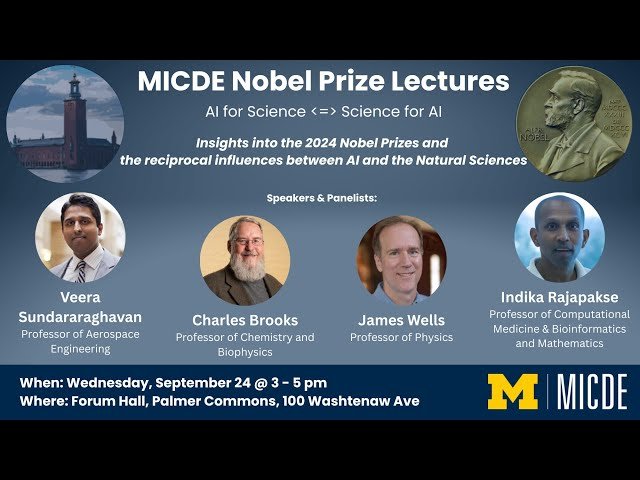
Explore the groundbreaking 2024 Nobel Prizes in Physics and Chemistry through this comprehensive lecture series examining the reciprocal influence between artificial intelligence and the natural sciences. Learn about the foundational advances in neural networks that underpin modern machine learning, which earned the Physics prize, and discover the AI-enabled breakthroughs in protein structure prediction and computational protein design recognized by the Chemistry prize. Begin with opening remarks from Karthik Duraisamy, Professor of Aerospace Engineering and Director of the Michigan Institute for Computational Discovery and Engineering, before diving into detailed presentations on each Nobel Prize. Gain insights into the Chemistry prize through Charles Brooks, Professor of Chemistry and Biophysics, who explains the revolutionary developments in protein research. Understand the Physics prize through Veera Sundararaghavan, Professor of Aerospace Engineering, who covers the neural network innovations that transformed machine learning. Participate in a moderated panel discussion titled "AI for Science - Science for AI" featuring distinguished faculty including James Wells (Physics), Indika Rajapakse (Computational Medicine & Bioinformatics and Mathematics), Charles Brooks (Chemistry and Biophysics), and Veera Sundararaghavan (Aerospace Engineering). Engage in cross-disciplinary discussions that illuminate the intersection of artificial intelligence and scientific discovery, making this essential viewing for anyone interested in understanding how AI is reshaping scientific research and how scientific principles are advancing AI capabilities.