

Courses
Discover thousands of courses from top institutions and platforms worldwide
Level
Course Type
Duration

YouTube
Explore the potential security vulnerabilities in home and workplace alarm systems in this 40-minute conference talk from nullcon Goa 2019. Delve into Kirils Solovjovs' research on a home alarm system, covering topics such as active keypad emulation, RF attacks, and firmware reverse engineering. Learn about the feasibility and process of uncovering security bugs that could compromise the very systems designed to protect us. Gain insights from Solovjovs, a lead researcher at Possible Security and prominent white-hat hacker, known for his work in network flow analysis, reverse engineering, and penetration testing. Discover whether security alarm systems truly provide peace of mind or if their vulnerabilities might be cause for concern.

LinkedIn Learning
Learn how to design fire-alarm systems in Revit.

YouTube
Explore the vulnerabilities of alarm systems in this eye-opening 56-minute video from Derbycon 2012, presented by Babak Javadi and Keith Howell. Discover the myriad ways in which security systems can be compromised, providing valuable insights for both security professionals and homeowners. Learn about potential weaknesses in alarm system designs, installation flaws, and common exploits that could render your protection ineffective. Gain a deeper understanding of how to assess and improve the reliability of your security measures, ensuring better protection for your property and loved ones.

YouTube
Explore the vulnerabilities of common household devices and physical security measures in this Black Hat conference talk. Dive into the world of security breaches affecting popular car models, home alarm systems, and baby monitors. Learn how keyless entry systems can be compromised using predictable rolling codes, software-defined radio, and custom-built robots. Discover the simplicity of eavesdropping on analog baby monitors and the concerning weaknesses in home alarm systems using fixed codes. Examine how a low-cost Arduino and Raspberry Pi-based device can be used to capture and replay codes, effectively disabling alarms. Investigate physical tampering techniques that allow attackers to read secret passcodes from alarm system microcontrollers. Gain insights into these simple yet effective attacks on everyday physical devices and understand mitigation strategies to differentiate between secure and vulnerable products. Follow along with detailed analyses of signal processing, cluster analysis, and phase space analysis techniques used to break device security.

LinkedIn Learning
Learn to design sprinkler and fire-alarm systems with AutoCAD.
YouTube
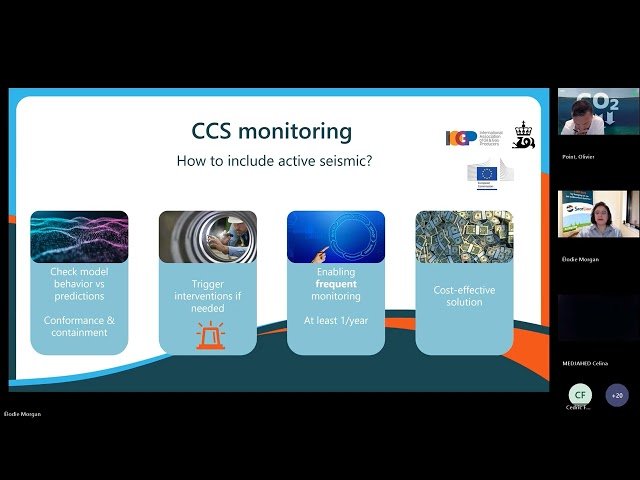
Explore the critical question of whether carbon dioxide storage facilities require subsurface alarm systems in this 57-minute webinar presented by the CCS network group. Join Elodie Morgan from SpotLight as she examines the safety considerations, monitoring technologies, and regulatory frameworks surrounding CO2 storage facilities. Learn about potential risks, detection methods, and the importance of early warning systems in ensuring the long-term security and environmental safety of carbon capture and storage projects.

YouTube
Explore an insightful conference talk on optimizing industrial control system (ICS) security alerts using alarm management techniques. Gain valuable knowledge from Chris Sistrunk as he delves into effective strategies for fine-tuning security notifications in ICS environments. Learn how to apply alarm management principles to enhance the efficiency and accuracy of security monitoring, reducing alert fatigue and improving overall incident response capabilities in critical infrastructure settings.

Coursera
In the comprehensive exploration of "Types of Fire Detection Systems" within the course module, participants embark on a journey through the intricacies of fire safety. The module kicks off by emphasizing the pivotal role fire detection systems play in building safety, particularly in identifying and responding to fires during their early stages. This early detection not only ensures the safety of occupants but also provides ample time for a well-organized evacuation. The installation of these systems is highlighted as a proactive measure to mitigate property loss and minimize facility downtime through swift identification. Participants are introduced to the dichotomy between conventional and addressable fire detection systems. The former operates on a zoning concept, dividing alarm devices into distinct areas or zones. On the other hand, the addressable system allows for precise identification of the triggered device, offering enhanced sophistication and response capabilities. The importance of understanding these systems lies in their diverse applications and suitability for different environments. Delving deeper into the realm of fire detection devices, the module unfolds the various types, including smoke, flame, and heat detectors. This includes the classic ionization and photoelectric smoke detectors, each tailored to specific fire types, and advanced technologies like video image smoke detection providing visual confirmation. The significance of these detectors extends beyond traditional smoke and flame detection, incorporating heat detectors, multi-sensor detectors, and aspirating detectors with laser-based technology for early detection. Transitioning into the "Fire Alarm Notification Devices, Location and Coverage of Detectors" module, participants are immersed in the foundational terminologies shaping the landscape of fire alarm systems. The historical journey of fire detectors unveils key terminologies that form the basis for comprehension. The strategic placement of Notification Devices becomes a focal point, with emphasis on visibility, audibility, or a combination of both for optimal effectiveness. The exploration extends to the intricate world of detector coverage, where Heat and Smoke Detectors take center stage. Instructors guide participants through the complexities of Indian Standard 2189, offering benchmarks for recommended practices in detector coverage. Advanced detectors, such as Aspiration and Beam Detectors, are introduced, showcasing their unique coverage attributes. Real-world applications of these detectors, considering air movement and potential pitfalls in Smoke Detector placement, provide practical insights for participants. Moving forward, the course bridges the gap between fire detection systems and broader building environments in the "Fire & Emergency Safety Signages" module. Fire safety signages emerge as integral components of an effective safety strategy. Participants understand their classifications, addressing means of warning, manual controls, means of egress, firefighting equipment, prohibition signs, and broader health and safety signages. Instructors emphasize the strategic location, sizing, and color coding of these signages for universal recognition and effective emergency response. Overall, these interconnected modules provide participants with a holistic understanding of fire detection systems, alarm notification devices, and safety signages. From the technical nuances of detector technologies to the practical considerations of strategic placement, the course equips participants with the knowledge and skills essential for implementing and maintaining robust fire safety measures in diverse building environments. Target Learners: • Fire Safety Professionals and Inspectors • Undergraduate Students in Fire Safety Engineering, Electrical Engineering, and Building Management • Post-Graduate Students specializing in Fire Protection Engineering and Safety Systems • Practicing Engineers and Technicians in Fire Detection and Alarm Systems • Diploma Students in Fire Technology and Safety Management • Building and Facilities Managers
YouTube
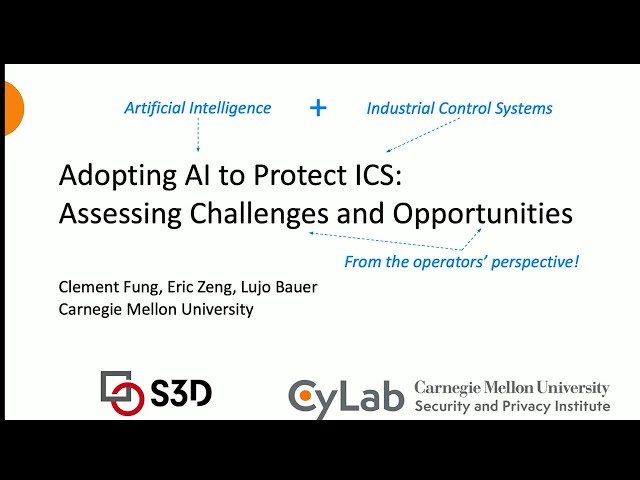
Explore a 13-minute conference presentation examining the adoption of AI technologies for protecting industrial control systems from a practitioner's perspective. Learn about research conducted through 18 semi-structured interviews with ICS security professionals who manage critical infrastructure like electric distribution and water treatment systems. Discover the current practices for alarm management in industrial environments, including anomaly detection, operator response coordination, and alarm rule set analysis. Understand why AI-based security approaches, despite their potential for detecting attacks and raising alarms, remain underutilized in practice. Examine the key challenges practitioners face beyond basic anomaly detection, particularly in alarm diagnosis and response coordination. Gain insights into the barriers preventing AI adoption in industrial control systems, such as limited data collection capabilities and low trust in vendor technologies. Review practical recommendations for making AI-based security tools more effective and trustworthy, including strategies for demonstrating model transparency through interactive pilot projects and addressing the unique operational constraints of critical infrastructure environments.

Udemy
Get the full information needed to be able to become a Wireless Technician What you'll learn: Understand the foundation theory of the Wireless LANBe able to configure and install a Wireless access pointGet prepared to the CWNP Certified Wireless Technician exam (CWT)Know which WLAN should you configure and how DISCLAIMER:This course is not officially sponsored by CWNP and not an authorized course by CWNP. We are neither affiliated with nor endorsed by CWNP. We respect the Trademarks of the mentioned company and institution. Hello,You are looking to this page because you are interested to become a Wireless Technician. Being a wireless technician nowadays is very required specially that all the networks need to have wireless enabled. However, if the wireless is deployed by unexperienced engineers, then this can cause a lot of issue as for the security, installation, frequency interference, and so on. For this, it is always required that the person who is installing the Wireless LAN to be an experienced one and to know what he is doing.In this course, Iwill prepare you to become ready to be a wireless technician. You will have to understand a lot of theory in wireless so when you will get a project to do a wireless installation then you know what you are doing.Also, I will be showing in this course many practical work. For instance, we are going to configure an Wireless Access Point Router from scratch so we have the wireless up and running, then to test if it is going to work.If you have taken previsouly the course Wireless Specialist, then you may see that some of the lectures are the same and that's because the 2 courses have a lot of matched topics.Finally, if you want to be read to be a Wireless Technician, all you need to do is to join this course and I will help you with your path.

Udemy
Master AUTOSAR/OSEK OS. The 1st RTOS In Automotive Software Industry What you'll learn: OSEK RTOS overviewExtended tasks managementStandard OIL description for events & alarmsEvents management in OSEK environmentsAlarms management & counters in OSEK environmentsHook routines & Debugging supportEvents, alarms, hooks APIs in OSEK standard Learn the most common real time operating system in the Automotive software industry. OSEK operating system which is the standard platform that is running on almost all of the Electronics Control Units (ECUs) in modern vehicles to support different application software components. This course provides a complementary part to the previous course [Intro To OSEK OS I] to give you a complete overview of what an OSEK real time operating system is and how it works using ARM Keil Uvision simulator and/or TM4C123 evaluation kit. In this course, we will start with quick review on the development cycle in OSEK environment, Oil system description, Task management and resource management in OSEK real time kernel. Then we will learn the alarm management, Event control and Hook routines in OSEK OS. OSEK Alarm Management You will understand the counter/alarm concepts, alarm types, alarm actions, alarm oil description and how can we use alarm objects to support periodic threads in OSEK kernel. The APIs that are provided by OSEK kernel to handle alarms. Each point is supported with practical example to ensure a rigid understanding and programming exercise will be conducted at the end. Event Control The event concept will be introduced first, Then the usage and oil description of event objects. The events effects on the task management and scheduling activities. The events & the server threads. Event setting as an alarm actions. Event APIs that are provided by OSEK kernel. Each point is supported with practical example to ensure a rigid understanding and programming exercise will be conducted at the end. Hook routines The hook concepts will be introduced as an OSEK object. The startup sequence of the OS and the startup hook. Pre/post task hooks will be introduced then and how to use them to handle the runtime measurements. The course includes lots of examples to make sure that you have a thorough and practical understanding. Now lets get started.

Udemy
An entry point into the Cisco Certified program What you'll learn: Master the principles of cybersecurity, including vulnerabilities and ethical considerationsAcquire skills in tools and commands to test your network (Wireshark, CLI, cmd)Learn about operating system security, malware removal, and software updates.Gain hands-on experience with Cisco, Microsoft, and Linux systems.Develop skills in incident handling, digital forensics, and compliance frameworks Are you looking to kickstart your career in cybersecurity? Our Cisco Certified Support Technician: Cybersecurity (CCST) course is specifically designed for entry-level technicians, students, interns, and IT professionals seeking to delve into the world of network and security. Hands-on experience with Cisco routers, switches, and access points will equip you with the real-world skills needed to protect digital assets. This course is an entry point into the Cisco Certified program. We will explore essential security principles, threats, vulnerabilities, access management principles, encryption methods, basic network security concepts, endpoint security, vulnerability assessment, risk management, incident handling, and moreThis course covers:Essential Security Principles: Grasp the foundations of cybersecurity, including the understanding of vulnerabilities, threats, and ethical considerations.Basic Network Security Concepts: Learn about TCP/IP vulnerabilities, network addresses, and the ins and outs of network security architecture.Endpoint Security Concepts: Explore operating system security, endpoint tools, system logs interpretation, and malware removal techniques.Vulnerability Assessment and Risk Management: Discover how to identify and manage vulnerabilities, assess risks, and plan for disaster recovery.Incident Handling: Develop skills in monitoring security events, understanding digital forensics, compliance frameworks, and cybersecurity incident response.By the end of this course, participants will be ready to take the Cisco Certified Support Technician: Cybersecurity exam and will be qualified work-ready cybersecurity technicians. Join now!!!

Coursera
In this foundational Pharmacy Technician Career Training Specialization, students will take four courses to master the fundamentals of a career in pharmacy. The first two courses teach how to communicate and engage professionally in any healthcare setting and the necessary knowledge of human anatomy and physiology required for any medical role. Next, students dive into two pharmacy-related courses - Pharmacy Technician Essentials and Pharmacy Dosages & Prescriptions Essentials - to round out their entry-level pharmacy education. IMPORTANT: This specialization is not designed to prepare students for national certification. Enrollees will gain the foundational/fundamental knowledge on subject matter relevant to the profession. However, to gain industry certification, a more comprehensive program must be completed through enrollment via approved/eligible schools such as MedCerts.

Coursera
This intermediate specialization equips pharmacy technicians with a comprehensive skill set, encompassing legal compliance, safety protocols, medication optimization strategies, specialized compounding techniques, and effective communication in pharmacy settings. Students gain expertise in navigating pharmacy law, emergency preparedness, ensuring medication safety, mastering syringe use, and compounding medications. Additionally, students are taught how to foster empathetic patient interactions, facilitating a well-rounded and competent approach to a pharmaceutical career. IMPORTANT: This specialization is not designed to prepare students for national certification. Enrollees will gain the foundational/fundamental knowledge on subject matter relevant to the profession. However, to gain industry certification, a more comprehensive program must be completed through enrollment via approved/eligible schools such as MedCerts.

Coursera
The Pharmacy Technician Essentials course provides an in-depth look at what a career in a pharmacy will look like. Through several lessons, students learn the ins and outs of a pharmacy setting and the meaning of the terminology used daily within a pharmacy environment. This course also provides a deep dive into the purpose of the top 200 most commonly prescribed medications and drug routes and formulations. Students will be able to demonstrate correct processing of medication orders, preparation, storage, and distribution of medications, by the end of the course. On top of knowing the medications being prescribed, students must also learn how to use pharmacy equipment, including management software and reading of prescriptions. At the completion of this course, students should have a solid understanding of what their day-to-day tasks will be within a pharmacy environment and how to use the necessary tools to excel in their new career. Course objectives include: - Identify the primary functions of different pharmacy organizations - Discuss the different roles of the pharmacy technician - Describe the common drugs and their uses, drug routes and formulations, and factor affecting drug activity - Understand pharmacy management software, as well as reading and interpreting prescriptions

YouTube
Learn how to create a functional alarm clock using Python in this 11-minute tutorial. Explore the process of setting up a timer, implementing sound playback, and designing a user interface for inputting the desired alarm time. Gain hands-on experience with Python's time and datetime modules, as well as the pygame library for audio functionality. Follow along as the instructor guides you through writing the code, explaining key concepts and best practices along the way. By the end of this video, you'll have built a practical alarm clock application that can wake you up with custom music at your specified time.
YouTube
Learn how to schedule alarms in Android using AlarmManager in this comprehensive 22-minute video tutorial. Discover the step-by-step process of implementing alarm functionality in your Android applications. Gain insights into best practices for working with AlarmManager, ensuring your app can effectively manage and execute scheduled tasks. Explore practical examples and code demonstrations to enhance your understanding of this essential Android development feature. By the end of the tutorial, you'll have the knowledge to create reliable and efficient alarm scheduling systems in your Android projects.

CourseHorse
Fire Protection Startup and Closeout What Will You Learn? The Fire Protection Startup & Closeout course provides students with a deep understanding of fire suppression, fire alarm systems, life safety measures, and project commissioning. This course covers the installation, testing, and final handover of fire protection systems, ensuring students develop expertise in system functionality, code compliance, and project closeout procedures. By completing this course, you will: Develop expertise in fire suppression and alarm system installation and testing. Learn life safety requirements, egress strategies, and emergency preparedness. Gain skills in integrating fire safety measures with mechanical and electrical systems. Understand MEP trim-out, startup, and system commissioning processes. Master project closeout, documentation turnover, and post-occupancy protocols. Benefits of Learning with VDCI By enrolling in this course, students gain access to high-quality training through VDCI, a nationally accredited institution offering structured learning experiences tailored to AEC professionals. Accredited Training Provider: VDCI is an ACCET-accredited Autodesk Authorized Training Center. Flexible Learning: Access self-paced course materials with structured progress tracking. Cost-Effective Training: Course bundles and certificate programs offer affordable, high-quality education. Project-Based Learning: Each lesson includes hands-on assignments assessed by industry professionals. Expert Instruction: Learn from Autodesk Certified Instructors with real-world experience. Collaborative Support: Engage in discussion forums and networking opportunities. Industry-Recognized Credentials: Earn digital badges and certificates to enhance your professional portfolio. Portfolio Development: Complete structured projects demonstrating proficiency in fire protection systems. Course Lessons and Projects Lesson 1: Fire Suppression Systems This lesson introduces students to fire suppression system types, installation methods, and testing procedures. Skills Learned: Understanding sprinkler systems, standpipes, and fire pumps. Managing fire suppression system layouts, piping, and valve assemblies. Evaluating wet, dry, pre-action, and foam-based fire suppression systems. Coordinating testing, inspections, and maintenance requirements. Ensuring compliance with NFPA, IBC, and local fire codes. Project: Develop a fire suppression system layout, ensuring proper coverage, zoning, and compliance with fire safety standards. Lesson 2: Fire Alarm Systems Students will explore fire alarm system design, installation, and programming. Skills Learned: Understanding fire alarm panel configurations and notification appliances. Managing fire alarm detection devices, including smoke and heat sensors. Evaluating voice evacuation, strobe lights, and alarm sequences. Coordinating fire alarm interfaces with HVAC, elevators, and suppression systems. Ensuring system commissioning, inspection, and compliance with NFPA 72. Project: Design a fire alarm system diagram, incorporating detectors, notification appliances, and system zoning. Lesson 3: Life Safety and Egress Planning This lesson focuses on life safety planning, emergency egress, and fire-rated construction. Skills Learned: Understanding egress routes, exit signage, and stairwell pressurization. Managing fire barriers, fire doors, and smoke control zones. Evaluating emergency lighting and backup power systems. Coordinating emergency response procedures with local fire authorities. Ensuring compliance with NFPA 101 Life Safety Code and ADA regulations. Project: Develop a life safety plan, ensuring egress compliance, fire compartmentalization, and emergency preparedness measures. Lesson 4: Elevator Fire Safety Integration Students will learn about elevator fire safety integration and emergency operations. Skills Learned: Understanding elevator shaft pressurization and fire-rated enclosures. Managing fire recall functions, emergency power, and smoke detection integration. Evaluating elevator safety systems, brakes, and emergency access. Coordinating MEP interfaces between elevators and fire alarm systems. Ensuring compliance with ASME A17.1 and IBC elevator safety codes. Project: Develop an elevator fire recall plan, detailing fire alarm triggers, pressurization systems, and emergency operations. Who Should Take This Course? This course is designed for professionals and students seeking expertise in fire protection systems, commissioning, and project closeout, including: Students & Recent Graduates: Build foundational skills in fire protection system installation and compliance. Aspiring Fire Protection Engineers & Contractors: Expand knowledge of fire suppression and alarm system integration. Aspiring MEP Coordinators & BIM Technicians: Strengthen expertise in fire safety commissioning and system startup. Construction Project Managers: Improve workflow coordination for fire protection system closeout. Facility Managers & Safety Inspectors: Enhance skills in fire protection system maintenance and compliance. With increasing demand for fire safety compliance and system efficiency, this course equips professionals with the knowledge needed to implement, manage, and maintain fire protection systems in a range of building environments.

Coursera
The Behavior Technician specialization provides foundational knowledge in behavior analysis and practical strategies for supporting individuals with developmental and behavioral challenges. Participants will gain hands-on skills in behavior acquisition techniques, functional assessment, verbal operant instruction, and both antecedent and consequence-based interventions. By the end of the program, learners will be able to implement structured teaching methods, identify functions of behavior, apply behavior intervention strategies, and support communication development through mand, tact, and intraverbal training. IMPORTANT: This specialization is not designed to prepare students for national certification, such as the Registered Behavior Technician credential offered by the BACB. Enrollees will gain the foundational/fundamental knowledge on subject matter relevant to the profession. While references may be made throughout the training to Registered Behavior Technicians (RBTs) or Behavior Technicians (BTs), to gain industry certification, a more comprehensive program must be completed through enrollment via approved/eligible schools such as MedCerts.

Udemy
A Video Study Guide for the Pharmacy Technician Certification Exam What you'll learn: By the end of this course, you will be able to utilize the skills you have learned to achieve a job as a pharmacy technician.Read sig codesPerform simple pharmacy mathUnderstand commonly used pharmacy lawBrand and generic equivalents Becoming a pharmacy technician is a simpler path than most students think. While many students are convinced that becoming certified involves months of schooling -currently this is NOT the case. To become a certified pharmacy technician an individual must: 1. Register with the PTCB or ExCPT to take a certification exam. Most states require the PTCB, but the ExCPT is accepted in many states. 2. Study the required material to pass the PTCB or ExCPT examination. (Note: Studying for the exam can be a part of a lengthy/costly college course, but is not required - a simple online video course will be sufficient ) 3. Pass your exam! 4. Register with your respective State Board of Pharmacy. We provide the web URL for all 50 State Boards of Pharmacy to make registering easy! This course is designed to help students learn the concepts needed to become a certified pharmacy technician (C. Ph.T). Many different topics are covered in the course, including pharmacy law, common abbreviations, commonly used calculations, and many other skills used by pharmacy technicians in their day to day tasks. Utilizing the advantages of a self-paced course, student will be able to prepare to take the certification exam needed to work as a pharmacy technician. Included in this course are how-to videos, drugs lists, commonly seen abbreviations, pharmaceutical calculations, sample test questions, and other resources useful in a successful pharmacy career. This course will require additional time and repetition to reinforce skills learned within the included materials. Students are encouraged to take a slow and steady pace in this course - it is designed as a 6-week course but may be longer or shorter depending on the rate of learning by the student.