

Courses
Discover thousands of courses from top institutions and platforms worldwide
Level
Course Type
Duration
IBM Training
This introductory course on watsonx Assistant is designed for anyone interested in exploring the latest advancements in Generative AI and how they can enhance customer and employee experiences through the creation of AI assistants.

YouTube
Explore the fundamental concepts of Principal Component Analysis (PCA) in this 27-minute video tutorial. Dive into variance and covariance, eigenvectors and eigenvalues, and practical applications of PCA. Learn through a visual approach with minimal formulas and abundant illustrations. Understand dimensionality reduction using housing data examples, grasp the importance of mean and variance, and delve into covariance matrices and linear transformations. Discover the significance of eigenvalues and eigenvectors in PCA, and gain insights into how this technique can be applied to real-world data analysis problems.

Swayam
This course is meant for capacity building of school headteachers/principals and the prospective headteachers of schools to provide them with the necessary knowledge, skills and competencies for effectively playing the role of the ‘Headmaster’ or ‘Principal’ in schools. The online course includes Twelve Modules with two/three units under each module. A total of twenty-five units. Pedagogy: Learning material will be in the form of e-text, PPTs, Audio-Video Lectures, and tutorials. Discussion Forum, 10 MCQs as Self-Assessment Questions per Module.

YouTube
Learn about the challenges and solutions in principal component analysis through this mathematics research talk that addresses the 'curse of isotropy' - a critical issue affecting the interpretation of principal components with similar eigenvalues. Explore how rotational variability can impact analysis results and discover a novel approach using probabilistic covariance models parameterized with flags of subspaces. Master the concept of principal subspace analysis as a more reliable alternative to traditional principal components, with demonstrations of its practical applications across various scientific datasets. The presentation, delivered at the Erwin Schrödinger International Institute's Thematic Programme on "Infinite-dimensional Geometry," offers a straightforward methodology that promises improved interpretability in exploratory data analysis.
YouTube
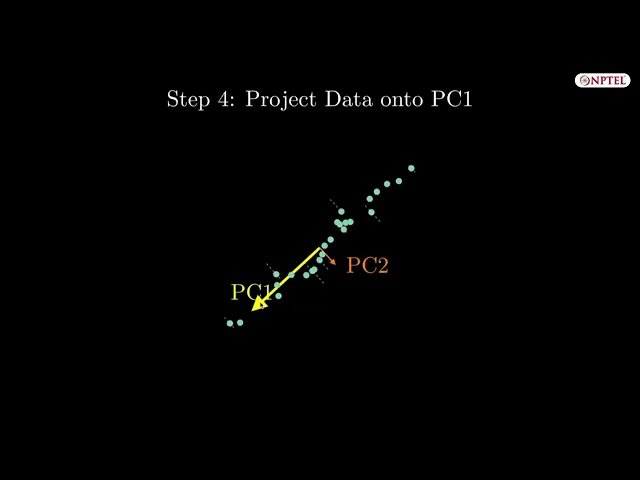
Learn the fundamental concepts and practical applications of Principal Component Analysis (PCA) through this 12-minute tutorial from NPTEL-NOC IITM. Master the mathematical foundations of PCA as a dimensionality reduction technique used to transform high-dimensional data into lower-dimensional representations while preserving the most important variance in the dataset. Explore how PCA identifies principal components by finding the directions of maximum variance in data, understand the eigenvalue and eigenvector computations involved in the process, and discover how to interpret the results for data visualization and feature extraction. Gain hands-on insights into when and why to apply PCA in machine learning and data analysis projects, including its role in preprocessing data, reducing computational complexity, and eliminating multicollinearity among variables.

Coursera
This course will provide a comprehensive view of major and principal gift development work for students who seek to build upon their experiences gained in the introductory session. Participants will gain an understanding of the philosophy and strategies implemented in major gift development including prospect identification, how to initially engage a potential major gift donor, the process of cultivation and moves management, effective proposal writing, making a successful ask and on-going donor stewardship. Students will practice fundamental major gift development skills by developing their own prospect strategy, producing essential documents to support the process, and engaging in role playing activity to simulate interaction with prospects and donors.

YouTube
Learn about principal equivariant spectral triples in this 47-minute lecture presented by Bram Mesland from the University of Leiden at the Banach Center, exploring advanced mathematical concepts and their applications in spectral geometry and noncommutative geometry.

YouTube
Explore the concept of principal equivariant spectral triples in this 46-minute lecture presented by Bram Mesland from the University of Leiden. Delve into advanced mathematical topics as Mesland discusses the intricacies of this subject, offering insights and explanations that will be valuable to researchers and students in the field of mathematics, particularly those interested in noncommutative geometry and operator algebras. Gain a deeper understanding of the theoretical foundations and potential applications of principal equivariant spectral triples through this comprehensive presentation hosted by the Banach Center.

YouTube
Explore a cutting-edge approach to learning unions of subspaces from data corrupted by outliers in this 51-minute lecture by René Vidal from Johns Hopkins University. Delve into Dual Principal Component Pursuit (DPCP), a non-convex method that outperforms state-of-the-art techniques in handling high-dimensional subspaces and large numbers of outliers. Examine the geometric and probabilistic conditions for DPCP's success, and discover how it can tolerate as many outliers as the square of the number of inliers. Learn about various optimization algorithms for solving the DPCP problem, including a Projected Sub-Gradient Method with linear convergence to the global minimum. Gain insights into experimental results demonstrating DPCP's superior performance in handling outliers and higher relative dimensions compared to existing methods.

YouTube
Explore a powerful TEDx talk that delves into personal transformation and resilience. Follow Dr. Lukas Carey's inspiring journey from incarceration to becoming a school principal as he shares valuable insights on overcoming adversity, turning mistakes into opportunities, and the importance of lived experience in education and policy-making. Discover how mental strength and a positive mindset can help navigate challenging periods in life. Learn about the significance of including diverse voices and experiences in educational settings, particularly in alternative schooling for at-risk youth. Gain perspective on the role of formerly incarcerated individuals in shaping justice system policies related to education, recidivism, and post-release employment. This thought-provoking presentation challenges viewers to reflect on their own mistakes and the power of owning one's past while working towards a better future.

YouTube
Explore the robust variant of principal component analysis (RPCA) in this 22-minute video lecture. Learn how robust statistics handle data with corruption or missing entries, making RPCA a crucial algorithm in fields like fluid mechanics, the Netflix prize, and image processing. Discover the basic problem, motivation, and core ideas behind RPCA. Examine its applications in fluid flows and the Netflix Prize challenge. Access additional resources, including the companion book "Data-Driven Science and Engineering: Machine Learning, Dynamical Systems, and Control" by Brunton and Kutz, for a deeper understanding of the topic.

YouTube
Dive into the world of Principal Component Analysis in this 55-minute lecture from MIT's Computational Thinking course. Explore key concepts such as matrix rank, data cloud size measurement using statistics, and the Singular-Value Decomposition (SVD). Learn how to transform images into data, understand the effects of noise, and measure data set width. Discover techniques for rotating axes and data, and delve into higher dimensions. Gain insights into correlated data, standard deviation, and rotations in 300 dimensions. Follow along with timestamped sections for easy navigation through topics like understanding data, matrix rank, and the SVD. Enhance your computational thinking skills and grasp fundamental principles of data analysis in this comprehensive lecture from The Julia Programming Language.

YouTube
Explore the intricacies of principal blocks for different primes in this insightful 40-minute lecture by N. Rizo from Universidad de Oviedo. Delve into advanced group theory concepts as part of the Young Group Theorists workshop, which aims to uncover new connections in the field. Gain valuable insights into this specialized area of mathematics and enhance your understanding of prime-related block structures within group theory.

YouTube
Explore how to build a truly personal AI assistant that knows you as an individual in this 19-minute conference talk from the AI Engineer World's Fair. Discover why current large language models like GPT-4, despite their massive training datasets, cannot provide personalized assistance without significant user input. Learn about an innovative approach that creates a personal, private, and proactive AI assistant by downloading your transaction logs from major consumer platforms like Google, Facebook, Amazon, DoorDash, Strava, and Uber directly to your local device. Understand how implementing a RAG (Retrieval-Augmented Generation) system using this personal data enables immediate utility without requiring extensive user configuration. Gain insights into how a modest amount of powerful personal data can unlock the true potential of personalized AI assistance, moving beyond generic responses to truly individualized support.

YouTube
Explore the fundamental concepts of electron shells and the principal quantum number in this 15-minute chemistry video. Delve into the structure of atoms, including shells, subshells, angular momentum, and electron spin. Learn how to determine the number of electron shells in neutral atoms and understand their relationship to the periodic table of elements. Gain valuable insights for MCAT, DAT, NEET, and ACT exam preparation in quantum physics and chemistry.

YouTube
Explore principal components along quiver representations in this 34-minute lecture from the Tensor Methods and Emerging Applications to the Physical and Data Sciences 2021 workshop. Delve into the concept of quivers as sets of vertices and directed edges, and learn how their representations assign vector spaces to vertices and linear maps to edges. Discover how this framework generalizes tensors of multi-indexed data. Investigate the process of finding principal components compatible with the linear maps of quiver representations. Examine the computation of the vector space of sections and understand how principal components are derived through optimization over this space. Gain insights from the joint work of Anna Seigal, Vidit Nanda, and Heather Harrington, presented at the Institute for Pure and Applied Mathematics, UCLA.

Coursera
Welcome to this 2 hour long project-based course on Principal Component Analysis with NumPy and Python. In this project, you will do all the machine learning without using any of the popular machine learning libraries such as scikit-learn and statsmodels. The aim of this project and is to implement all the machinery of the various learning algorithms yourself, so you have a deeper understanding of the fundamentals. By the time you complete this project, you will be able to implement and apply PCA from scratch using NumPy in Python, conduct basic exploratory data analysis, and create simple data visualizations with Seaborn and Matplotlib. The prerequisites for this project are prior programming experience in Python and a basic understanding of machine learning theory. This course runs on Coursera's hands-on project platform called Rhyme. On Rhyme, you do projects in a hands-on manner in your browser. You will get instant access to pre-configured cloud desktops containing all of the software and data you need for the project. Everything is already set up directly in your internet browser so you can just focus on learning. For this project, you’ll get instant access to a cloud desktop with Python, Jupyter, NumPy, and Seaborn pre-installed.

Canvas Network
Threat assessment is a critical part of an overall school safety strategy. In this course you will learn best practices in threat assessment and school safety so that will help you create a safe school environment.

edX
What kind of leader are you? Are you equipped to transform your learning organisation into the place you know it can be? In this course, we investigate leadership styles, best practices and philosophies that challenge you to develop your leadership capacity. You will be guided in evaluating your leadership strengths and opportunities for growth, and will develop a personal leadership philosophy and vision. Strategic management theory and practice will be introduced and examined in the school context. This course is aimed at school teachers in leadership roles who are looking to advance their career as a: head teacher assistant or deputy principal principal organisational leader or in educational policy or advisory roles. This course certificate offers 12 hours of high-quality professional development for current and aspiring leaders. It may be used by participants to apply in their school systems for professional learning credit.

edX
This course will explore the practices and philosophies of effective strategic leaders and guide you in applying these techniques into your own practice. We will study how school leaders work strategically to develop organisations that are driven towards a clear shared vision, with motivated staff, engaged students, and a supportive school community. You will be encouraged to study leadership in your own workplace and find out how leadership impacts on learning. You will reflect on your own leadership strengths and opportunities and develop a 21 day plan for personal leadership growth. This course is aimed at school teachers in leadership roles who are looking to advance their career as a: head teacher assistant or deputy principal principal organisational leader or in educational policy or advisory roles. This course certificate offers 12 hours of high-quality professional development for current and aspiring leaders. It may be used by participants to apply in their school systems for professional learning credit.