

Courses
Discover thousands of courses from top institutions and platforms worldwide
Level
Course Type
Duration

YouTube
Explore the impact of non-canonical DNA structures on sequencing errors in this 30-minute webinar presented by Dr. Matthias H. Weissensteiner, an evolutionary biologist and bioinformatician at the Institute of Avian Research. Delve into the world of alternative DNA structures, such as G-quadruplexes, cruciforms, and Z-DNA, which comprise approximately 13% of the human genome and play crucial roles in cellular processes. Discover how these non-B DNA structures affect polymerase and helicase activity, potentially leading to increased sequencing errors across various technologies including Illumina, Pacific Biosciences HiFi, and Oxford Nanopore Technologies. Learn about the specific error patterns observed for different non-B motifs and their implications for low-read-depth studies, rare variant detection, and future research combining multiple sequencing technologies. Gain valuable insights into the challenges and considerations for accurately sequencing and analyzing regions with alternative DNA structures, essential knowledge for genomics researchers and bioinformaticians working with diverse sequencing data.

YouTube
Dive into a comprehensive series of recorded lectures from California State University, Monterey Bay's BIO410/510 Bioinformatics course. Explore a wide range of topics including genome composition, sequencing technologies, molecular evolution, scientific reasoning, probability and statistics in bioinformatics, sequence alignment techniques, BLAST, hidden Markov models, phylogenetics, genome assembly and annotation, read mapping, and genetic variation analysis including genome-wide association studies (GWAS). Gain a solid foundation in bioinformatics principles and applications through 14 hours of in-depth content, suitable for both undergraduate and graduate-level study.

YouTube
Explore a 30-minute webinar presented by Jacob Munro, a bioinformatician from the Bahlo Laboratory at The Walter and Eliza Hall Institute. Delve into the scalable pharmacogenetic screening of the complex CYP2D6 locus using SMRT long-read amplicon sequencing. Learn about computational pipeline development for processing and analyzing large sequencing datasets from an expert with a background in Science and Information Technology. Gain insights into cutting-edge techniques in pharmacogenetics and bioinformatics. Connect with Labroots on various social media platforms for more scientific content and updates in the field.

YouTube
Dive into intermediate-level Python programming for bioinformatics in this 5-hour course. Learn to read single and multi-sequence FASTA files, calculate GC content, work with GenBank files, plot Venn diagrams using Matplotlib, extract gene sequences, count features in multiple files, and download sequences from NCBI. Master techniques for reading and manipulating FASTA files, including extracting sequences and determining sequence lengths. Explore codon extraction from sequences and gain practical experience running Python code online, equipping biologists and aspiring bioinformaticians with essential skills for analyzing biological data.

YouTube
Learn how to join multiple heatmaps using the ComplexHeatMap package in R. Explore techniques for combining heatmaps horizontally and vertically, adding titles and labels, adjusting heatmap sizes and gap sizes, and incorporating various annotations. Follow along with step-by-step instructions on package installation, dataset creation, and heatmap plotting. Discover how to effectively visualize complex data relationships and maximize information display in a single figure. Access the provided script on GitHub and refer to the ComplexHeatmap reference book for further guidance. Perfect for bioinformaticians and researchers looking to enhance their data visualization skills in R.

YouTube
Dive into a comprehensive 18-hour video playlist covering the fundamentals of bioinformatics, taught by Professor Greg Caporaso. Explore topics ranging from biological information and microbiome science to Python programming, sequence alignment, and machine learning in bioinformatics. Learn essential skills such as working with the Linux command line, text manipulation using regular expressions, and sequence homology searching. Gain insights into microbiome analysis methods, reproducible bioinformatics practices, and how to effectively seek help with bioinformatics software. This lecture series, originally recorded for Northern Arizona University's BIO 450/590 course, closely follows Prof. Caporaso's free JupyterBook, "An Introduction to Applied Bioinformatics," providing a solid foundation for aspiring bioinformaticians.

YouTube
Explore online False Discovery Rate (FDR) control techniques and their applications to RNA-Seq data analysis in this informative conference talk from the Computational Genomics Summer Institute (CGSI) 2022. Delve into the power of batching in multiple hypothesis testing, adaptive discarding algorithms for online FDR control, and the SAFFRON algorithm for adaptive online control of the false discovery rate. Gain insights from related research papers and learn about the R package 'onlineFDR' for practical implementation. Discover how these advanced statistical methods can enhance the accuracy and reliability of RNA-Seq data interpretation, providing valuable tools for computational genomics researchers and bioinformaticians.

YouTube
Explore a comprehensive analysis of computational methods for detecting spatially variable genes in spatially resolved transcriptomics data. Delve into the categorization of 31 distinct computational approaches presented by Jingyi Jessica Li at the Computational Genomics Summer Institute (CGSI) 2024. Learn about the latest advancements in spatial transcriptomics analysis and gain insights into the various methodologies used to identify genes with spatially varying expression patterns. Understand the strengths and limitations of different computational techniques and their applications in genomics research. This 50-minute conference talk provides a valuable overview for researchers, bioinformaticians, and genomics enthusiasts interested in spatial gene expression analysis and its implications for understanding cellular heterogeneity and tissue organization.

YouTube
Learn to visualize linkage disequilibrium (LD) in genomic data through a 17-minute tutorial demonstrating the complete workflow of Haploview software. Download and install Haploview from the Broad Institute website, understand the data loading process, and master LD visualization techniques. Follow step-by-step instructions covering software installation, data import procedures, and advanced visualization methods. Gain practical experience with a powerful genomics tool used by researchers worldwide for analyzing genetic linkage patterns. Access additional support through NEOGEN's genotyping and sequencing services, available with a special discount for viewers. Perfect for genomics researchers, bioinformaticians, and students looking to enhance their understanding of genetic association studies and population genetics.
YouTube
Watch a 24-minute webinar exploring computational methods for analyzing cancer neoantigens derived from aberrant RNA splicing. Led by bioinformatician Dr. Daniel P. Wickland, learn about the SPLICE-neo module developed to identify neoantigens from aberrant RNA transcripts, focusing on DNA mutations within splice sites and de novo RNA aberrant splicings. Discover how this builds upon the REAL-neo computational framework for identifying and prioritizing HLA-presented neoantigens from various genetic alterations including somatic mutations, insertions, deletions, and gene fusions. Gain insights into Dr. Wickland's expertise in developing analytical approaches for translational research in complex diseases like glioma, breast cancer, and Alzheimer's disease, supporting the advancement of personalized therapeutics and precision medicine. PACE continuing education credits are available upon completion through Labroots' platform.

YouTube
Explore the cutting-edge advancements in metagenomic assembly through this 30-minute webinar presented by Dr. Derek Bickhart, a Research Microbiologist/Bioinformatician at the US Department of Agriculture's Dairy Forage Research Center. Delve into the challenges of separating distinct lineages of closely related organisms in microbial communities and learn how low error rate long-reads are revolutionizing the identification of long variant haplotypes in metagenome assemblies. Discover how this technology addresses limitations in DNA sequencing, particularly in dealing with highly related organisms in the same environment and species with low abundances. Gain insights into overcoming the obstacles posed by short reads and high error rates in traditional sequencing platforms. After watching, registered Labroots members can earn PACE credits by following the provided instructions. Connect with Labroots on various social media platforms for more scientific content and updates.

YouTube
Attend a 44-minute panel presentation on authenticated and reproducible cell line 'omics data, featuring experts Dr. Jonathan Jacobs and Dr. Telmo Henriques. Learn about ATCC Cell Line Land, a growing database of standardized and authenticated 'omics data from human and mouse cell lines. Explore key limitations of public cell line data, data curation processes, data provenance, available 'omics data types, and how this resource empowers preclinical experiment planning. Discover how to identify cell lines expressing specific genes of interest and validate mutations from literature. Gain insights into accessing genomic profiles of cell lines for successful preclinical experiments. This webinar is ideal for biologists, preclinical researchers, bioinformaticians, and data scientists seeking reliable cell line 'omics data for their research.

Coursera
In this course, you will follow in the footsteps of the bioinformaticians investigating the COVID-19 outbreak by tracing the evolution of SARS-CoV-2. Whether you’re new to the world of computational biology, or you’re a bioinformatics expert seeking to learn about its applications in the COVID-19 pandemic, or somewhere in between, this course is for you! As you go through this journey, we will introduce and explain genomic concepts and give you many opportunities to practice your skills, and we will provide a series of problems with gradually increasing complexity. This fifth course will discuss the "Italy First" hypothesis of COVID-19 origins, and it will cover bioinformatics methods for rooting and dating a phylogenetic tree inferred from SARS-CoV-2 genome sequences.

YouTube
Dive into a comprehensive tutorial on variant calling from whole genome sequencing (WGS) data using the GATK best practice workflow. Learn how to set up a pipeline in bash (Linux) to pre-process and align reads, ultimately generating a VCF file. Follow step-by-step instructions for quality control with FastQC, alignment using BWA-MEM, marking duplicate reads, performing Base Quality Score Recalibration (BQSR), and calling variants with HaplotypeCaller. Gain insights into the intuition behind each step, runtime expectations, and memory requirements. Access provided code, data sources, and additional resources to enhance your understanding of SAM file formats, SAM flags, and VCF file formats. Perfect for bioinformaticians and researchers looking to master variant calling techniques in genomic analysis.

YouTube
Embark on a comprehensive beginner-level course in Python for Bioinformatics, designed to equip biologists and aspiring bioinformaticians with essential programming skills. Learn fundamental Python concepts, including data types, strings, lists, and functions, while applying them to real-world bioinformatics problems. Master DNA sequence manipulation techniques, such as extracting subsequences, finding reverse complements, and analyzing multiple Genbank files. Explore practical applications like generating DNA sequences and counting features in genomic data. Gain hands-on experience through tutorials and coding exercises, culminating in the ability to run Python code online for bioinformatics analysis. By the end of this 4.5-hour course, develop a solid foundation in Python programming tailored specifically for biological data analysis and manipulation.

YouTube
Explore the fundamentals of next-generation sequencing (NGS) technologies and bioinformatics in this 58-minute webinar presented by Ambry Genetics. Gain a high-level overview of sample preparation for sequencing and learn how bioinformaticians analyze the resulting data to answer important questions. Delve into topics such as historical context, data sources, laboratory analysis, sequencing techniques, quality checks, mapping, variant calling, and annotation. Discover conceptual examples of differential expression and liquid biopsy applications. No prior knowledge of laboratory techniques or bioinformatics is required. Join Dr. Brice Sarver and Brooke Overstreet, MS, CGC, as they guide you through the revolutionary world of genomic technologies, comparing Sanger and capillary sequencing methods, exploring human genome references, and discussing variant calling in interpretation.

YouTube
Explore cancer somatic mutation analysis using the MAFtools R package in this comprehensive 40-minute tutorial. Learn to analyze and visualize cancer genomic data, starting with an introduction to R and package installation. Master techniques for importing and manipulating Mutation Annotation Format (MAF) files, including manual import and accessing TCGA data. Discover various visualization methods such as oncoplots, lollipop plots, and rainfall plots to interpret mutation patterns. Dive into advanced topics like copy number variation analysis, somatic interaction detection, and cancer driver identification. Gain insights into survival analysis, comparing cancer cohorts, and interpreting clinical data. Perfect for bioinformaticians and researchers seeking to enhance their understanding of cancer genomics and mutation analysis using R.

Coursera
In this course, you will follow in the footsteps of the bioinformaticians investigating the COVID-19 outbreak by annotating the SARS-CoV-2 genome and using the annotation to design a COVID-19 diagnostic test. Whether you’re new to the world of computational biology, or you’re a bioinformatics expert seeking to learn about its applications in the COVID-19 pandemic, or somewhere in between, this course is for you! As you go through this journey, we will introduce and explain genomic concepts and give you many opportunities to practice your skills, and we will provide a series of problems with gradually increasing complexity. This second course will only discuss the annotation of the SARS-CoV-2 genome, but future courses in this series will explore follow-up bioinformatics analyses used in the COVID-19 pandemic.

YouTube
Explore cutting-edge models and methods for spatial transcriptomics in this comprehensive lecture by Ben Raphael at the Computational Genomics Summer Institute (CGSI) 2023. Delve into advanced techniques for analyzing spatially resolved transcriptomics data, including discrete and continuous spatial variation in gene expression. Learn about the Belayer model, which addresses the challenges of modeling spatial gene expression patterns. Discover methods for alignment and integration of spatial transcriptomics data across multiple tissue sections. Gain insights into the latest developments in partial alignment techniques for multi-slice spatially resolved transcriptomics data, such as the PASTE2 algorithm. This 41-minute talk provides a deep dive into the forefront of spatial transcriptomics research, offering valuable knowledge for computational biologists, genomics researchers, and bioinformaticians working with spatially resolved gene expression data.
YouTube
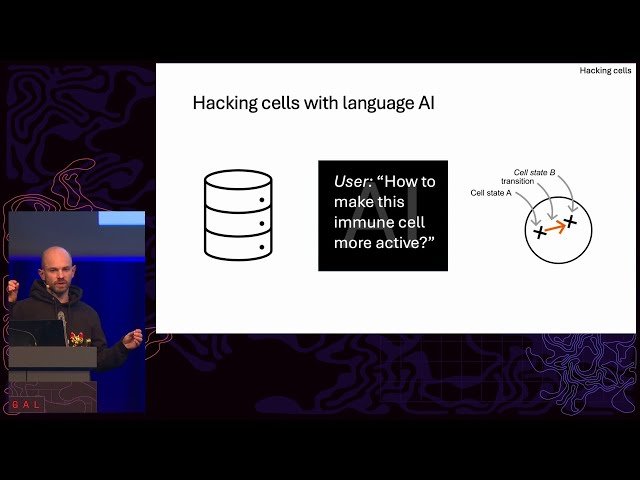
Explore a 42-minute conference talk from the 38th Chaos Communication Congress (38C3) that delves into the revolutionary intersection of artificial intelligence and cellular biology. Learn how multimodal large language models are being employed to decode gene activation levels and interpret complex cellular measurements using natural language processing. Discover the cutting-edge research in "AI cell models" and how these technologies enable the manipulation of cellular behavior through molecular agents. Gain insights into how these advancements in AI-driven biological research are paving the way for disease treatments and potential life span extension. Follow along as researcher Moritz Schaefer presents a comprehensive overview of how biologists and bioinformaticians are leveraging AI to understand and modify the fundamental building blocks of life.