

Courses
Discover thousands of courses from top institutions and platforms worldwide
Level
Course Type
Duration

YouTube
Learn Nano, Nano-Biomimicry, Synthesis of nanomaterials by Physical, Chemical and Biological Methods, the use of nanotechnology in Organ printing, Diagnostics, and Tissues Engineering, along with Nano-Toxicology in this Biomedical nanotechnology by Professor P.Gopinath from IIT Roorkee

Coursera
Visualisation is a rapidly progressive specialty in academia, research and industry, and becoming the future of science. With the advancement of digital technologies and their applications, biomedical visualisation is an evolving and popular field. With new techniques and technologies to image, process and analyse data related to the human body, and its biological processes, it is at the forefront of the digital revolution. Why not view our course trailer video. Copy and paste this link into your browser https://youtu.be/vB_QcIVSiTs By the end of this course, you will be able to: Define and describe anatomical terminology related to the human body. Describe the various body systems, what comprises them, and how they relate to function. Create your own 3D modelling and animations using industry standard, open-source software (Blender). Analyse various visualisation techniques and methods, and be able to apply them to areas of biomedical science. This course is the first of its kind on Coursera. It explores the structure and function of the human body including terminology used. It showcases visualisation techniques available using technology to image and display data related to the body and biological processes.. It also provides training in the creation of animations, and examines the applicability of different types of reality. You will learn from experts in these fields and with the knowledge you will gain from this course, be able to evaluate and apply how best to use visualisation in your own discipline. No prior experience is necessary but should be able to learn at an intermediate level.

Swayam
Biomedical nanotechnology is a rapidly developing field, which includes a diverse collection of disciplines. The applications of nanotechnology are gaining overwhelming response in almost all the fields. Especially in healthcare sector, tremendous developments have been achieved. For example, cancer diagnosis and therapy, medical implants, tissue engineering etc. In the coming years, the developments in this field are expected to fluorish and lead to several life saving medical technologies and treatment methods. Thus, the main objective of this course is to impart knowledge on biomedical applications of nanotechnology.INTENDED AUDIENCE :UG/PG students of Biotechnology/ Nanotechnology.PRE-REQUISITES :Basic knowledge in biology.
Swayam
ABOUT THE COURSE:Biomedical Instrumentation will focus on Biomedical Sensors, Measurements and Instrumentation to detect electrical and non-electrical parameters in the human body. The course will start with an introduction to sensors, principles of sensing, types of sensors. Then the course will focus on Biopotentials, their origin and faithful measurement. Examples from ECG, EMG, EEG and other ExG will be discussed in sufficient depth and detail. Then we move on the GSR, PCG. Then the focus will be on non-electrical parameter measurements such as blood pressure, temperature, volume and flow, respiratory measurement (Sphygmomanometer), cardiac output. Then the focus will shift to Ventilator,Cardiac Pacemaker, Defibrillator, hemodialyser. The final topics will be on safety, standards and regulations in medical devices.INTENDED AUDIENCE: UG and PG students in Biomedical Engg, Instrumentation Engg and electrical engg.PREREQUISITES: Basic Electrical Engg, Basic principles of sensing, measurement and transductionINDUSTRY SUPPORT: Medical Devices and MedTech industry

XuetangX
The course ‘Biomedical Sensors’ is offered to undergraduate students with the major of Biomedical Engineering at Year 2 or Year 3. Students will learn about the basic concepts, principles and design of biomedical sensors, and the associated methodologies of analysis and measurement. The course mainly the knowledge of the overview of modern biomedical sensors, the characteristic structure, detection principles and methods of biomedical sensors, and the application of biomedical sensors, e.g. electrochemical sensors, Optical sensors, DNA sensors, enzyme sensors, thermal sensors, SPR sensors, Magnetic sensors ,cell sensors, biochip and nano sensors etc.

edX
Maintaining and troubleshooting sophisticated medical instruments is not an easy task. In order to deliver effective care, the technician requires the knowledge of different aspects of biology and engineering. The different devices work in so many different ways and the literature about repair and troubleshooting is often hard to come by. It can be quite frustrating to search for solutions every time the operator encounters a problem. There is added pressure because the availability of medical devices is critical for therapeutic and diagnostic care. The longer a device stays out of operation, the slower the hospital would be able to deliver care to the patients. This course has been designed by the interdisciplinary collaboration of both TU Delft biomedical engineers as well as the local expertise of the medical technicians of the Nick Simons Institute in Nepal to help new and emerging biomedical engineers/technicians working in low-income hospitals to care for biomedical equipment. This course provides a compilation of the techniques hospitals use to effectively maintain and troubleshoot the medical devices so that repair time is reduced and the availability and safety of the medical devices is improved. Completing this course adds a complementary skill set to prior competence of the learner to perform maintenance routines and diagnose problems in sophisticated equipment with care. A faster service routine will help smoothen the process flow of the hospital and help extend the care to more patients. On a personal level, the learner can rely on the knowledge gained from this course as ‘the blueprint’ for whenever they have to maintain/troubleshoot any medical device. Accredited Course This course is accredited by the Dutch Association for Specialists in Sterile Medical Tools (VDSMH). Learners who successfully complete the course and obtain a certificate can request Professional Development Points.

Swayam
Biomedical Instrumentation and Sensors is a course designed to introduce students to the use of instrumentation and sensors in the field of biomedical engineering. The course focuses on the fundamentals of instrumentation, including the principles of operation, calibration and maintenance of biomedical instrumentation. Students will learn how to construct and troubleshoot electronic circuits, as well as how to use a variety of biomedical sensors. Additionally, the course will cover topics such as medical imaging, signal processing, and instrumentation safety. The course will also include a variety of hands-on lab activities to give students the opportunity to practice their knowledge and gain an understanding of the practical use of biomedical instrumentation and sensors. Upon completion of the course, students should be able to analyze and interpret biomedical signals, design and construct circuits, and utilize biomedical instrumentation and sensors in a variety of contexts.

YouTube
Explore the fascinating world of artificial organs and synthetic biomaterials in this 51-minute lecture from Yale University's Frontiers of Biomedical Engineering course. Delve into the body's immunological and scar healing responses to foreign materials, and learn about various polymer and plastic materials like Dacron and GORE-TEX. Discover the design and function of artificial organs, including lens implants, heart valves, vessels, hip replacements, dialyzers, heart/lung bypass machines, and artificial hearts. Gain insights into the challenges and areas for improvement in the field of biomedical engineering. The lecture covers topics such as introduction to biomaterials, polymers, coagulation and clotting threats, physical responses to biomaterials, joint replacement, dialysis, and concludes with a discussion on artificial organs.

edX
The demand for skilled data scientists continues to surge as organizations seek to harness the power of machine learning and data-driven insights. The Data Scientist program, developed by Microsoft and delivered on edX, is designed for learners ready to take their data science skills to the cloud. Through three practical, project-based courses, you’ll explore how to set up and configure the Azure Machine Learning workspace, train models using custom scripts, and deploy models as scalable endpoints. You’ll gain proficiency with tools like Jupyter Notebooks, Python, and Azure ML SDKs—all while learning to operationalize machine learning in real business scenarios. This program is ideal for data professionals, analysts, and aspiring machine learning engineers seeking to build robust, cloud-based ML pipelines. Whether you're transitioning into a data science role or expanding your cloud skill set, this program delivers a strong foundation aligned with industry needs and Azure certification pathways.
Udacity
This advanced Nanodegree prepares you to tackle data science at scale. Work with AI best practices, build production-ready projects, and gain the confidence to lead data-driven solutions.
YouTube
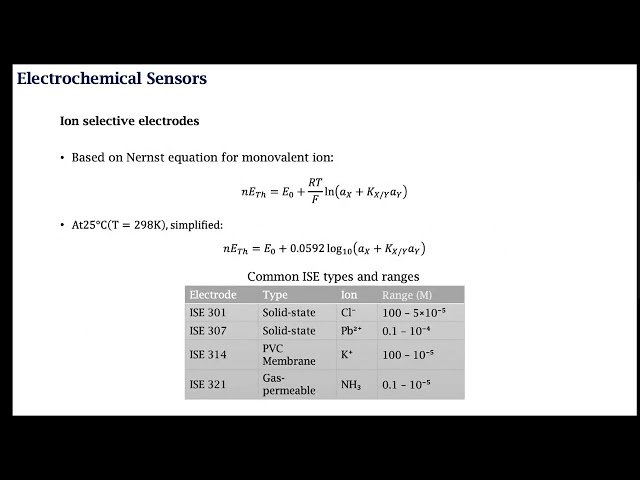
Learn about electrochemical sensors used in biomedical applications through this 17-minute educational video that explores the fundamental principles, design considerations, and practical implementations of these critical sensing devices. Discover how electrochemical sensors detect and measure biological substances by converting chemical reactions into electrical signals, examine their role in medical diagnostics and patient monitoring systems, and understand the various types including potentiometric, amperometric, and conductometric sensors. Explore the advantages and limitations of electrochemical sensing technology in healthcare settings, analyze real-world applications such as glucose monitoring, blood gas analysis, and ion-selective measurements, and gain insights into the technical specifications and performance characteristics that make these sensors essential tools in modern biomedical instrumentation.
Swayam
ABOUT THE COURSE: Biostatistics is a discipline that develops and applies methodology for quantitative studies in public health and biomedical research. The methodology learnt using this course will help students to design & analysis of health surveys, clinical trials, prevention trials, intervention studies, longitudinal studies, and laboratory studies. The objective of this course is to provide a comprehensive knowledge on these aspects to the Senior Undergraduate, M.Tech, MS and Ph.D. students, primarily to enhance their analysis and employability skills. The course will provide an introduction of Biostatistics, data representation and analysis. Also will provide Brief insight into probability theory and statistical inference methods. Students will learn various experimental design strategies and statistical methods that can be used to conduct research studies pertaining to health services.INTENDED AUDIENCE: Undergraduate Students, IIIrd/IVth Year students and Masters studentsPREREQUISITES: Preferably Masters/Senior Undergraduate students with engineering/mathematics backgroundINDUSTRY SUPPORT: This is a basic course and will serve as a pre-requeiste for AI/ML courses in medical domain and hence provides value for wider audience in the area of biomedical engineering
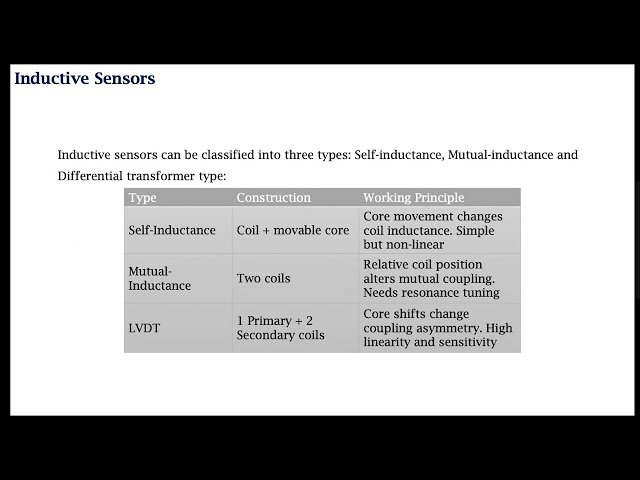
YouTube
Learn about inductive sensors and their applications in biomedical engineering through this 25-minute educational video that explores the fundamental principles, design characteristics, and practical uses of inductive sensing technology in medical devices and healthcare monitoring systems.
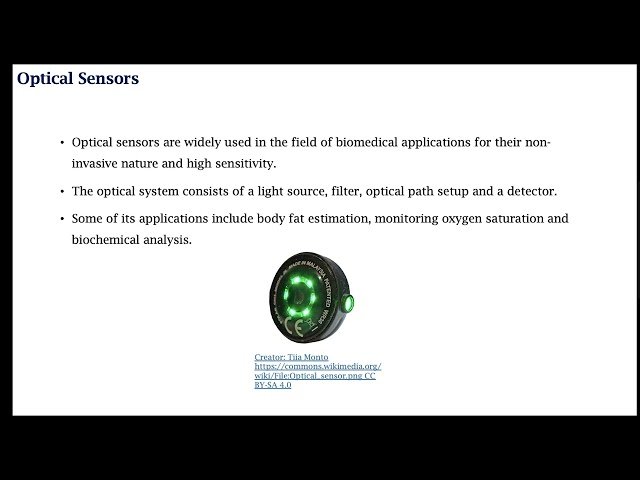
YouTube
Learn about optical sensors used in biomedical applications through this 12-minute educational video that explores the principles, design, and functionality of light-based sensing technologies in medical devices. Discover how optical sensors detect and measure biological parameters by utilizing light interaction with tissues and biological samples. Examine the fundamental concepts of photodetection, light sources, and optical transduction mechanisms commonly employed in healthcare monitoring systems. Understand the advantages of optical sensing methods including non-invasive measurement capabilities, high sensitivity, and immunity to electromagnetic interference. Explore practical applications of optical sensors in pulse oximetry, blood glucose monitoring, and other vital sign detection systems used in clinical and home healthcare settings.

Pluralsight
While other industries continue to decline, the market for medical devices in the United States continues to steadily grow. Because of this, it's important than ever to have the skills to get jobs in the medical device field. This course, Fusion 360 - Biomedical Design, will cover intermediate to advanced Fusion 360 tools that will allow designers to create the complex shapes required in medical device design. First you will learn of the FDA's "Innovation Pathway" that is used to approve medical devices. Then, you will learn about advanced organic shapes, hybrid modeling, FEA simulation, and prototyping. Finally, you will learn best practices in terms of CAD modeling and documentation that will streamline the entire process when working with organic geometry. Upon completion of this course, you will have the experience that medical device companies are looking for in their employees, and the skills needed to execute on the job. Software required: Fusion 360.

YouTube
Explore the critical importance of genetic diversity in biomedical research through this 55-minute seminar from the Equity in Biomedicine Series. Delve into presentations by Broad Institute and MIT scientists as they discuss the need for increased genetic diversity in cell line models and CRISPR experimental tools. Learn how the lack of genetic diversity can limit scientific understanding and impact equity in downstream translational benefits. Discover why expanding the genetic diversity of pluripotent stem cell models is crucial for ensuring equitable and broadly useful scientific insights. Examine how genetic ancestry-based CRISPR guide bias can lead to false negatives in cell-based screens. Engage with the panel discussion moderated by Broad Institute scientist Anne Carpenter, focusing on challenges and opportunities in this vital area of biomedical research.

Swayam
In order to improve the research skills of Indian medical postgraduate (PG) students and teachers in medical institutions, the Board of Governors (BoG) in supersession of Medical Council of India (MCI) has recommended a uniform research methodology course across the country. The online course, “Basic Course in Biomedical Research”, will be offered by ICMR-National Institute of Epidemiology (ICMR-NIE), Chennai (www.nie.gov.in). The course will explain fundamental concepts in research methodology. The course includes 23 Lectures covering conceptualization of a research study, epidemiological and bio-statistical considerations in designing a research study, planning and conducting a research study, writing a research protocol and publication ethics. The learning materials will include video lectures, presentation slides, reading materials and assignments. INTENDED AUDIENCE: • Medical Postgraduate (MD, MS, Diploma, MPH) of academic year 01 July 2019 onward) • Teachers in Medical institutions INDUSTRY SUPPORT: Course approved by Board of Governors - in supersession of Medical Council of India, for medical postgraduates and teachers in medical institutions of India

Udemy
RAHBME282 - Become an expert in Nanodevices & improve your Biomedical skills-Rahsoft Biomedical Engineering Certificate What you'll learn: Silicon & Introduction to MEMSMicrofabricationScaling LawMicrofluidicsElectro kineticsDNA SequencingElectrical TransducersFluorescenceOptical TransducersLight ScatteringMechanical TransducersNano biosensors Welcome to the Nanodevices course, brought to you by Rahsoft. In this course we will be going over the basics and fundamentals of nanodevices and nanosensors, as well as in-depth examples and practice problems to give you a better understanding of the field. The course is taught by Dennis Fer, a Biomedical Engineering Instructor at Rahsoft, and the course advisor is Ahsan Ghoncheh, the Co-Founder and Technical Advisor at Rahsoft. We will be presenting this information to you in a way that is simple and easy to understand! Our course is aimed for engineers, science students, and others who are interested in learning more about biomaterials, and how different materials work in various techniques and phenomena in order to sense, observe, and determine various nanoscale topics within the field of biomedical engineering. Throughout the course, you will be given examples, practice problems and quizzes in order to not only allow you expand your knowledge on the material covered, but also to test what you learned in a way that is stress-free and effective! The course will begin with some basics in nanodevices, followed by more in-depth technical aspects on how nanodevices are created, as well as specific tools and methods used. We will then look over some of the main transduction methods, such as electrical, optical, and mechanical transduction. Lastly, we will go in-depth on nanodevice biosensors, as well as some potential future applications. I want to thank you for choosing Rahsoft to teach you over this subject, and we will do everything we can to meet your needs and go further beyond. We are excited to help teach you more about the field of Nanodevices, and help you learn more and achieve your goals. If you have any questions, please feel free to contact us and we’ll be happy to help! Hope to see you soon, when you decide to take the course.

Swayam
This course attempts to provide an introduction to the different commonly-used medical imaging systems. Although there are several courses and textbooks available from medical physics background, there are only few materials that treat the subject from a system’s perspective, which is the view point taken here. This course will be thought at a level where the students from different engineering branches may find it useful. After the initial introduction and review modules, the different modalities can be taken as a stand-alone-module, and for each the physics, instrumentation, reconstruction and Image quality will be discussed.INTENDED AUDIENCE :7th-8th semester students from UG from Biomedical Engineering (BME) and other engineering programs (e.g., EE, ME, CSE, BT,etc.)PRE-REQUISITES :Engineering students from most core branch will be ready to take it in 6th-8th semester as they would have completed signals and systems and linear algebra.INDUSTRY SUPPORT :Most Medical imaging industry, MNC and otherwise, will recognize the value of this course

Udemy
RAHBME220 - Become an expert in Biomaterial Engineering from Rahsoft Biomedical Engineering Certificate What you'll learn: a good understanding of BiomaterialsSilicon & Introduction to MEMSMicrofabricationScaling LawMicrofluidicsElectro kineticsDNA SequencingElectrical TransducersFluorescenceOptical TransducersLight ScatteringMechanical TransducersNano biosensors Welcome to the Biomaterials course, brought to you by Rahsoft. In this course we will be going over the basics and fundamentals of biomaterials, as well as in-depth examples and practice problems to give you a better understanding of the field. The course is taught by Dennis Fer, a Biomedical Engineering Instructor at Rahsoft, and the course advisor is Ahsan Ghoncheh, the Co-Founder and Technical Advisor at Rahsoft. We will be presenting this information to you in a way that is simple and easy to understand! Our course is aimed for engineers, science students, and others who are interested in learning more about biomaterials, and how different structures, materials, and objects interact with the body in order to create medical devices. Throughout the course, you will be given examples, practice problems and quizzes in order to not only allow you expand your knowledge on the material covered, but also to test what you learned in a way that is stress-free and effective! The course will begin with some basics in biomaterials, followed by more in-depth technical aspects on how biomaterials work, the forces and systems involved, and interactions with the environment. We will then present examples and more technical systems in the four main types of biomaterial structures: metals, polymers, ceramics, and composites. Lastly, we will go in-depth on biomaterial applications, and how they benefit various parts of our physiological systems. I want to thank you for choosing Rahsoft to teach you over this subject, and we will do everything we can to meet your needs and go further beyond. We are excited to help teach you more about the field of Biomaterials, and help you learn more and achieve your goals. If you have any questions, please feel free to contact us and we’ll be happy to help! Hope to see you soon, when you decide to take the course.