

Courses
Discover thousands of courses from top institutions and platforms worldwide
Level
Course Type
Duration
YouTube
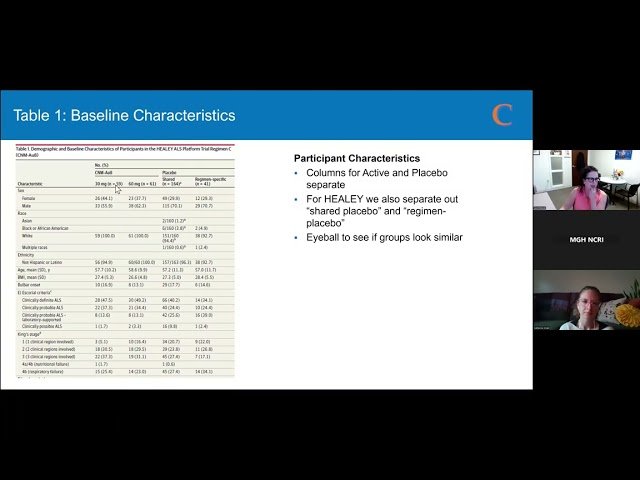
Learn essential skills for interpreting scientific literature in this 38-minute webinar focused on ALS research findings. Discover practical tips and strategies for effectively reading and understanding scientific publications from biostatistician Lori Chibnik, PhD, MPH of Massachusetts General Hospital. Examine the results papers from the first five regimens of the HEALEY ALS Platform Trial through detailed analysis and discussion. Gain insights into how to critically evaluate research methodologies, interpret statistical findings, and understand the implications of clinical trial results in ALS research. Participate in an interactive Q&A session where audience questions about reading scientific literature and the Platform Trial results are addressed by an expert researcher.

DataCamp
In this course you will gain an overview clinical trial designs, determine the numbers of patients needed and conduct statistical analyses. Clinical trials are scientific experiments that are conducted to assess whether treatments are effective and safe. They are used by a variety of organizations, including pharmaceutical companies for drug development. Biostatisticians play a key role in ensuring the success of a clinical trial. In this course you will gain an overview of the important principles and a practical introduction to commonly used statistical analyses. This course would be valuable for data analysts, medical students, clinicians, medical researchers and others interested in learning about the design and analysis of clinical trials.
YouTube
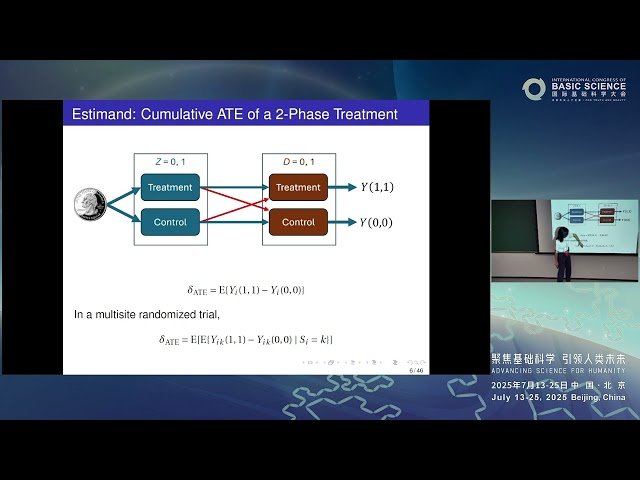
Explore advanced statistical methods for analyzing two-phase treatment scenarios with patient noncompliance in this 58-minute conference talk from ICBS2025. Learn how to identify and estimate cumulative average treatment effects when dealing with complex real-world situations where patients may not fully adhere to prescribed treatment protocols. Discover the application of multisite instrumental variables as a powerful analytical tool for addressing noncompliance issues across different research sites or populations. Gain insights into sophisticated causal inference techniques that can help researchers and practitioners better understand treatment effectiveness in the presence of adherence challenges, making this presentation valuable for biostatisticians, epidemiologists, and clinical researchers working with longitudinal treatment data.

YouTube
Explore the concept of assignment control plots for causal inference study design in this informative conference talk by Rocky Aikens from Stanford University. Delve into the importance of understanding the distribution of treated and untreated subjects in terms of measured baseline covariates for causal inference studies. Learn about the proposed set of visualizations that decompose the space of measured covariates into different types of baseline variation crucial for study design. Discover how these assignment-control plots visually illustrate core concepts of causal inference and suggest new directions for methodological research. Gain practical insights through an application of assignment-control plots to a cardiothoracic surgery study. Understand the potential of simple visual tools in education, application, and methods development for causality studies. Benefit from Aikens' expertise as a collaborative biostatistician focused on developing data-centered tools for stronger observational studies.

Coursera
This course is targeted to early career and novice researchers writing their first major competitive biomedical / health research grant proposals. After the course, you will be able to: 1) Identify and summarize key decisions in study design that align scope and complexity with budget and timeline; 2) Describe key variables and their relationships to each other; and 3) Interpret essential parts of a power analysis and summarize appropriate questions for an expert biostatistician. We are faculty at a major research institution with proven experience training others to health sciences research career success. Study design and analysis planning are key skills for grant writing. This course is part of a larger Specialization called Grant Writing for Health Researchers. Please consider taking the other two courses on (1) Grant proposal plans, sections, and resubmission, and (2) Scientific writing. Together, these have been a recipe for success for researchers at the University of Colorado and beyond. Upon completion, you will earn an e-badge to display your new skills. Please join us!

Coursera
Fundamental concepts in probability, statistics and linear models are primary building blocks for data science work. Learners aspiring to become biostatisticians and data scientists will benefit from the foundational knowledge being offered in this specialization. It will enable the learner to understand the behind-the-scenes mechanism of key modeling tools in data science, like least squares and linear regression. This specialization starts with Mathematical Statistics bootcamps, specifically concepts and methods used in biostatistics applications. These range from probability, distribution, and likelihood concepts to hypothesis testing and case-control sampling. This specialization also linear models for data science, starting from understanding least squares from a linear algebraic and mathematical perspective, to statistical linear models, including multivariate regression using the R programming language. These courses will give learners a firm foundation in the linear algebraic treatment of regression modeling, which will greatly augment applied data scientists' general understanding of regression models. This specialization requires a fair amount of mathematical sophistication. Basic calculus and linear algebra are required to engage in the content.

edX
Do you want to inform healthcare decisions by conducting research on the effectiveness, benefits, and potential harms of treatment options? Would you like to help patients choose care that best meets their needs? Perhaps you’d like to learn the basics of clinical research? Or maybe you’d like to use a national health data registry to answer a research question? If any of these questions resonate Comparative Effectiveness Research Training and Instruction – CERTaIN - Professional Certificate Program is right for you! Created by investigators from The University of Texas MD Anderson Cancer Center and partner institutions, the CERTaIN Professional Certificate program provides a comprehensive overview of core concepts, research methods and data analysis techniques used in comparative effectiveness (CER) and patient-centered outcomes research (PCOR) across five key areas: Course 1. Introduction Course 2. Knowledge Synthesis Course 3. Patient-Centered Outcomes Research (PCOR) Course 4. Pragmatic Clinical Trials and Healthcare Delivery Evaluations Course 5. Observational Studies and Registries Learn from expert decision scientists, biostatisticians, oncologists, economists, social scientists, health care policy experts and epidemiologists how to conduct CER/PCOR and see how CER/PCOR methods have been applied in the real world to conduct state of the art research studies. The CERTaIN Professional Certificate Program is intended for anyone interested in CER/PCOR methods. This program is comprised of 5 courses and includes a combined total of almost 50 lectures in CER/PCOR topics. Each course consists of a series of lectures delivered by content experts and each lecture is segmented into short videos, followed by a quiz to assess your understanding of the material. The CERTaIN Professional Certificate Program is supported by grant number R25HS023214 from the Agency for Healthcare Research and Quality. The CERTaIN Professional Certificate Program was created by investigators.

Udemy
Mastering Clinical Data Management: Learn and build a successful career in Clinical Trials and Research What you'll learn: Fundamentals of clinical data management, including data collection, storage, and analysisRegulatory Frameworks of Clinical Data ManagementWhat are Clinical Data Management PlanWhat are CRFs and how are they related to Clinical Data ManagementWhat are Informed Consent FormsQuery Management in Clinical Data ManagementDatabase Locking ProceduresHow to develop a Statistical Analysis PlanWhat is a Clinical Study ReportThe trends and future of Clinical Data Management Welcome to "Clinical Data Management (CDM) - The Ultimate Overview," a comprehensive course designed for professionals and students eager to master the essential principles and practices of clinical data management. In the fast-paced world of clinical research, effective data management is crucial for the success of trials and the integrity of research findings. What You Will Learn:Fundamentals of Clinical Data Management: Understand the key concepts, terminology, and processes involved in CDM, including data collection, validation, and analysis. Regulatory Compliance: Gain insights into the regulatory landscape governing clinical trials, including Good Clinical Practice (GCP) and the role of regulatory authorities such as the FDA and EMA. Data Management Lifecycle: Explore the entire data management lifecycle, from study design and data collection to database lock and reporting, ensuring you grasp each critical step. Data Quality Assurance: Learn techniques for ensuring data accuracy and reliability, including data cleaning, validation checks, and audit trails. Technology in CDM: Discover the latest tools and technologies used in clinical data management, including Electronic Data Capture (EDC) systems and data analytics software. Practice: Practice your new skills with quizzes and practice tests.This course is ideal for clinical research associates, data managers, biostatisticians, and anyone involved in clinical trials or interested in pursuing a career in clinical data management. Whether you are a beginner or looking to enhance your existing knowledge, this course provides valuable insights and practical skills. Enroll today and take the first step towards mastering Clinical Data Management!

Udemy
Clinical Research, Phase trials, Good Clinical Practices, Ethics Committee, Pharmacovigilance, Clinical Data Management What you'll learn: Introduction to Clinical ResearchCareers in Clinical Research, Data Management & PharmacovigilanceDrug Development, Phase trials & Regulatory SubmissionsGood Clinical Practices & 13 Principles of ICH GCPFundamentals of Clinical Data ManagementDrug Safety & PharmacovigilanceStakeholders in Clinical ResearchRole of Human Subject in Clinical Trials & Inform Consent ProcessMonitoring in Clinical TrialsRoles & Responsibilities of Sponsor, Investigator, Site team in Clincial TrialsEthics Committee and Role in Subject Safety ProtectionRoles & Responsibilities of Clinical Research Coordinator, Clinical Trial Assistant & Clinical Research AssociateClinical Trial DesignBlinding, Unblinding, Placebo & Randomization in Clinical trialsRegulatory Submissions, Rules & RegulationsEssential Documents in Clinical ResearchTerminologies for Adverse Events (AE), Adverse Drug Reactions (ADR) & Serious Adverse Events (SAE) & timelines This is the ideal course for you if you find are curious about Drug Development Process and want to explore & seek a career in Clinical Research. In order to safeguard the public's health, the pharmaceutical industry is subject to numerous government restrictions, making it one of the most heavily regulated sectors. Marketing a Drug/Medicinal product that satisfies regulatory criteria is a key goal for the pharmaceutical sector which is achieved through conducting Clinical Trials. Clinical research is medical research that studies people to understand health and disease. Clinical research helps improve the way doctors treat and prevent illness. Through clinical research, researchers learn about important as aspects of the medicine such as How the Drug Works in the human? How illness develops in people, such as how diseases get better or worse over time? How the body handles a possible treatment & cures of the disease, Which behaviors help people stay healthy and prevent illness, and which behaviors raise the chance of illness The goal is to use science to improve people’s health care and health over time. The participants who join and take part in clinical research studies may or may not get any benefit for themselves.You will gain a solid understanding of the drug development process, clinical research and related documentation, GCP, and the roles and duties of key clinical research players in a condensed form from this course. Topics covered in this course are:- Introduction to Clinical Research- History of Clinical Research- Declaration of Helsinki- Nuremberg Code & Medical Ethics- Good Clinical Practices (GCP)- 13 Principles of ICG GCP- ICH, Contents & it's Importance.- Glossary terms- Stake Holders in Clinical Research- Roles & Responsibilities of PI- Roles & Responsibilities of Sponsor- Roles and Responsibilities of EC- Roles and Responsibilities of Contract Research Organization- Roles & Responsibilities of CRA, CRC- Role of Subject in Clinical Trials & Inform Consent process- Role of RA, Biostatistician & Clinical Data Manger in trials- Monitoring in Clinical Trials- Clinical Trial Design- Essential Documents in Clinical Trials- Careers & Opportunities in Clinical Research- Skill Development & Seeking various Careers in Clinical Research- Investigator's Brochure & Protocol- Clinical Trial overview
You've viewed all 9 courses
Try adjusting your filters to see more options