

Courses
Discover thousands of courses from top institutions and platforms worldwide
Level
Course Type
Duration
YouTube
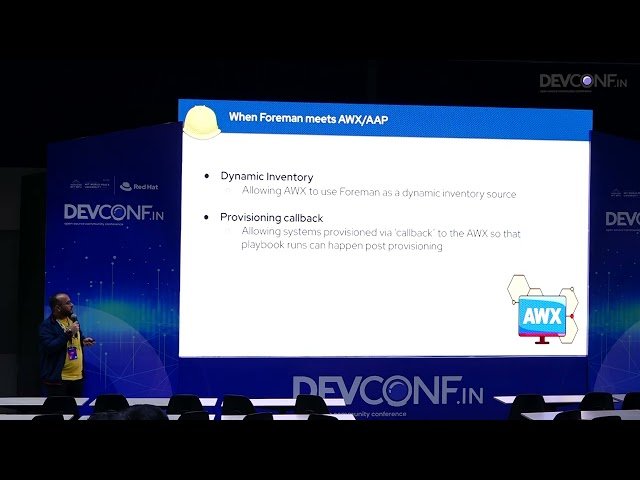
Learn how to leverage the integration of Ansible and AWX with Foreman to streamline provisioning, configuration management, and automation processes in this 16-minute conference talk by Gaurav Talreja at DevConf. Discover how connecting these powerful open-source tools enhances infrastructure automation capabilities, allowing for execution of complex Ansible playbooks and efficient management of diverse environments from a single interface. Gain insights into the flexibility and control this integration brings to infrastructure management within an open-source ecosystem. Access slides and additional resources through the provided link.

YouTube
This course explores the history of the George Foreman Grill, shedding light on its rise to fame and impact on popular culture. By the end of the course, learners will have a deeper understanding of George Foreman's legacy beyond his boxing career and the cultural significance of his eponymous grill. The teaching method involves a concise 13-minute video presentation. This course is suitable for history enthusiasts, food aficionados, and individuals curious about the intersection of sports, celebrity, and consumer products.

LinkedIn Learning
Discover how to work with concrete in modern construction. Explore the history and usage of concrete, the principles of concrete reinforcing, and how pre-stressed concrete works.

Udemy
how to build a road What you'll learn: Protection of existing underground servicesField density test-cone methodCalifornia bearing ratio testRoad cross-section and profileclearing and preparing the area for road workExcavation for roadwayEmbankment for roadRoad subgradeFuture utilitiesPavement layers-Sub-base materialsAggregate base coursePrime coatTack CoatAsphalt mixturesAsphalt Paving Courses typesConstructing of asphalt courseTesting of completed asphalt coursesAsphalt design-Marshal method This course designed to expand your practical side of engineering knowledge. This course is concentrating on the construction of roads. Here you will learn how the road constructed. The construction stages such as protection of existing services, clearing the area, future utilities, preparing the road subgrade, then placing different pavement layers such as sub-base, base course, and asphaltic courses. Also, we will discuss the types of asphaltic course and the common defects of asphaltic pavement, such as permanent deformation, fatigue cracking, and low-temperature cracking. Also, I will show a typical cross-section of road and road profiles. Also, I will explain what the prime coat is, why the prime coat is used, and the proper way of applying, preparing the surface of the pavement layer before applying the prime coat, and the curing time for a prime coat. Tack coat, what is the Tack coat, why the Tack coat used, where the tack coat is used, and the proper way of applying of tack coat. This course will explain the process of placing the various pavement layers, spreading of these layers, compacting then testing of the laid layers. Each layer will be tested to determine the in-situ density, level, thickness, and surface smoothness. Also, the course will discuss the various tests conducted on asphalt courses such as density, degree of compaction, stability, flow, and thickness. This course will discuss the Marshall method, Marshall method used to select the suitable bitumen content for a specific gradation of aggregates by testing specimens to assess their properties and suitability.

VDCI
Gain a thorough understanding of the building construction process, from initial site work to final system installations. Learn the essential skills to navigate every phase of construction and prepare you for a career in the construction industry.

LinkedIn Learning
Learn about modular construction, a collection of practices and techniques for constructing buildings offsite.

LinkedIn Learning
Explore the lean theory of production and learn how it's being adopted in the construction industry.

LinkedIn Learning
Learn the fundamentals of reading drawings for civil construction projects. Discover how to decipher site plans, plot plans, drainage plans, landscaping plans, and more.

edX
In this program you will learn to successfully manage construction projects and deliver with the skills of a modern Construction Manager. During the past several years, the construction industry and the built environment has been through enormous changes. From general contracting to construction management to project management and program management. Construction Management is the application of knowledge, skills, tools, and techniques to the many activities required to complete a project successfully. This requires both practitioners and students to understand the many aspects of the world of owners, designers, developers, local, state, & federal government agencies, tenants, regulatory agencies, community groups & stakeholders, contracting lawyers, zoning attorneys, environmental lawyers, insurance providers, financial agencies, bonding companies, and subcontractors. The successful Construction Manager must recognize the role of each participant, understand the nature of the project, and utilize modern management tools to bring the project forward in a timely and cost-effective manner. In addition, the Construction Manager also has his or her own organization and staffing to navigate including those of the owner and the designer. The recipe for success is indeed a complicated one. Core concepts include: Cost estimating and schedule controls necessary for project productivity and quality control. How to manage the sustainable civil engineering infrastructure process. Role of construction management in civil engineering, and how a construction management program benefits all parties in the industry. The most critical construction methods and construction materials needed to deliver. The characteristics that a successful construction project manager needs to understand and utilize, including problem solving. The roles of the people involved in the planning, design, and construction process, and the tools required to manage and lead the people in the project. How modern CM practice emphasizes an expanded role for the construction management professional during the planning, design, and early construction process. Cost engineering and cost control, and how those will ensure an effective feedback system. Project administration procedures, communication protocols, and project planning. How the construction project manager is key to creating an atmosphere where the owner and designer support is established. Sustainable construction management and sustainable design best practices. Integrating safety programs and disaster prevention into sustainable construction practices. Sustainable facility management, energy management and renewable energy. Green building construction. Strategic planning and project financial analysis. Explores the legal and administrative world of projects.

VDCI
Build a strong foundation in construction management and prepare for successful project leadership. Learn the skills to manage construction projects, from planning to execution.

XuetangX
"Construction Technology" is a fundamental course for construction engineering majors, aimed at cultivating students' understanding and mastery of the construction process and precautions for each part of the building, providing construction methods for students to build excellent building projects, and solving problems that may arise during actual construction. It has good applicability and practicality. Based on the knowledge and skill requirements in engineering project tasks and workflows, the course content is integrated and divided into eight modules: Introduction, Earthwork, Foundation and Foundation Engineering, Masonry Engineering, Reinforced Concrete Engineering, Pre stressed Concrete Engineering, Structural Installation Engineering, and Waterproofing Engineering. Teaching is organized on a project by project basis.
YouTube
Explore the Foreman Delay Survey (FDS) through illustrative examples and engage in a comparative discussion of Performance Management System (PMS), Work Sampling (WS), and FDS methodologies in this 15-minute video lecture. Gain insights into the practical applications and differences between these productivity measurement techniques, enhancing your understanding of construction management and project efficiency assessment.

Coursera
This course focuses on learning how to develop and manage a schedule. The first module provides an overview of the Construction Scheduling course. The second module introduces bar or Gantt charts and how they are used as scheduling tools. During the third module, learners will create activity precedence diagrams, also referred to as activity on node diagrams, which graphically represent the construction activities in a project and their relationships. The fourth module provides an overview of the types of construction activity relationships encountered in a construction project and how to represent them in an activity precedence diagram. Forward and backward pass calculations are covered in the fifth module, and during the sixth module, Professor Odeh discusses the importance of critical paths, including what it is and why it is important. By the end of this course, you will be able to: -Discover key project scheduling techniques and procedures -Learn how to develop and manage a schedule, and understand scheduling tools such as bar charts, activity on arrow, and activity on nodes -Explore the multiple relationships that connect all the construction activities in our project from start to finish -Learn about creating a network diagram, defining the importance of the critical path in a project network, and defining project activities float -Understand the fundamentals of bar charts, precedence diagrams, activity on arrow, Program -Evaluation and Review Technique (PERT), range estimating, linear project operations, and the line of balance (LOB)

Coursera
This course expands the knowledge of a construction project manager to include an understanding of economics and the mathematics of money, an essential component of every construction project. Topics covered include the time value of money, the definition and calculation of the types of interest rates, and the importance of Cash Flow Diagrams. The course covers these topics in three sections. The first section focuses on the foundation of building the mathematics of money, often referred to as value of money. It also highlights the present value techniques and the internal rate of return from a construction manager point of view. The second section of the course focuses on vertical construction finance and the last part focuses on horizontal construction finance. Under the vertical construction finance, the instructor discusses real estate finance and how that has been done with more in-depth details and gives examples for students to solve with instructions. The last topic, horizontal finance, is divided into two parts. To begin, the instructor introduces vast details about public private partnership. This module highlights around three case studies about PPP projects, which would be an introduction to project financing in horizontal work. After introducing case studies, the instructor demonstrates the risks associated with construction finance. After that, similar to the previous three courses, the course finishes with emphasizing the importance of construction finance.

Coursera
The Construction Management specialization is curated for professionals in the construction and civil engineering industry looking to advance their careers. Through this specialization, students will gain comprehensive industry knowledge along with the latest trends and development within the industry. This 5-course specialization will cover the major facets of construction management including project initiation and planning, scheduling techniques and procedures, cost estimating and control, and construction project financials. After students complete this specialization, they will have gained significant skills and tools to stay relevant and ahead of the curve in the world of construction management. This specialization is designed to build on the foundational skills developed in the Google Project Management Professional Certificate; earn a dual credential when you complete a Google Career Certificate and this specialization.

YouTube
Learn about essential typography concepts in this 32-minute NPTEL-NOC IITM lecture covering the concept of space in typography, formal attributes of type design, optical breaks, and ink-traps. Explore important typographic elements including margins, indents, leading, word spacing, kerning, counter space, letter stroke contrast, axis, ligatures, and optical correction techniques that form the foundation of effective type construction.
VDCI
Gain a comprehensive understanding of the construction industry with training in fundamentals, project management, blueprint reading, and professional skills. Learn the technical knowledge, leadership abilities, and communication skills needed to excel in modern construction roles.

Coursera
The Construction Management specialization is curated for professionals in the construction and civil engineering industry looking to advance their careers. Through this specialization, students will gain comprehensive industry knowledge along with the latest trends and development within the industry. This 5-course specialization will cover the major facets of construction management including project initiation and planning, scheduling techniques and procedures, cost estimating and control, and construction project financials. After students complete this specialization, they will have gained significant skills and tools to stay relevant and ahead of the curve in the world of construction management. This specialization is designed to build on the foundational skills developed in the Google Project Management Professional Certificate; earn a dual credential when you complete a Google Career Certificate and this specialization.

Coursera
This course provides a comprehensive practical understanding of the construction and maintenance aspects of airport infrastructure. It delves into the processes that transform blueprints into tangible, operational airport facilities, ensuring safety, durability, and environmental responsibility. Begin with the essential groundwork of pre-construction activities. Understand the intricacies of statutory approvals for site infrastructure and labor licenses, ensuring regulatory compliance. Learn to plan the phase-wise deployment of key resources and establish efficient site infrastructure. Master the estimation of plant and equipment requirements, and gain familiarity with earthmoving, compaction, hoist, and tower crane operations. Explore the practical execution of runway and taxiway construction, focusing on civil works. Understand the airport layout and grading plans, and learn to execute and estimate various layers of flexible and rigid pavements. Master the construction of drainage systems, runway markings, and the installation of ducts and approach lighting systems. Gain insights into navigational and meteorological aids, ensuring the functionality and safety of the airside environment. Understand the critical importance of maintaining and rehabilitating existing airport pavements. Learn to evaluate the condition of runways and taxiways, identifying causes and typical failures in flexible and rigid pavements. Master maintenance, strengthening, and rehabilitation techniques, ensuring the long-term functionality and safety of airport surfaces. Delve into the environmental considerations that shape modern airport construction and operation. Understand the impacts of aircraft noise and learn noise mitigation strategies. Explore social and ecological factors, and master emissions management and water quality control. Learn to implement sustainability practices at airports, and examine real-world applications through in-depth case studies, such as the Singapore Changi Airport. From meticulous pre-construction planning and regulatory approvals to the precise construction of runways and taxiways, you'll learn the critical aspects of pavement maintenance and rehabilitation. Furthermore, you'll explore the vital considerations of environmental impact and sustainability. This course empowers you to be a key player in the physical creation and upkeep of vital aviation infrastructure. The target learners for this specialization are civil engineering graduate students, postgraduate students and professionals working in the field of Airports. The prerequisites include Basic Civil Engineering, Building Materials and Transportation Engineering.
Swayam
Learn the fundamental properties, characteristics, and applications of construction materials used in civil engineering and building construction through this 8-week course. Explore various materials including cement, concrete, steel, timber, bricks, stones, and modern composite materials while understanding their physical and mechanical properties. Study material testing procedures, quality control measures, and selection criteria for different construction applications. Examine the behavior of materials under various loading conditions and environmental factors. Analyze the durability, sustainability, and cost-effectiveness of different construction materials. Investigate emerging materials and technologies in the construction industry, including green building materials and innovative composites. Gain practical knowledge through laboratory experiments and case studies that demonstrate real-world applications of construction materials in infrastructure projects.