

Courses
Discover thousands of courses from top institutions and platforms worldwide
Level
Course Type
Duration

edX
This eight-course Professional Certificate from IBM prepares you with job-ready skills for an entry level data analyst role. Position yourself competitively and power your data analyst career for a job in a thriving market or leverage foundational data skills to explore problems in an increasingly data-driven professional world. The U.S. Bureau of Labor Statistics projects a growth rate of 20% in the data analytics industry until 2028. You will learn the core principles of data analysis, participate in hands-on skills-based practice, and gain the knowledge to help companies make smarter business decisions. You will work with a variety of data sources, project scenarios, and data analysis tools, including Excel, SQL, Python, Jupyter Notebooks, and Cognos Analytics. These online learning tools will offer you practical experience with data manipulation and the application of analytical and data visualization techniques. This Professional Certificate does not require any prior programming or statistical skills, and is suitable for learners with or without college degrees. A willingness to learn, basic computer literacy, comfort working with numbers, high school math, and a desire to enrich your profile with valuable skills is all you need to get started in this course. With the IBM Data Analyst Professional Certificate you will develop the confidence and portfolio to begin a career as an associate or junior data analyst by learning the essential skills that help professionals in a wide range of job functions and industries explore business problems.

Udacity
Clean up messy data, uncover patterns and insights, and communicate your findings. You'll start with an introduction to data analysis tools, including Jupyter Notebook, NumPy, pandas, and Matplotlib. Using these tools, you will ask questions about data and answer them through data collection, exploration, wrangling, and visualization. This intermediate-level program includes real-world projects where you will choose your own datasets, research questions, and analysis approach. As you progress through the program, each course will repeat the data analysis process while introducing more advanced techniques, such as applying data imputation to fill in missing data and applying appropriate encodings when developing data visualizations.

Udacity
The goal of the Security Analyst Nanodegree Program is to equip students with the skills required to be successful in an analyst role.

edX
The US Bureau of Labor Statistics projects a 23% increase in cybersecurity jobs to 2033. The demand for cybersecurity analysts is growing ever stronger! What do cybersecurity analysts do? Cybersecurity analysts protect an organization's digital assets by identifying, analyzing, and mitigating security threats, ensuring data and systems remain secure against cyberattacks. This IBM Cybersecurity Professional Certificate has been designed by industry experts to provide you with the job-ready cybersecurity and digital forensic skills you need to jumpstart your cybersecurity career. No prior cybersecurity experience is required. To begin, you’ll build your foundational knowledge of cybersecurity essentials, tools, and technologies, operating systems, networking fundamentals, and the basics of cyberattacks. You’ll explore database fundamentals and vulnerabilities and learn about the steps a cybersecurity analyst would take to prevent, manage, and mitigate cybersecurity attacks. Plus, you’ll learn about cybersecurity architecture, compliance frameworks, standards, and regulations. You’ll also explore gen AI for cybersecurity and build valuable skills and hands-on experience in penetration testing, incident response, forensics, and threat intelligence. You’ll work on real-world projects developing cybersecurity plans and compliance frameworks, giving you great practical work to talk about in interviews. Plus, you’ll use real-world case studies that demonstrate that you can: Apply incident response methodologies and forensics practices. Use industry-specific security tools. Apply cybersecurity industry standards and best practices that mitigate risks, enhance security, and ensure compliance through audit processes. Use gen AI tools to boost cybersecurity effectiveness and productivity. Investigate a real-world security breach by identifying the attack, vulnerabilities, costs, and prevention. Take advantage of the insights provided by seasoned industry experts to guide your job search, resume creation, and Interviewing to help you land your first cybersecurity role. This program will also prepare you to take and earn a 30% discount on the CompTIA Security+ and CySA+ certification exams. After successfully completing this program, you’ll have an industry-recognized IBM Professional Certificate that you can add to your resume and portfolio. If you’re looking to kickstart your cybersecurity career as a sought-after analyst, ENROLL TODAY, and look forward to being job-ready in less than 6 months!

Udemy
Understand Data Security What you'll learn: Deep knowledge of organization’s IT Systems.IT Security threat analysis and management.IT Security maintenance, training and supportIT security fixes, tools, countermeasures, testing plus upgrade paths This course is designed for anyone who wants to understand the analysis of data security. More than ever, information security analysts are needed to rescue companies when they have been hacked or breached, as well as to put in place controls and counter-measures to avert cyber attacks.Gain the skills required to detect and mitigate information and cyber security threats and vulnerabilities. The security analyst role is an entry point to many other security specialties and is highly in-demand in today’s evolving threat environment.In the fast moving world of cyber security, with new threats evolving daily, up to date knowledge and skills that involves protecting systems and networks of companies and other assets containing mission-critical data as well as designing and developing new security solutions routinely to stay ahead of the hackers and cyber attackers.Learn the essential prerequisites for your career success! ENROLL TODAY!

edX
Step into the fast-growing world of data analytics with the Data Analyst program. This comprehensive, beginner-friendly series of courses from Microsoft will equip you with essential skills to collect, clean, model, and visualize data using Power BI—a leading business intelligence platform. Through hands-on projects and interactive lessons, you’ll learn how to turn raw data into actionable insights, build compelling dashboards, and effectively communicate trends and findings to stakeholders. Whether you're aiming to launch a new career in data analysis or upskill in your current role, this program offers the practical knowledge and tools to succeed in today’s data-driven job market.
EMMA
Social and environmental responsibility has become a common issue in corporate communication, but how to design an efficient communication plant? Why did the subject of ‘responsibility’ become a relevant topic? Which role is playing ICT in corporate communication? Are they suitable for communication of corporate social responsibility? This course offers insight on the corporate social responsibility and communication reporting the connections among organizational models, communicational functions, consumptions trends, new communication technologies and socio-environmental crises. The course will show examples of the communication of energy companies and how they face the socio-environmental responsibility in marketing communication and public relations.

Udemy
What you'll learn: Understand How CSR Relates to customersUnderstand how CSR Relates to EmployeesUnderstand How CSR Relates to environmentUnderstand the Different World Views on CSRLearn about Corporate Social Initiatives Introduces the concept of Corporate Social Responsibility (CSR) as it relates to customers, employees, the environment and society at large. It also does a historical treatment of the concept of CSR and explains the sometimes complex relationship between business society by focusing on the Milton Friedman view of CSR; the Archie Carroll and Carnegie views on Corporate Social Responsibility.

Udemy
Hands-On Data Analysis with SQL What you'll learn: Analyse and manipulate dataCreate Database and TablesAnalyse data using aggregate functionsAnalyse data using analytic functionsAnalyse data using ranking functionsAnalyse data using various operatorsAnalyse data using sub queriesAnalyse data using views A SQL data analyst is a data scientist that uses the SQL language to interpret data. This analysis is used to improve business information and provide new insights to managers.SQL data analysts design scripts and programs to perform specific database functions and to analyse and maintain data. Some SQL Data Analyst Duties and ResponsibilitiesDuties vary for SQL data analysts based on the specific needs of the hiring company and the amount of data being analysed. However, these core tasks are commonly associated with this job:Integrate DataSQL data analysts integrate data from multiple data sets into o:ne database system to streamline information.Create Database FunctionsSQL data analysts program specific database functions to create database triggers and design data tables.Design ReportsAfter reviewing and analysing data, SQL data analysts design reports to show statistics and other information about specific database topics.Clean DatabaseSQL data analysts remove dead data files and other irrelevant information to free up database space.Write ScriptsSQL data analysts write scripts to analyse data and perform specific data queries.Resolve Data IssuesSQL data analysts isolate and resolve issues with data and databases.Add DataSQL data analysts collect data from multiple sources and add it to the database. We will be performing data analysis using SQL on relational databases like: MySQL, PostgreSQL and MS SQL Server.A relational database is a type of database. It uses a structure that allows us to identify and access data in relation to another piece of data in the database. Often, data in a relational database is organized into tables. A relational database includes tables containing rows and columns. For example, a typical business order entry database would include a table that describes a customer with columns for name, address, phone number and so forth.SQL or Structured Query Language is a critical tool for data professionals. It is undoubtedly the most important language for getting a job in the field of data analysis or data sciences. Millions of data points are being generated every minute. And raw data does not have any story to tell. After all this data gets stored in databases and professionals use SQL to extract this data for further analysis.

Coursera
Corporate strategy is the strategy a firm uses to compete across multiple businesses. Many small firms want to grow by entering new businesses. Many large firms already are in multiple businesses, e.g. a photo camera producer selling also sunglasses. We developed this course to help you make good corporate strategy decisions. Of the many decisions a firm has to make, corporate strategy decisions are among the most consequential. We will look at these key corporate strategy decisions: - Diversification: How and which businesses should your firm enter? - Divestiture: How and from which businesses should your firm exit? - Corporate HQ: How should we organize corporate headquarters to create value across the different businesses?

Coursera
Participants learn methods to scan the external environment, identify emerging trends, and develop scenarios for informed decision-making. The course emphasizes proactive planning and innovation strategies, enabling organizations to navigate uncertainties and capitalize on emerging opportunities.
Corporate Finance Institute
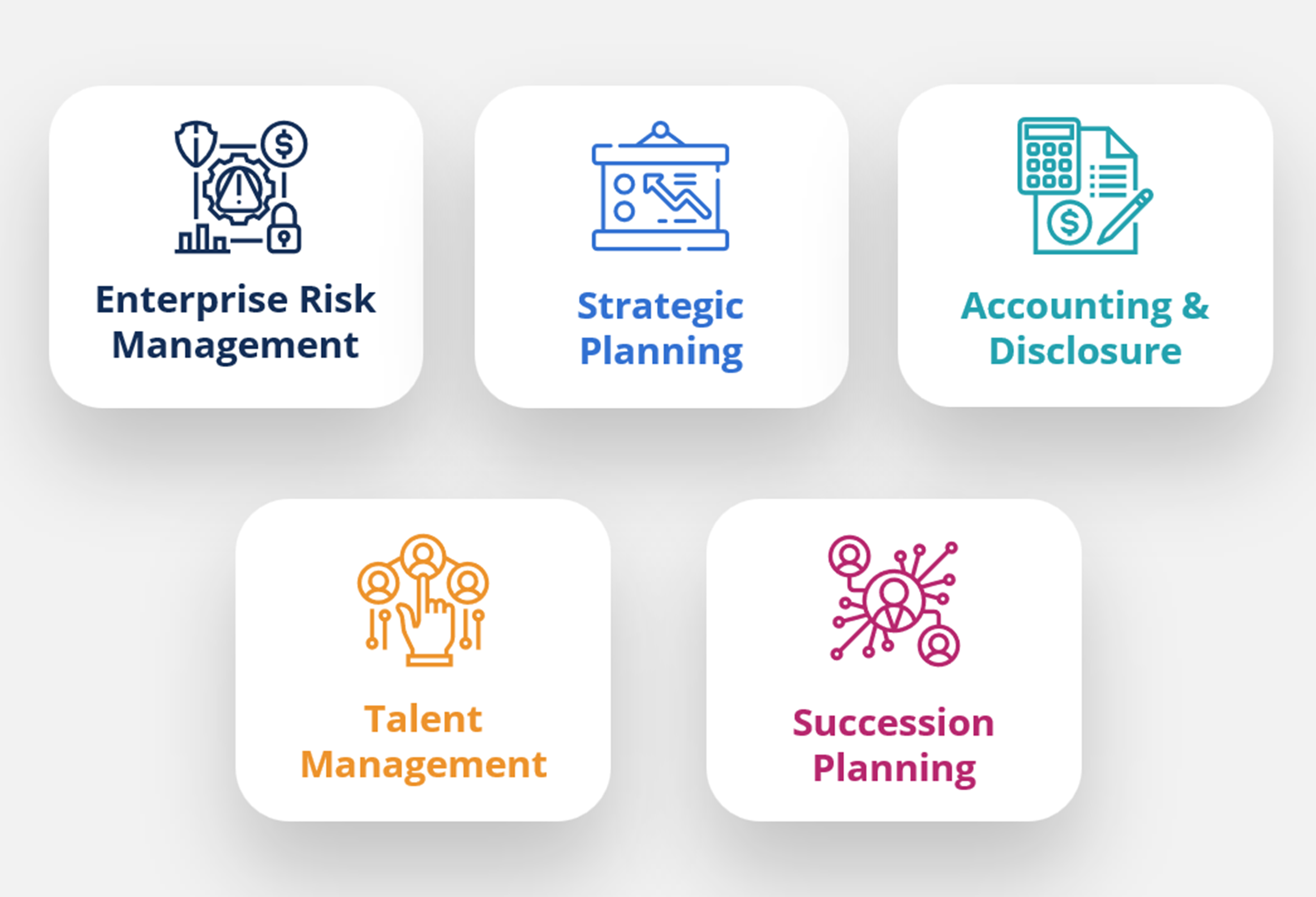
Corporate Governance OverviewThe purpose of corporate governance is to guide the conduct of an organization. Corporate governance is not a role or a position; it’s a system of stewardship that creates policies, protocols, and practices to ensure the alignment of interests between key stakeholders like management, investors, customers, and employees.Two core purposes of corporate governance are to mitigate risks and to support the development of long-term competitive advantages in the market. Through the deployment of functions like enterprise risk management, strategic planning, accounting and disclosure practices, talent management, and succession planning, directors can have a significant impact on an organization’s longevity.In this course, we cover the five Ps of corporate governance and how each is applied within an organization. Next, we outline and compare the roles between company management and its board of directors, and between public and private market governance strategies. Finally, we will discuss how to assess and improve corporate governance performance as well as how to create an internal governance structure. Corporate Governance Learning ObjectivesDefine the purpose, function, and core concepts of corporate governanceCompare the roles of company management and its board of directorsExplain the nuances between public vs. private market governance and modern ESG expectations. Describe how strong governance reduces risk and creates opportunities for a firmAnalyze various techniques to measure corporate governance outcomesProvide recommendations on how to improve corporate governance practicesWho Should Take This Course?This Corporate Governance course is perfect for investment professionals, consultants, financial analysts, and investor relations teams at both private and public companies. Whether approaching the topic through the eyes of a financial services professional, a founder, an ESG analyst, or a board advisor, this course has been designed to demystify corporate governance.

Coursera
With the increasing adoption of remote and hybrid work, effective communication in a corporate setting has become more critical than ever. This Corporate Communication specialization is designed to help you unlock the secrets of effective communication and build a strong, cohesive corporate culture. Learn how to harness the power of transparency and storytelling to connect with your audience and foster collaboration within your organization. Discover how a well-crafted mission statement, values, and DEI initiatives can build a strong corporate culture. This specialization also covers the art of external communications, teaching you how to promote your corporate brand, communicate effectively with media and investor relations, and build lasting relationships with your customers. Plus, learn how to leverage social media to encourage two-way communication and foster a sense of community around your brand. This specialization is ideal for professionals seeking to advance their careers in corporate communications or individuals aiming to enter this dynamic field with a strategic mindset. By the end of this specialization, you will be able to: Identify terms, tools, and strategies for corporate communication Analyze professional scenarios to select the best communication strategy for the situation Discuss various types of communication and their applications
Swayam
The objective of this course is to understand the conceptual framework of corporate accounting and to make students aware about the corporate entities and their working in the accounting scenario. The students will learn about many different aspects of corporate accounting such as issue of shares, debentures, buy back of shares, right shares valuation of shares and many important aspects.

edX
This course from Tuck Executive Education at Dartmouth offers a comprehensive look into corporate responsibility and how it shapes a business's positioning in the modern landscape. Learners will engage with critical questions like a business's fundamental purpose and weigh the balance between profit and public interest. Through an in-depth exploration of environmental, social, and governance (ESG) issues, the course provides a framework for understanding and articulating an organization's purpose and its implications for reputation and perception. Learners will leave the course with a nuanced understanding of how to integrate corporate responsibility into their leadership approach and the broader strategic positioning of the organization, ensuring that values are translated into action. This course was designed to be the fourth and final Strategic Corporate Communication professional certificate. You will get the most out of the contents and assignments for this course after you complete Communicating Strategically, Corporate Brand and Reputation, and Crisis Communication and Management.

XuetangX
Corporate finance describes the basic principles of corporate finance from both theoretical and practical aspects. Taking non-financial enterprises as the research object, it solves the problems such as what kind of long-term investment projects the company should choose, how to raise funds for the projects to be invested, and how enterprise managers manage daily cash and financial work, namely capital budget, capital structure and working capital management. This course mainly includes: introduction to corporate finance, investment valuation, capital budget and capital structure. This course is designed to enable students to understand and master some basic theories and principles of corporate finance. Through the study of this course, students would more clearly understand the significance of investment, financing and dividend payment decisions for the goal of "maximizing the wealth of corporate shareholders".

XuetangX
The course vividly explains and constructs the basic framework of corporate finance, focusing on the mainline of value evaluation and closely combining with the needs of financial practice. It covers the main content of corporate finance in the form of special topics, elaborating on the basic notions and concepts, basic methods and practical skills of corporate finance. We hope that through the course, students can reach a consensus that correct financial decisions will increase the value of the enterprise and shareholders, while poor financial decisions will destroy their value. The key to increasing or damaging value lies in cash flow. To achieve value appreciation, the cash flow generated by a company must be greater than the cash flow consumed.The course mainly introduces the basic theories, methods, and practical knowledge of corporate finance. It is divided into four topics, namely: Introduction, Valuation and Capital Budgeting, Risk, and Capital Structure & Dividend Policy. This course emphasizes the connection between theory and practice, highlighting the practical application scenarios of corporate finance. Through the study of this course, students can understand the connotation of corporate finance, establish basic values such as time value of money and risk reward balance, familiarize themselves with financing, investment, operation, and distribution processes, master valuation methods, and enhance financial decision-making ability.

Coursera
Entrepreneurial spirit, entrepreneurial culture, are terms that are heard and read repeatedly. These have emerged with renewed strength in an economy in which new and great business opportunities appear. For this reason, entrepreneurial skills are valued in companies and organizations that base their growth and competitive advantage on innovation. It is increasingly common for entrepreneurial projects to be deployed within an established organization, which is known as intra-entrepreneurship or corporate entrepreneurship. Expand your knowledge on this topic with this online course. The purpose of this administration course is to explain to participants the main concepts of corporate entrepreneurship and introduce topics of "Entrepreneurial Culture" aimed at developing competencies for the organic growth of the company or the development of the organization.

Coursera
In this course you will learn how organizations create, capture, and maintain value, and how it is fundamental for sustainable competitive advantage. You will be able to better understand economic value creation and value appropriation, and learn the tools to analyze both competition and cooperation from a corporate level perspective, (e.g., through vertical integration, diversification, and geographic scope decisions). You will: • Understand how corporations create, capture, and sustain competitive advantage. • Analyze business situations and create a coherent corporate strategy. • Understand the fit between corporate strategy and organization structure to improve economic performance. This course is part of the iMBA offered by the University of Illinois, a flexible, fully-accredited online MBA at an incredibly competitive price. For more information, please see the Resource page in this course and onlinemba.illinois.edu.

FutureLearn
Understand what is meant by business sustainability Sustainability aims to meet the needs of today without compromising future generations’ ability to meet theirs. For businesses, it’s important to not only focus on the growth of profit but also the concepts of green and sustainable development. This is known as corporate sustainability. On this six-week course, you’ll be introduced to the United Nations’ SDGs and how you can use them as a blueprint for sustainable corporate development. You’ll be given specific methods to move towards a sustainable enterprise and how to implement SDGs in your business strategy. You’ll gain an understanding of how companies can create profits and be responsible for the interests of investors and, at the same time, assume social responsibilities for employees, society, and the environment. Gain an introduction to sustainable finance You’ll start by exploring sustainable financial development to help develop an understanding of sustainable and responsible investing. Through this exploration, you’ll discover the challenges of sustainable investing in your country and the use of AI for sustainable finance. Explore a sustainable supply chain Next, you’ll discover sustainability within a supply chain. Exploring case studies, you’ll discover how businesses can best face the challenges of sustainability to create a responsible supply chain. Understand the financial foundation of corporate sustainability On the final weeks of the course, you’ll unpack the financial foundation of corporate sustainability to learn how to balance between social and financial goals. You’ll also explore how corporate sustainability interlinks with the environment and how businesses can identify ecological impacts, balance resources, and minimise any environmental impacts. This course is designed for those interested in corporate sustainability research and wants to engage in business sustainability. It will also be of interest for students who are interested in business development, financial issues, and sustainable development issues.