

Courses
Discover thousands of courses from top institutions and platforms worldwide
Level
Course Type
Duration
EMMA
Social and environmental responsibility has become a common issue in corporate communication, but how to design an efficient communication plant? Why did the subject of ‘responsibility’ become a relevant topic? Which role is playing ICT in corporate communication? Are they suitable for communication of corporate social responsibility? This course offers insight on the corporate social responsibility and communication reporting the connections among organizational models, communicational functions, consumptions trends, new communication technologies and socio-environmental crises. The course will show examples of the communication of energy companies and how they face the socio-environmental responsibility in marketing communication and public relations.

Udemy
What you'll learn: Understand How CSR Relates to customersUnderstand how CSR Relates to EmployeesUnderstand How CSR Relates to environmentUnderstand the Different World Views on CSRLearn about Corporate Social Initiatives Introduces the concept of Corporate Social Responsibility (CSR) as it relates to customers, employees, the environment and society at large. It also does a historical treatment of the concept of CSR and explains the sometimes complex relationship between business society by focusing on the Milton Friedman view of CSR; the Archie Carroll and Carnegie views on Corporate Social Responsibility.

Coursera
Corporate strategy is the strategy a firm uses to compete across multiple businesses. Many small firms want to grow by entering new businesses. Many large firms already are in multiple businesses, e.g. a photo camera producer selling also sunglasses. We developed this course to help you make good corporate strategy decisions. Of the many decisions a firm has to make, corporate strategy decisions are among the most consequential. We will look at these key corporate strategy decisions: - Diversification: How and which businesses should your firm enter? - Divestiture: How and from which businesses should your firm exit? - Corporate HQ: How should we organize corporate headquarters to create value across the different businesses?

Coursera
Participants learn methods to scan the external environment, identify emerging trends, and develop scenarios for informed decision-making. The course emphasizes proactive planning and innovation strategies, enabling organizations to navigate uncertainties and capitalize on emerging opportunities.
Corporate Finance Institute
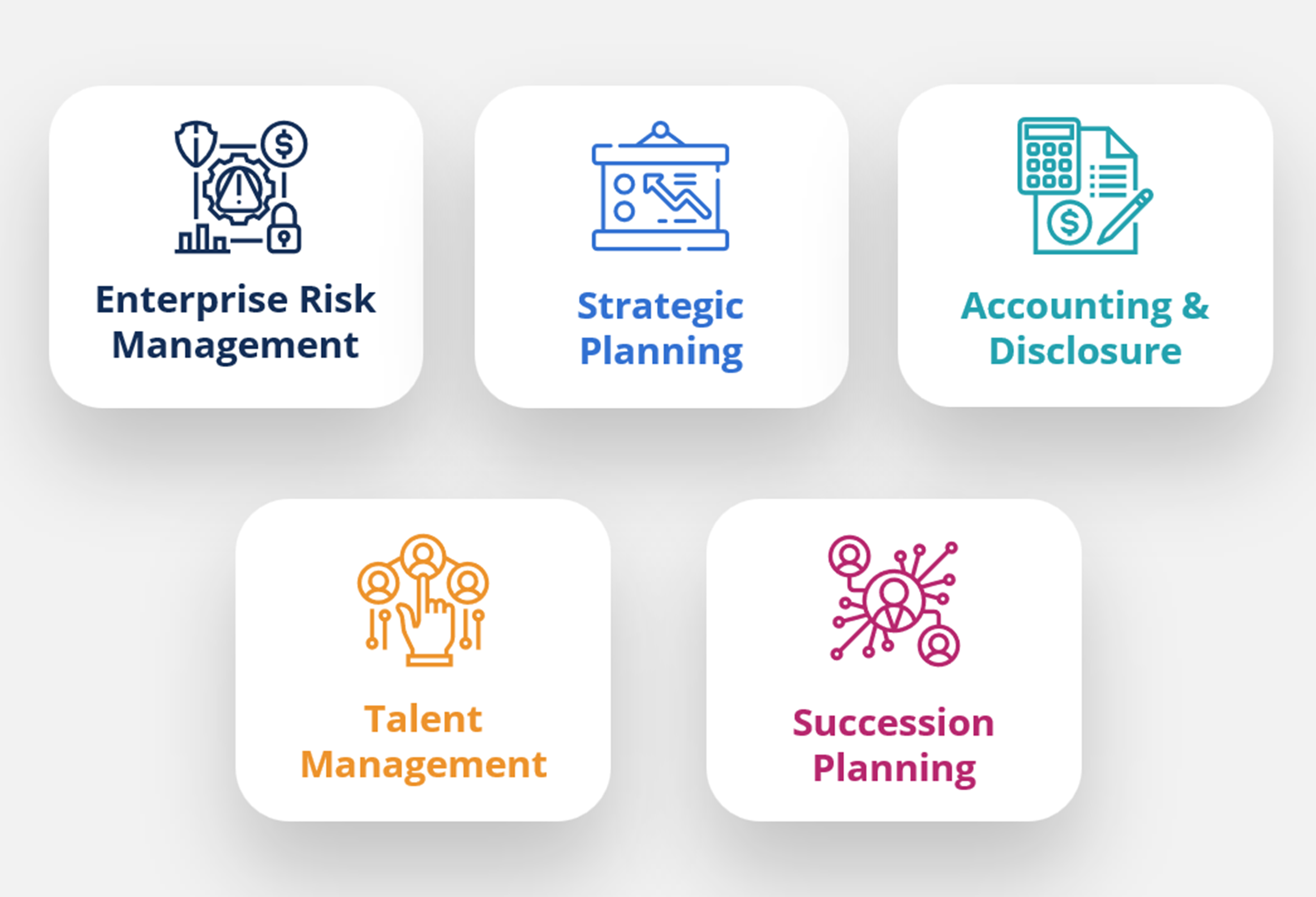
Corporate Governance OverviewThe purpose of corporate governance is to guide the conduct of an organization. Corporate governance is not a role or a position; it’s a system of stewardship that creates policies, protocols, and practices to ensure the alignment of interests between key stakeholders like management, investors, customers, and employees.Two core purposes of corporate governance are to mitigate risks and to support the development of long-term competitive advantages in the market. Through the deployment of functions like enterprise risk management, strategic planning, accounting and disclosure practices, talent management, and succession planning, directors can have a significant impact on an organization’s longevity.In this course, we cover the five Ps of corporate governance and how each is applied within an organization. Next, we outline and compare the roles between company management and its board of directors, and between public and private market governance strategies. Finally, we will discuss how to assess and improve corporate governance performance as well as how to create an internal governance structure. Corporate Governance Learning ObjectivesDefine the purpose, function, and core concepts of corporate governanceCompare the roles of company management and its board of directorsExplain the nuances between public vs. private market governance and modern ESG expectations. Describe how strong governance reduces risk and creates opportunities for a firmAnalyze various techniques to measure corporate governance outcomesProvide recommendations on how to improve corporate governance practicesWho Should Take This Course?This Corporate Governance course is perfect for investment professionals, consultants, financial analysts, and investor relations teams at both private and public companies. Whether approaching the topic through the eyes of a financial services professional, a founder, an ESG analyst, or a board advisor, this course has been designed to demystify corporate governance.

Coursera
With the increasing adoption of remote and hybrid work, effective communication in a corporate setting has become more critical than ever. This Corporate Communication specialization is designed to help you unlock the secrets of effective communication and build a strong, cohesive corporate culture. Learn how to harness the power of transparency and storytelling to connect with your audience and foster collaboration within your organization. Discover how a well-crafted mission statement, values, and DEI initiatives can build a strong corporate culture. This specialization also covers the art of external communications, teaching you how to promote your corporate brand, communicate effectively with media and investor relations, and build lasting relationships with your customers. Plus, learn how to leverage social media to encourage two-way communication and foster a sense of community around your brand. This specialization is ideal for professionals seeking to advance their careers in corporate communications or individuals aiming to enter this dynamic field with a strategic mindset. By the end of this specialization, you will be able to: Identify terms, tools, and strategies for corporate communication Analyze professional scenarios to select the best communication strategy for the situation Discuss various types of communication and their applications
Swayam
The objective of this course is to understand the conceptual framework of corporate accounting and to make students aware about the corporate entities and their working in the accounting scenario. The students will learn about many different aspects of corporate accounting such as issue of shares, debentures, buy back of shares, right shares valuation of shares and many important aspects.

edX
This course from Tuck Executive Education at Dartmouth offers a comprehensive look into corporate responsibility and how it shapes a business's positioning in the modern landscape. Learners will engage with critical questions like a business's fundamental purpose and weigh the balance between profit and public interest. Through an in-depth exploration of environmental, social, and governance (ESG) issues, the course provides a framework for understanding and articulating an organization's purpose and its implications for reputation and perception. Learners will leave the course with a nuanced understanding of how to integrate corporate responsibility into their leadership approach and the broader strategic positioning of the organization, ensuring that values are translated into action. This course was designed to be the fourth and final Strategic Corporate Communication professional certificate. You will get the most out of the contents and assignments for this course after you complete Communicating Strategically, Corporate Brand and Reputation, and Crisis Communication and Management.

XuetangX
Corporate finance describes the basic principles of corporate finance from both theoretical and practical aspects. Taking non-financial enterprises as the research object, it solves the problems such as what kind of long-term investment projects the company should choose, how to raise funds for the projects to be invested, and how enterprise managers manage daily cash and financial work, namely capital budget, capital structure and working capital management. This course mainly includes: introduction to corporate finance, investment valuation, capital budget and capital structure. This course is designed to enable students to understand and master some basic theories and principles of corporate finance. Through the study of this course, students would more clearly understand the significance of investment, financing and dividend payment decisions for the goal of "maximizing the wealth of corporate shareholders".

XuetangX
The course vividly explains and constructs the basic framework of corporate finance, focusing on the mainline of value evaluation and closely combining with the needs of financial practice. It covers the main content of corporate finance in the form of special topics, elaborating on the basic notions and concepts, basic methods and practical skills of corporate finance. We hope that through the course, students can reach a consensus that correct financial decisions will increase the value of the enterprise and shareholders, while poor financial decisions will destroy their value. The key to increasing or damaging value lies in cash flow. To achieve value appreciation, the cash flow generated by a company must be greater than the cash flow consumed.The course mainly introduces the basic theories, methods, and practical knowledge of corporate finance. It is divided into four topics, namely: Introduction, Valuation and Capital Budgeting, Risk, and Capital Structure & Dividend Policy. This course emphasizes the connection between theory and practice, highlighting the practical application scenarios of corporate finance. Through the study of this course, students can understand the connotation of corporate finance, establish basic values such as time value of money and risk reward balance, familiarize themselves with financing, investment, operation, and distribution processes, master valuation methods, and enhance financial decision-making ability.

Coursera
Entrepreneurial spirit, entrepreneurial culture, are terms that are heard and read repeatedly. These have emerged with renewed strength in an economy in which new and great business opportunities appear. For this reason, entrepreneurial skills are valued in companies and organizations that base their growth and competitive advantage on innovation. It is increasingly common for entrepreneurial projects to be deployed within an established organization, which is known as intra-entrepreneurship or corporate entrepreneurship. Expand your knowledge on this topic with this online course. The purpose of this administration course is to explain to participants the main concepts of corporate entrepreneurship and introduce topics of "Entrepreneurial Culture" aimed at developing competencies for the organic growth of the company or the development of the organization.

Coursera
In this course you will learn how organizations create, capture, and maintain value, and how it is fundamental for sustainable competitive advantage. You will be able to better understand economic value creation and value appropriation, and learn the tools to analyze both competition and cooperation from a corporate level perspective, (e.g., through vertical integration, diversification, and geographic scope decisions). You will: • Understand how corporations create, capture, and sustain competitive advantage. • Analyze business situations and create a coherent corporate strategy. • Understand the fit between corporate strategy and organization structure to improve economic performance. This course is part of the iMBA offered by the University of Illinois, a flexible, fully-accredited online MBA at an incredibly competitive price. For more information, please see the Resource page in this course and onlinemba.illinois.edu.

FutureLearn
Understand what is meant by business sustainability Sustainability aims to meet the needs of today without compromising future generations’ ability to meet theirs. For businesses, it’s important to not only focus on the growth of profit but also the concepts of green and sustainable development. This is known as corporate sustainability. On this six-week course, you’ll be introduced to the United Nations’ SDGs and how you can use them as a blueprint for sustainable corporate development. You’ll be given specific methods to move towards a sustainable enterprise and how to implement SDGs in your business strategy. You’ll gain an understanding of how companies can create profits and be responsible for the interests of investors and, at the same time, assume social responsibilities for employees, society, and the environment. Gain an introduction to sustainable finance You’ll start by exploring sustainable financial development to help develop an understanding of sustainable and responsible investing. Through this exploration, you’ll discover the challenges of sustainable investing in your country and the use of AI for sustainable finance. Explore a sustainable supply chain Next, you’ll discover sustainability within a supply chain. Exploring case studies, you’ll discover how businesses can best face the challenges of sustainability to create a responsible supply chain. Understand the financial foundation of corporate sustainability On the final weeks of the course, you’ll unpack the financial foundation of corporate sustainability to learn how to balance between social and financial goals. You’ll also explore how corporate sustainability interlinks with the environment and how businesses can identify ecological impacts, balance resources, and minimise any environmental impacts. This course is designed for those interested in corporate sustainability research and wants to engage in business sustainability. It will also be of interest for students who are interested in business development, financial issues, and sustainable development issues.

Coursera
In this course you will learn how corporations create, capture, and maintain value, going beyond the management of a single line of business. It is thus a complement to (and should typically follow) a course on Business Strategy, which focuses on developing and sustaining competitive advantage for a single business unit. Here, you will be able to better understand and learn the tools to analyze and manage decisions from a corporate-level perspective, which emphasizes the management of multiple businesses and multiple stakeholders. Examples of such decisions include vertical integration, diversification, mergers and acquisitions, strategic alliances, international expansion, global strategy, corporate governance and corporate social responsibility. You will: • Understand how corporations create and capture value as multi-business enterprises. • Learn tools and frameworks to assess choices regarding corporate scope, corporate transactions and global strategy. • Learn to analyze complex business situations and develop coherent corporate strategies. • Understand the role of corporate governance and stakeholder management in modern companies. This course is part of the iMBA offered by the University of Illinois, a flexible, fully-accredited online MBA at an incredibly competitive price. For more information, please see the Resource page in this course and onlinemba.illinois.edu.

edX
You will learn how to value a firm over the course of this Corporate Finance professional certificate program, giving you the skills necessary to make sound financial and investment decisions. We will cover: Framework for valuation (including, as special cases, valuation of stocks and bonds, and evaluation of investment opportunities) Free cash flow method for firm valuation Concepts of risk and return and identification of opportunity cost of capital Alternative sources of external funding for company operations Together, these concepts make up the essential building blocks for a career in finance. In this hands-on program, you will be given the opportunity to learn through a variety of real-world transactions and case studies as well as work through exercises in constructing Excel models to help deepen your understanding of concepts. This program is for those looking to advance their career in a range of professions, including investment banking, private equity, consulting, general management, and CFO track jobs within a corporation. This program is based on the first-year course taught in Columbia Business School’s MBA core program.

YouTube
Explore the concept of corporate evil in this thought-provoking conference talk delivered by Chris Anderson at SkyDogCon 2011. Delve into the ethical challenges and moral dilemmas faced by corporations in today's business landscape. Gain insights into the potential negative impacts of corporate actions on society and individuals. Examine case studies and real-world examples that illustrate the complexities of corporate decision-making and its consequences. Reflect on the role of corporate responsibility and the importance of ethical leadership in mitigating harmful practices. Consider the broader implications of corporate behavior on social, economic, and environmental issues.

Coursera
In the complex landscape of modern business, Corporate Governance emerges as a critical pillar for companies aiming to navigate ethical, legal, and competitive arenas successfully. This course offers an in-depth exploration of the principles and practices underpinning effective corporate governance, focusing on board responsibilities, regulatory compliance, risk management, and stakeholder engagement, as well as evolution of the corporate governance concept itself. Through this course, professionals will develop the skills to shape governance structures that promote integrity, accountability, and informed decision-making. Upon completion, participants will be well-equipped to contribute to their organizations' governance policies, ensuring resilience and fostering a culture of ethical business practices that align with global standards. This course targets board members, corporate executives, governance professionals, and compliance officers seeking to deepen their understanding of effective governance practices. It is equally relevant for financial analysts, corporate lawyers, and consultants involved in advising organizations on governance, ethics, and compliance issues. Furthermore, students and academics interested in corporate governance theories and applications will find valuable insights and practical knowledge. No specific prerequisites are required for this course. However, a fundamental understanding of business operations, corporate law, or management principles will enhance the learning experience. An interest in the ethical, legal, and strategic aspects of corporate governance is essential for learners. After completing this course, learners will adeptly identify corporate governance principles, effectively manage regulatory challenges, enhance stakeholder relations, and implement robust risk management practices to ensure ethical business operations and safeguard corporate assets and reputation.

XuetangX
Based on financial statement analysis, Corporate Finance enables students to master the professional knowledge of financial decision-making, such as investment, financing, dividend distribution and so on, and to have a good grasp of capital markets, investment instruments, risk-return relationships in the open market environment. The main contents of the course include: financial statements and cash flow, time value of money, bond and stock valuation, capital budgeting, risk and return, cost of capital, capital structure and dividend policy, etc.The course adopts English-language textbooks and is taught in English. This is consistent with the common practice of international business schools, which is beneficial for students' future overseas studies. This course cultivates students' problem-solving abilities, which will lay a solid foundation for a student to achieve excellence in finance, accounting, management and other fields.

edX
Business organizations are constantly engaged in financial decision-making related to financial planning, investments, capital purchases, etc. The right financial decisions play a critical role in maximizing an organization’s business value. How do we value assets? What is a good investment? Does a project create value? Corporate finance will address these issues to help managers make value-enhancing decisions. This business and management course will introduce you to the role of corporate finance in an organization and the tools used to evaluate investment proposals. The course will cover commonly used tools and techniques that help managers make decisions that create value for their organizations such as time value of money, opportunity cost, net present value and internal rate of return. If you are interested in creating value for your organization, then this course is for you.

edX
The ability to innovate is crucial for business survival and growth in the current climate of rapid technological advancement and changing consumer preferences. Without innovation and entrepreneurship skills, more and more corporate ventures are failing when faced with market challenges. In this MicroMasters program, you will develop the knowledge and skills to encourage innovation and entrepreneurship within your organization. The program will teach you how to understand, integrate and promote innovation in a variety of settings, including public, private and not-for profit organizations and research institutions. Drawing on the innovation value chain, this program will provide you with a comprehensive understanding of the different aspects of corporate innovation, including: how to foster creativity and design thinking in the initial idea generation phase how organizations can utilize idea management tools to select the most feasible ideas for development, including how to manage intellectual property, introduce innovative processes and commercialize new technologies, products and services; how an evidence-based approach to innovation management can be utilized to improve the decision-making process and how to introduce open innovation practices; and How to build innovation into the strategy, capabilities and culture of an organization. During this program, theory will be complemented with real-world case studies, which will help you develop strategies that you can apply to improve business productivity, economic growth and global competitiveness. Additionally, as a verified learner, you will have the opportunity to refine your knowledge and skills, with the guidance of UQ experts, through a series of activities that allow you to apply theory and tools to your own ideas. Graduates of the program will be empowered with the ability to foster entrepreneurial and innovative behaviors in themselves and others; making them well suited to leadership roles within innovation programs, and enhancing an organizations ability to rapidly respond to and survive market threats.