

Courses
Discover thousands of courses from top institutions and platforms worldwide
Level
Course Type
Duration

Zero To Mastery
The Cybersecurity Bootcamp that will take you from ZERO to HIRED as a Cyber Security Engineer. You'll learn the latest best practices, techniques, and tools used for network security so that you can build a fortress for digital assets and prevent black hat hackers from penetrating your systems.How to launch your career in Cyber Security from scratchHave the skills and understanding to confidently apply for Cyber Security jobsLearn the entire Cyber Security ecosystemBecome an Incident Response Analyst, the first responders to a cyber attackLearn to identify social engineering and protect against itBecome a Risk Analyst, the tacticians that perform regular assessments of a company's cyber security systemsHow to develop effective end-point protection and network security systemsBecome a Penetration Tester / Ethical Hacker, the mercenaries that design, simulate, and execute attacks on enterprise networks to identify vulnerabilitiesUnderstand how hackers track you and your associates onlineBecome a Forensic Analyst, the detectives that investigate breaches and solve virtual crimesProtect yourself online using advanced anonymity and privacy techniquesMaster Cyber Security best practices and techniques to become a Top 10% Cyber Security Engineer

Udacity
Build the skills needed to outsmart cyber threats. This Nanodegree teaches you how to secure infrastructure, assess vulnerabilities, and apply top industry practices to protect your organization from digital attacks.

edX
This program focuses on demonstrating your ability to build functional and effective applications, showcasing your skills and knowledge throughout the application development process. Emphasis is placed on practically applying learned concepts to real-world scenarios, validating your competence in app development. You will gain a comprehensive understanding of securing core cloud infrastructure across network, compute, storage, and database components. Learn fundamental network security principles, including implementing controls, managing traffic, deploying firewalls, configuring secure virtual networks, and using segmentation to protect resources. Explore tools and services to monitor and defend against threats, enabling you to design and maintain a secure network architecture. Additionally, you will delve into securing virtual machines, data at rest and in transit, and databases using best practices such as access control, encryption, and threat mitigation. Acquire the knowledge and hands-on skills necessary to manage and enhance an organization's security operations. This course covers key principles like risk assessment, incident response, and the strategic use of security technologies. You will learn how to monitor security events, analyze threats, and ensure compliance with industry standards. With a strong focus on real-world application, this course provides a solid foundation for effectively leading or supporting security operations.
YouTube
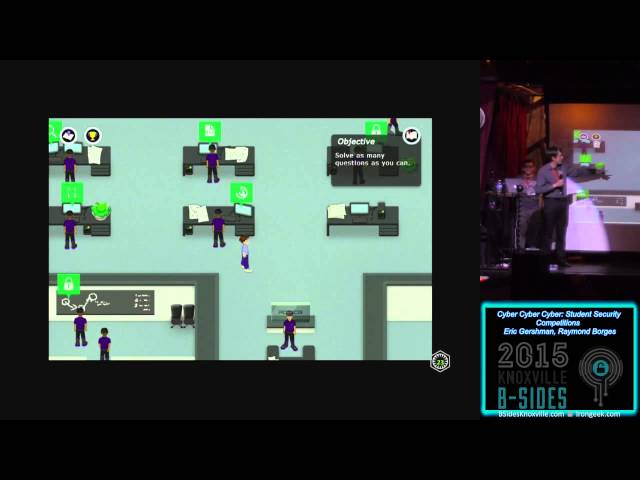
Explore the world of student cybersecurity competitions in this informative conference talk from BSides Knoxville 2015. Gain insights into the structure, challenges, and benefits of these competitions as presenters Eric Gershman and Raymond Borges share their expertise on the topic. Learn about the various types of cybersecurity challenges students face, the skills they develop, and how these competitions prepare participants for real-world security scenarios. Discover the importance of such events in fostering talent and promoting interest in the cybersecurity field among students.

Swayam
ABOUT THE COURSE: As we interact with various industry and their needs for cyber security, they often complain that the courses at academic institutions provide students with the fundamentals of cyber security, but the students are often not familiar with the practical issues associated with running a cyber security operation in a real organization. Also, while a lot of the theses at master’s level or dissertation at the PhD level are based on theoretical exploration of techniques, algorithms, or mathematical modeling of cyber security problems, there is a dearth of dissertation and thesis on the practical aspects of running cyber security operations. Having worked very closely with industry, we appreciate such concerns because there are very interesting problems to be solved for practical cyber security which also requires a great deal of fundamental thinking, reasoning, and concerns about human cognition of the inputs the operators and leaders receive from cyber security tools, dashboards, policy formulations but then in the crowd of details, fundamentals are lost, reasoning is replaced by ad hoc decisions. To change that, we need workforce, as well as academics who can abstract out the fundamentals from such practical problems are develop various practically oriented methods, methodologies, policy frameworks, and decision processes which would simplify cyber operations. This course is meant to be a first step towards that line of thinking, modeling, and methodology development.INTENDED AUDIENCE: 3rd,4th year students of Computer Science and post graduate students of Computer Science, Cyber Security and Working ProfessionalsPREREQUISITES: A previous course on fundamentals of Cyber Security is desirable, if not, courses in Operating System, Networking, Software Engineering, and Programming will be desirable

FutureLearn
Gain an introduction to cyber security This 3-week course for beginners will highlight the importance of cyber security in the current landscape. It will be particularly useful for IT professionals. Cyber attacks cost a huge amount of money annually, and this figure is on the rise. According to sources, the cost of cybercrime for 2021 will rise to $6 trillion, double the estimated figure for 2015. By 2025, this is predicted to rise to $10.5 trillion. On this course, you’ll learn about common types of cyber attacks, including phishing, viruses, and social engineering attacks, and how you can protect against them. You’ll also learn how to build a safe password policy, build in ransomware protection, and best practices for mobile data security. Explore common cyber attacks and how to protect against them To understand why cyber security is important, we must understand the risks we face. This cyber security training course will introduce you to some common and dangerous cyber attacks, and key topics such as: how to build a good password policy and how using a password manager increases data security risks associated with using unknown USB drives, including USB “rubber ducky” password stealers how to defend against viruses, including ransomware protection, and what to do when infected cyber security risks associated with social media, including social engineering attacks how to identify spear phishing and phishing emails best practices for mobile data security, including VPNs and DNS redirects disaster recovery and how to prepare for worst-case scenarios Completing this introduction to cyber security will enable you to take the first key steps to protecting your data. With these cyber security basics, you can prevent sensitive information getting into the wrong hands. This cyber security training is aimed at beginners to cyber security and IT professionals who want to understand how to protect their organization from cyber attacks. This might include data administrators, those working with sensitive data, or those targeting a career in cyber security.

YouTube
Explore the lucrative and in-demand field of cyber security through this comprehensive 47-minute video lecture. Discover the importance of cyber security in today's digital landscape, potential security threats, and strategies to prepare for a successful career. Learn about threat agents, the cyber kill chain, and employee responsibilities in maintaining digital security. Gain insights into the high job satisfaction, competitive salaries, and abundant career opportunities in this rapidly growing field. Understand the critical role cyber security professionals play in protecting organizations from costly attacks and data breaches. By the end of this lecture, you'll have a clear roadmap for pursuing a rewarding career in cyber security and be equipped with the knowledge to take your first steps in this exciting industry.

Udemy
Cyber Security, Cyber Security Awareness, Cyber Security Social Engineering, cyber security analyst, Cyber law What you'll learn: Learning the Introduction and importance of cyber security and cyber security awarenessUnderstand the types, layers and stages of cyber securityAnalyze how to create a cyber security awareness among the organizationUnderstanding the cyber security in Microsoft, IBM, Oracle and SAPLearn the concepts of Cyber security analyst skills and how to become a cyber security analyst Master course in cyber security and cyber security awarenessCyber security is all about keeping your stuff safe from people who shouldn't have it. This includes your computer, your network, your programs, and your data. There are a lot of different ways to do this, from using strong passwords to installing security software. But the most important thing is to be aware of the latest threats and to take steps to protect yourself.For example, you should use strong passwords that are different for each account. You should also be careful about what links you click on and what emails you open. And you should install and keep up to date with security software.Cyber security awareness is all about knowing how to protect yourself from cyber threats. It's important for everyone, from individuals to businesses to governments, to be cyber security aware.There are many different ways to improve your cyber security awareness. You can take training courses, read online resources, or even just talk to your friends and family about cyber security.One of the most important things you can do to improve your cyber security awareness is to be careful about what you click on. Don't click on links in emails or on websites unless you're sure they're safe. And make sure you have strong passwords for all of your accounts.In the rapidly evolving digital landscape, cyber security plays a crucial role in safeguarding sensitive information and systems from malicious threats. As cyber threats become increasingly sophisticated, professionals with expertise in cybersecurity are in high demand. Completing a comprehensive cyber security course equips individuals with the necessary skills to tackle diverse challenges, from network security and ethical hacking to penetration testing and information security. Ethical hacking and penetration testing are ethical approaches to identifying vulnerabilities and strengthening defenses. Certification programs like CISSP, CompTIA Security+, and Certified Ethical Hacker (CEH) validate one's proficiency in this field. Familiarity with tools like Kali Linux and Cisco CCNA also adds value to a cyber security specialist's repertoire. Furthermore, being aware of cyber security risks and the dark web is essential, along with mastering security operations, web security, and social engineering techniques. The continuous pursuit of knowledge in this domain ensures the establishment of robust cyber security measures for organizations and individuals alike.Cyber security awareness is an ongoing process. By staying informed about the latest cyber security threats and best practices, you can help to keep yourself and your organization safe.In this master course, I would like to teach the 7 major topics:1. Introduction and importance of cyber security and cyber security awareness2. Types, layers and stages of cyber security3. How to create a cyber security awareness among the organization4.Cyber security in Microsoft, IBM, Oracle and SAP5. Cyber security analyst skills and how to become a cyber security analyst6. Cybersecurity Ransomware Incident Response7. Cybersecurity Vulnerability ManagementEnroll now and learn today !

Udemy
Cyber Threats, Attacks, Viruses, ChatGPT & Cyber, Cyber Crimes, Firewalls, Cyber Security Concepts, Digital Forensics What you'll learn: Explain the differences between Threat, Vulnerability, and RiskExplore the needed skills set and job profiles in the field of CybersecurityDiscuss the evolution of threats and the types of security goalsDefine what cybersecurity isLearn the Importance of CybersecurityDifferentiate Networking Devices such as Router and SwitchDifferentiate IP, MAC, and PORT AddressDefine DNS and VPNLearn Hacking and the different Types of HackersLearn the fundamentals of networkingDiscuss the layers of the OSI ModelExplain the different networking protocols such as TCP, HTPP, UDP, ARP, and DHCPHow to troubleshoot a networkLearn the different types of attacksKnow the different types of malwareExplain the Man in the Middle and Denial of Service AttackDiscuss what is Distributed Denial of Service AttackHow to recognize Sniffing, Phishing, SQL Injection, Cross-site Scripting, and Post Scanning AttackDefine Cryptography and why we need itDiscuss important terminologies in CryptographyKnow the different types of ciphersLearn the advantages and disadvantages of Symmetric and Asymmetric KeysLearn what is Digital Signature and the Signing and Verification ProcessKnow how to check the Integrity of a MessageDiscuss the different security measuresLearn the various types of firewallsLearn Cyber Law and why there is a need for itDiscuss the classifications of cyber crimeDefinition, Process, and Types of Digital ForensicsCreate KALI Linux Virtual Machine in VMWARE Get instant access to an 87-page workbook of Cyber Security AwarenessIntroduce yourself to our community of students in this course and tell us your goalsEncouragement and celebration of your progress every step of the way: 25% > 50% > 75% & 100%***PLUS Learn Digital Disruption &Digital Transformation - How Technology Is Changing The World (includes 36 page masterclass workbook)***13 hours of clear and concise step by step instructions, lessons, and engagementThis course is designed for anyone who is interested in learning more about cyber security and how to combat the very real threats that everyone faces from hacking and catastrophic loss of data. This course is beginner-friendly, does not require technical cyber security skills, and is meant for everyone who wishes to help secure their own data, and their organisation's data from hackers and cyber threats.What you will learn:Define what cyber security isDiscuss the evolution of threats and the types of security goalLearn the Importance of cyber securityExplain the differences between Threat, Vulnerability, and RiskDifferentiate Networking Devices such as Router and SwitchDifferentiate IP, MAC, and PORT AddressDefine DNS and VPNLearn Hacking and the different Types of HackersExplore the needed skills set and job profiles in the field of cyber securityLearn the fundamentals of networking and securityDiscuss the layers of the OSI ModelExplain the different networking protocols such as TCP, HTPP, UDP, ARP, and DHCPHow to troubleshoot a network to improve securityLearn the different attacksKnow the different types of malware and how they affect securityExplain the Man in the Middle and Denial of Service AttackDiscuss what is Distributed Denial of Service AttackHow to recognize Sniffing, Phishing, SQL Injection, Cross-site Scripting, and Post Scanning AttackDefine Cryptography and why we need it for cyber securityDiscuss important terminologies in CryptographyKnow the different ciphersLearn the advantages and disadvantages of Symmetric and Asymmetric KeysLearn what is Digital Signature and the Signing and Verification ProcessKnow how to check the Integrity of a MessageDiscuss the different security measuresLearn the various types of firewalls and their securityLearn Cyber Law and why there is a need for itDiscuss the classifications of cyber crimeDefinition, Process and Digital Forensics...and more!Contents and OverviewYou'll start with What is Cyber security; Evolution of Cyber Threats; Three Types of Security Goals; Importance of cyber security; Threat, Vulnerability, and Risk; Networking Devices such as Router and Switch; What is an IP Address; What is a MAC Address; What is a PORT Address; What is DNS and VPN; Learn Hacking and the different Types of Hackers; Job Profiles in the field of cyber security; Important cyber security Skills.Then you will learn about Computer Networks; The OSI Model; OSI Layers Protocols; HTTP Protocol; TCP Protocol; UDP Protocol; the Difference between UDP and TCP Protocol; DHCP Protocol; ARP Protocol; What is an IP address and its types; What is a Port Address and its types; Network Troubleshooting; What is an Attack; Categories of Cyber Attacks; Password attack and its types; Malware Attack; Types of Malware; Man in the Middle Attack; Sniffing Attack; DOS Attack; What is DDOS Attack; Phishing Attack; SQL Injection Attack; Example of SQL Injection Attack; Cross-site Scripting Attack; Post Scanning Attack.We will also cover Post Scanning Attack; The Need for Cryptography; Basic Cryptography System; What is Encryption; What is Decryption; Define Plain text; What is Secret Key; What is Cipher text; Cryptography System; Cryptography in everyday life; Types of Cryptography; Symmetric Key Cryptography; Asymmetric Key Cryptography; What is Hashing; Hashing Algorithm; Techniques of Hashing; What is Substitution Cipher; What is Transposition Cipher; Cesar Cipher and how it works; Transposition Cipher; Stream Cipher; Block Cipher; Advantages of Symmetric Key Cryptography; Why Asymmetric key cryptography is important; Advantages of Asymmetric Key Cryptography; Digital Signature; Signing and Verification Process; How to check the Integrity of a Message and increase securityThis course will also tackle Security Measures; What is a Firewall; Types of Firewall; Cyber Law; Why there is a need for Cyber Law; What is Cyber Crime; Classification of Cyber Crime; Cyber Crimes Against Person; Cyber Crime Against Persons Property; Cyber Crime against Government; Cyber Crime against Society at Large; Definition of Digital Forensics; Process of Digital Forensics; Digital Forensics.Who are the Instructors?Vijal Jain is your lead instructor – a professional making a living from teaching cyber security.As a cyber security expert, she has joined with content creator Peter Alkema to bring you this amazing new course.You'll get premium support and feedback to help you become more confident with finance!Our happiness guarantee...We have a 30-day 100% money-back guarantee, so if you aren't happy with your purchase, we will refund your course - no questions asked!We can't wait to see you on the course!Enroll now, and we'll help you improve your cyber security !Peter and Digital Regenesys

Coursera
Mobile Security | Defend the Devices That Move the World Smartphones are no longer just communication tools—they’re digital vaults, business terminals, and personal ID cards all in one. And with every swipe, tap, and download, they’re becoming the new frontline of cyber risk. This course gives you the skills to secure, investigate, and defend the most pervasive technology in modern life. Protect the Pocket-Sized Threat Surface Developed by Macquarie University’s Cyber Skills Academy—ranked in the top 1% of universities globally and recognised as Australia’s leading cyber security school—this course has been co-designed with industry to reflect the fast-evolving realities of mobile threat landscapes, digital forensics, and enterprise security. You’ll gain deep technical knowledge and forensic capability across: • Mobile architecture fundamentals including iOS and Android OS, secure boot processes, and encryption systems. • File system analysis and the interpretation of mobile digital artifacts for forensic investigation. • The use of specialist tools like Autopsy, FTK, and debug environments to recover and analyse mobile data. • Evidence acquisition techniques that uphold integrity and are admissible in court—across memory, storage, and network traffic. • Deep static and runtime behavioural analysis of mobile applications to uncover hidden threats and trace user interactions. • Mobile device security mechanisms (e.g., authentication, encryption, anti-malware) and how attackers exploit them—and how to stop them. Forensically Ready. Security Smart. Legally Sound. This course is ideal for law enforcement personnel, digital forensic analysts, security professionals, and anyone working in threat detection, mobility, or enterprise IT. You’ll not only understand how mobile devices are targeted, but how to investigate them thoroughly—and secure them intelligently. Whether you’re building resilience into your organisation or preparing for mobile threat response, this course ensures you have the skills to defend what’s in every hand and pocket. Investigate with precision. Defend with confidence. Secure the mobile edge.

Coursera
This course is intended to provide a general introduction to key concepts in cyber security. It is aimed at anyone with a good general knowledge of information and communications technology. The nature, scope and importance of cyber security are explained, and key concepts are justified and explored. This includes examining the types of threat that cyber security must address, as well as the range of mechanisms, both technological and procedural, that can be deployed. The role of cryptography in providing security is explored, including how algorithms and keys play their part in enabling cyber security. The key supporting function played by key management is identified, including why the use of cryptographic functions depends on it. The need for security management in an organisation is explained, and its main elements are introduced - including the key role played by risk management. The importance of standardised approaches to security management is explained, as is the notion of compliance.

edX
This economics course provides an introduction to the field of cybersecurity through the lens of economic principles. Delivered by four leading research teams, it will provide you with the economic concepts, measurement approaches and data analytics to make better security and IT decisions, as well as understand the forces that shape the security decisions of other actors in the ecosystem of information goods and services. Systems often fail because the organizations that defend them do not bear the full costs of failure. In order to solve the problems of growing vulnerability to computer hackers and increasing crime, solutions must coherently allocate responsibilities and liabilities so that the parties in a position to fix problems have an incentive to do so. This requires a technical comprehension of security threats combined with an economic perspective to uncover the strategies employed by cyber hackers, attackers and defenders. The course covers five main areas: Introduction to key concepts in security economics. Here, we provide an overview of how information security is shaped by economic mechanisms, such as misaligned incentives, information asymmetry, and externalities. Measuring cybersecurity. We introduce state of the art security and IT metrics and conceptualize the characteristics of a security metric, its challenges and advantages. Economics of information security investment. We discuss and apply different economic models that help determine the costs and benefits of security investments in network security. Security market failures. We discuss market failures that may lead to cybersecurity investment levels that are insufficient from society’s perspective and other forms of unsafe behaviour in cyber space. Behavioural economics for information security, policy and regulation. We discuss available economic tools to better align the incentives for cybersecurity, including better security metrics, cyber insurance/risk transfer, information sharing, and liability assignment. After finishing this course, you will be able to apply economic analysis and data analytics to cybersecurity. You will understand the role played by incentives on the adoption and effectiveness of security mechanisms, and on the design of technical, market-based, and regulatory solutions to different security threats.

Udemy
Cyber Security Fundamentals What you'll learn: Information Cyber Security Basics Security BasicsElements of InformationSecurityCyber Security introductionData Encryption StandardDigital SignatureSecure Electronic TransactionIntrusion Detection System.Firewall Basics Course OutcomeSummarize principle concepts, basic approaches in information and cyber security.Estimate the security protections and limitations provided by existing Data Encryption TechnologyInterpret Public key Cryptography and its ManagementAnalyze threats in order to protect or defend it in cyberspace from cyber-attacks.You must have heard of the word cyber security, making headlines in the news, internet, social media, IT forums, etc. However, has it ever occurred to you that what is cyber security or why does the security administrator of your organization keep on talking about the importance of cyber security?Fundamentally, cyber security is the body of technology, process, and practice, designed to protect systems, networks, programs, and data from cyber risks like cyber attacks, damage, or unauthorized access. It is also referred to as information technology security. With cyber attacks evolving today as a danger to organizations, employees and customers, cyber security plays a very crucial role in prevention against such security threats.As we have entered into this new decade, we can already see new challenges arising in cyber security since day one! It is no surprise to see that cyber security is constantly on a rise and there is a lot in store for the near future. Today, companies have become more technologically reliant than ever and the trend doesn’t seem to stop. Rather, it looks like this technological reliance will keep evolving in the long term.Almost every organization nowadays, uses cloud storage services like Dropbox or Google Drive to store their confidential data and sensitive information. If not taken proper online security measures, this data present online can easily be exploited by cyber criminals.

YouTube
Explore key cybersecurity insights and strategies in this BSides Cleveland 2021 conference talk. Delve into the current state of cyber crime, attacker methodologies, and the growing threat of ransomware. Learn about executive biometrics, the importance of implementing basic security measures, and the concept of victim shaming in cybersecurity incidents. Examine ransomware groups, OTNs, and engineering metrics while gaining valuable knowledge on the MITRE framework. Discover practical approaches to improve your organization's cyber defenses and participate in a Q&A session to address specific security concerns.

Coursera
Prepares students for a role as a network security administrator and analyst. Topics include viruses, worms, other attack mechanisms, vulnerabilities and countermeasures, network security protocols, encryption, identity and authentication, scanning, firewalls, security tools, and organizations addressing security. A component of this course is a self-contained team project that, if the student wishes, can be extended into a full operational security system in a follow-course. Upon successful completion of this course, students will be able to: - Describe foundational concepts in cybersecurity. - Apply access control and scripting techniques. - Design and implement secure architechtures. - Integrate physical and environmental security measures. - Secure telecommunications and network systems. - Implement cryptographic solutions. - Develop business continuity and disaster recovery plans. - Navigate legal, regulatory, and compliance requirements.

Coursera
This Specialization combines three foundational and leadership-focused courses - Cyber Security: Essentials, Cyber Security: Essentials for the Workplace, and Cyber Security: Essentials for Managers and Leaders to provide a complete pathway into cyber fluency and leadership. It is designed for individuals at all levels who want to understand, apply, and lead effective cyber security practices in professional environments. You’ll begin with the fundamentals, learning how to secure personal and organisational assets against common threats such as phishing, ransomware, and identity theft. You’ll then apply these concepts to workplace scenarios, gaining the tools to create and sustain a culture of cyber awareness across teams. Finally, you’ll advance into leadership-focused training, developing strategies that align cyber priorities with business objectives, strengthen governance, and guide teams through incidents with confidence. Developed by Macquarie University’s Cyber Skills Academy, ranked in the top 1% of universities globally and recognised as Australia’s leading cyber security school, this Specialization combines academic rigour with real-world application. By the end, you’ll be prepared to strengthen organisational resilience, enhance compliance, and safeguard digital trust in an era of constant cyber threats.

Udemy
The right way to start your career in cybersecurity What you'll learn: How to start your career in cybersecurityCybersecuity marketsize & statisticsCybersecuity laws (US, EU & Australia)Cybersecuity standards (NIST, ISO27001, PCI-DSS)Cybersecuity career pathway (including the certifications)Malwares CategoriesHackers techniques & MotivationsHackers categoriesCybersecurity killchaincyber security basics If you are freshly graduated and looking to start your career in cybersecurity (or even if you are switching from other ITfield), then this is the right course for you!This course cover all the aspects that anyone needs for a good start in cybersecurity, including the basics of this fields : Like what exactly is cybersecutiy? what are the differences between cybersecurity and information security? Is the cybersecurity marketsize really huge? and what does it cover exactly? Certification and career roadmap are included in the course, so that you can prepare your plans for a great career (including salary expectations)You will also be able to classify hackers and know the way they think, so that you can easly protect your company. For this, we will dive deep into the cybersecurity kill chain, and discover the malicious tools that are used by hackers, in order to hack systems.This course also cover the laws and standards that organize the cybersecurity world. For the laws we take the example of the United states of America, the European Union and Australia cybersecurity laws. Regarding the standards, we will take the most well known ones, this include PCI-DSS for payment cards security, National Institute of Standards and Technology (NIST) & ISO27001 as part of the ISO 27k family of standards.

YouTube
Dive into a comprehensive 15-hour video course on Cisco Cyber Security, taught by CCIE Security expert Adeolu Owokade. Master essential network security concepts, from risk assessment and common threats to advanced topics like AAA, ACLs, and VPNs. Learn to implement security measures on Cisco routers, switches, and ASA firewalls using both CLI and GUI tools. Explore cryptography, intrusion prevention systems, and various VPN technologies. Gain practical skills in configuring secure network topologies, managing passwords, implementing firewalls, and setting up VPNs. By the end of this course, acquire the knowledge and hands-on experience needed to effectively secure Cisco networks and prepare for the Implementing Cisco Network Security (IINS) certification.
Independent
About the Course Series Cyber Security Base is a free course series by University of Helsinki and MOOC.fi in collaboration with F-Secure that focuses on building core knowledge and abilities related to the work of a cyber security professional.Learn about tools used to analyse flaws in software systems, necessary knowledge to build secure software systems (esp. within Web), the skills needed to perform risk and threat analysis on existing systems and the relevant legislation within EU.The course series consists of 6 smaller courses, each with a specific theme. Themes include a brief introduction to cyber security, operational security, web software development, types of vulnerabilities typical of web software, discovery and mitigation of such vulnerabilities, and advanced topics such as secure software architectures and cryptography. There will be several case studies as well as projects for participants. At the end of the course series, we'll also organize a friendly capture-the-flag competition where participants will try to solve some security puzzles.Each course is open for a certain period of time, and must be completed during that window. Work load and prerequisites There will be programming assignments, essays, quizzes and puzzles throughout the courses, and completing a specific part of a course means working and completing most if not all of them. See course descriptions for estimated required hours. Some programming background and ICT experience is required.The course has started! You don't need to register to start doing the course. There is an optional registration for those who want ECTS credits that can be done AFTER completing the course. More instructions in the material. So just head to the material and start doing the courses!

YouTube
The Cyber Security industry is booming, and there is a tremendous demand for qualified Cyber Security professionals. With the ever-changing landscape of Cyber Security threats, organizations are searching for candidates with the most up-to-date skills and knowledge to protect their networks and data. Consequently, there is a lot of enthusiasm around the Cyber Security skills required to succeed in this discipline. In this course, you will gain insights on how to improve your skills to be a Cyber Security Expert and what are their roles and responsibilities.