

Courses
Discover thousands of courses from top institutions and platforms worldwide
Level
Course Type
Duration

Udacity
Develop the expertise to architect modern data ecosystems. Learn advanced database design, data modeling, cloud integration, and governance to deliver secure, efficient, and scalable enterprise data solutions.

Udemy
Get your Salesforce Data Architect certification with this course, aligned with the Spring 23 exam guide objectives What you'll learn: Data modeling/Database DesignCustom fields, master detail, lookup relationshipsMaking best use of Salesforce standard and big objectsSalesforce metadataMaster Data ManagementSalesforce license typesData consistency techniques in SalesforceSalesforce Consent Management ObjectsData Governance TechniquesLarge Data Volume considerationsIndexing, LDV migrations, performanceData Virtualization in SalesforceSalesforce Platform declarative and programming conceptsData Quality Skills (concerned with clean data) The Salesforce Certified Data Architect credential is intended for the architect who assesses the architecture environment and requirements; and designs sound, scalable, and performant solutions on the Salesforce platform.This certification is part of the Application Architect certification, and it emphasizes on the data side of Salesforce. I highly encourage you to take this course even if you are not seeking to get your Application Architecture certification as it contains key objectives related to data in Salesforce.The Salesforce Certified Data Architect Course was designed to be fully aligned with the official Salesforce Data Architect certification exam guide objectives. Ialways like to organize my Salesforce study for any certification to be based on the objectives. I always get the latest exam guide, understand each objective, and go through every requirement of every objective, this way I am sure to cover everything needed to pass the exam.The sections of this course are aligned with the objectives, and they are:Data modeling/Database DesignMaster Data ManagementSalesforce Data ManagementData GovernanceLarge Data Volume considerationsData MigrationAll supporting references are also included. These include Trailhead modules and trails, external links for articles and videos.I will make sure to update the videos after every release, if Salesforce changes the exam objectives.Finally, I have been there, I spent hours and hours preparing for this exam, I dissected each and every topic of the Study Guide, and took tons of notes, just like I did when preparing for my other certifications. I guarantee that after completing this course, after exploring all the provided resources, and after practicing on the Salesforce environment, you will pass this exam, and you will become a Salesforce Certified Data Architect! Good Luck! Walid

Udemy
The Qlik Sense Developer Bootcamp What you'll learn: Create a data model in QlikSenseCreate and maintain data connectionsDevelop and debug QlikSense scriptCleanse and transform source dataResolve data model issuesOptimization for performanceCreate and use Qlik Data Files (QVD) filesManage security with Section Access Welcome to QlikSese Data Architect Masterclass. In this course, you will master skill to develop associativedata models in Qlik Sense from scratch.In this brand new QlikSense masterclass, you will learn step-by-step to cleanse, transform, and unify data from multiple disparate sources using June 2018 release version and its features.You will build optimized associative data model using powerful ETL scripting and learn how to deal withcomplex data integration challenges.Throughout the course, with hands-on examples and challenges, you will master QlikSense developer skill to build a data model which business analysts can use to build insight driven, self service applications for your enterprise.QlikSense data architect masterclass topics include: data connections, cleansing and transforming source data, resolvingdata model issues, optimization for performance, using QlikView Data Files (QVD) files and data model security.This course is designed so that anyone can learn how to develop data models in Qlik Sense!
Coursera
Gain practical, real-world experience in data architecture through this hands-on capstone project course, developing skills highly valued by employers. During this course, you’ll apply all that you’ve learned throughout the Data Architecture Professional Certificate. As you work through the course, you’ll evaluate, design, migrate, and integrate enterprise data systems through a case study. In the capstone project, you will assess the current data architectures of two organizations, highlighting their strengths and identifying areas for improvement. Based on this analysis, you will design and implement a unified and efficient architecture for the newly merged entity, aligning with business goals. The project includes working with both RDBMS and NoSQL databases and developing ETL pipelines to ensure smooth data integration and flow. Additionally, you will create a data governance plan that addresses regulatory compliance and outlines strategies for data protection. Overall, this real-world inspired scenario will give you plenty to talk about implementing an architecture and managing a system transition in interviews. If you’re keen to add practical experience to your portfolio that employers look for, enroll today!

Coursera
Kickstart your career in the high-growth field of data architecture. In this program, you’ll learn in-demand skills like data modeling, database design, and enterprise data management to build scalable and secure data systems. Data architects design, implement, and manage data systems, support analytics, ensure compliance, and drive modernization. In this program, you’ll gain a strong foundation in data engineering, SQL, and relational databases (RDBMS), while building essential technical skills such as Linux commands, shell scripting, and database administration (DBA). You’ll also develop hands-on experience in key areas of the field, preparing you to work with modern data infrastructure. You’ll also explore topics like data warehousing, NoSQL databases, and ETL workflows with tools such as Airflow and Kafka. You’ll also work with big data processing using Spark and Hadoop, while covering key areas like data integration, governance, security, privacy, and compliance, ensuring you’re ready to tackle complex data challenges. When you complete this full program, you’ll have a portfolio of projects and a Professional Certificate from IBM to showcase your expertise. You’ll also earn an IBM digital badge and will gain access to career resources to help you in your job search, including mock interviews and resume support.

Udemy
AWS Databases, EMR, SageMaker, IoT, Redshift, Glue, QuickSight, RDS, Aurora, DynamoDB, Kinesis, Rekognition & much more What you'll learn: Confidently architect AWS solutions for Ingestion, Migration, Streaming, Storage, Big Data, Analytics, Machine Learning, Cognitive Solutions and moreLearn the use-cases, integration and cost of 40+ AWS Services to design cost-economic and efficient solutions for a variety of requirementsAnswer detailed technical questions of your design and development teams regarding implementation and buildPractice hands-on labs on complex AWS services like IoT, EMR, SageMaker, Redshift, Glue, Comprehend and many more Hi! Welcome to the AWSData Architect Bootcamp course, the only course you need to learn everything about data architecture on AWS and play the role of an Enterprise Data Architect. This is the most-comprehensive AWScourse related to AWS data architecture on the market. Here's why:This is the only online course taught by an Enterprise Cloud Architect, who leads large teams of junior architects in the real world, who has an industry experience of close to two decades in the ITindustry, who is a published author, and leads technology architecture of XXX million dollar projects on cloud for multi-national clients. Data Architects draw a salary in the range of $150K - $250Kon an average. This course trains you for that job! This is my 10th course on Udemy, 3rd on AWS topics (previous 2 are best-sellers). Typical AWSclassroom trainings on data architecture which contains a fraction of the topics covered in this course, costs $3000 - $5000. And this course teaches you 5 to 7 times more topics than AWSTraining (40+ AWSServices)in the fraction of the cost. Everything covered in this course is kept latest. Services which are in Beta and launched in Re-invent (last Nov)are already covered in the course . AWSinnovates and adds features to their stack very fast, and Ikeep my course constantly updated with those changes. Think of this course as a Architecture Updates subscription. Developers have questions, Architect's have questions, Clients have questions - All technical curious minds have questions. And this course also has 500+questions and answers (FAQs) curated from AWSFAQs, to equip you with as many ready-to-use answers as you would need in your architect role. The entire course is formed of 40+services. Every service is composed of the below listed sections, with their proportion in each section / service. Architecture (12%) – Diagrams, Integration, TerminologyUse-Cases (6%) – Whether and When to use the AWS ServicePricing (2%) – Cost estimation methods to assess overall solution costLabs (75%) – To-the-point labs for architectural understanding covering all major and important featuresFrequently Asked Questions (5%) – Selected question from AWS FAQs explained concisely. (Total 500+) Apart from AWSServices, we will use a number of client tools to operate on AWSServices, Databases and other technology stack. Here is a list of the tools that we would be using:1. EC2 2. Putty 3. Cloud9, 4. HeidiSQL 5. MySQL Workbench 6. Pgadmin 7. SSMS8. Oracle SQL Developer 9. Aginity Workbench for Redshift 10. SQL Workbench / J11. WinSCP 12. AWS CLI 13. FoxyProxy 14. Oracle Virtualbox 15. Linux Shell Commands 16. FastGlacier 17. Rstudio 18. Redis Client 19. Telnet 20. S3 Browser21. Juypter Notebooks Below is a detailed description of the curriculum as AWSServices we will be learning to understand how they fit in the overall cloud data architecture on AWS and address various use-cases. If you have any questions, please don't hesitate to contact me. AWSTransfer for SFTP (Nov 2018 Release) - We will start our journey in this course with this service and learn how to ingest files in self-service manner using an sFTPserver on AWSand sFTPtools on-premise to ingest file based data on AWS. AWSSnowball - Large data volumes spanning hundreds of TBs are not ideal for ingestion via network. Using this service, we will learn how to ingest mega volume data using device based offline data transport mechanism to AWScloud. AWSKinesis Data Firehose - One of the data ingestion mechanism is streaming. We will learn how to channel streamed data from Kinesis Data Streams to AWSData Storage &Analytics Repositories like S3, Redshift, ElasticSearch and more using this service. AWSKinesis Data Streams - Clients can have streaming infrastructure or even devices (IoT)which may stream data continuously. Using this service we will learn how to collect streaming data and store it on AWS. AWSManaged Streaming for Kafka (MSK)(Nov 2018 Release) - AWSrecently added Kafka to their technology stack, which has lot of similarities with Kinesis. Learn comparative features as well as the method of standing up Kafka cluster on AWSto accept streaming data in AWS. AWSSchema Conversion Tool - Database migration is a complex process and can be homogeneous (for ex. SQLServer on-premise to SQLServer on AWS) or heterogeneous ( for ex. MySQLto PostgreSQL). We will use this offline tool to learn about assessing migration complexities, generate migration assessment reports, and even perform schema migration. AWSDatabase Migration Service (DMS) - Database Migration / Replication is a very common need for any federated data solution. We will use this service to learn how to migrate and/or replicate on-premise data from databases to AWShosted relational databases on AWSRDS. AWSData Sync (Nov 2018 Release)- Continuous synchronization of data from on-premise to cloud hosted data repositories becomes a key requirement in environments where data is generated or changes very fast. We will use to service to learn how it can solve this requirement. AWSStorage Gateway - This service has striking resemblance with AWSData Sync, and is one of the alternatives for standing cached volumes and stored volumes on AWSto build a bridge between on-premise data storage and AWS. We will briefly learn similarities between AWSData Sync and AWSStorage Gateway. AWSElastiCache ( Memcached )- After covering most of the mechanisms of data ingestion, we will shift focus on caching data before moving on the databases. We will start learning about caching with Memcached flavor of this service which offers powerful caching capabilities for simpler data types. AWSElastiCache ( Redis )- We will learn comparative difference between Memcached and Redis for caching, and learn how to use Redis flavor of caching which can build cache clusters and can host complex data types. AWSS3 (Advanced)- AWSS3 is the basis of data storage and data lake in AWS. We will learn advanced tactics like locking data for legal compliance, cross-region global replication, data querying with S3 Select feature, Life-cycle management to move data to cold storage etc. AWSGlacier - Data keep accumulating on cloud and can increase storage costs dramatically. Infrequently used data is suitable for cold storage, where this service comes into play. We will learning archival, archive retrieval and archive querying using this service. AWSRelational Database Service(MariaDB)- We will be focusing heavily on AWSService, which consists of 6 different types of databases. We will learn basic concepts of AWSRDSusing MariaDB, stand-up an instance and query it with a client tool. AWSRelational Database Service(SQLServer) - Data needs to be imported and exported between data-centers and cloud hosted database instances. We will learn such tactics for dealing with backups and restores across cloud using SQLServer database on RDSwith a client tool. AWSRelational Database Service(Oracle) - We will spend some time to learn how to stand up Oracle on AWSRDS, especially for Oracle professionals. AWSRelational Database Service(MySQL) - After spending time on practicing basic concepts, with MySQLdatabase on AWSRDS, we will start practicing advanced concepts for High-Availability and Performance, like Read Replicas and Performance Insights features. AWSRelational Database Service(PostgreSQL) - There can be use-cases where there may be need to convert one database to another on cloud, for example convert PostgreSQLto MySQL. We will learn about some compatibility features where we can create a MySQLread replica from a PostgreSQLinstance and make a read replica as an independent database. AWSRelational Database Service(Aurora) - Aurora on AWSRDSis a native database service from AWS. It comes in two flavors - cluster hosted and serverless, which is suitable for different use-cases. Also the storage architecture of Aurora is shared by various other AWSservices like AWSNeptune and DocumentDB. We will learn this service in-depth. AWSNeptune - Relational databases is just one of the types of databases in the industry as well as on AWS. Graph is special use-case for very densely connected data where the value of relationships is much higher than normal. We will learn graph theory of RDFvs Property Graph, and learn how Neptune fits in this picture, stand-up a Neptune Server as well as client, and operate on it with query languages like Gremlin ( Tinkerpop )and SPARQL. AWSDocumentDB (Nov 2018 Release) - MongoDBis one of the industry leader in NoSQLDocument Databases. AWShas recently introduced this new service which is a native implementation of AWSto provide an equivalent database with MongoDBcompatibility. We will learn details of the same. AWSDynamoDB- Key-value databases are important for housing voluminous data typically logs, tokens etc. We will learn document database implementation in depth with advanced features like streaming, caching, data expiration and more. AWSAPIGateway - RESTAPIs are today's standard mechanism of data ingestion. We will learn how to build data ingestion and access pipeline with APIs using this service with AWSDynamoDB. AWSLambda - Microservices are often tied with APIs, and are the cornerstone of any programmatic integration with AWSServices, typically AWS's Artificial Intelligence and Machine Learning Services. We will learn developing Lambda functions AWSCloudWatch - System logging is at the center of all programmatic logic execution, and it ties very closely with microservices and metrics logging for a variety of AWSServices. We will learn how to access and log data from microservices in CloudWatch logs. AWSInternet of Things (IoT) - Today IoTis one of the fastest growing areas, and from a data perspective, its one of the most valued source of data. The first challenge enterprises phase is the mechanism of ingesting data from devices and then processing it. With prime focus on ingestion, we will learn how to solution this using an end-to-end practical example which reads data from a device and sends text messages on your cell phone. AWSData Pipeline - With Data Lakes already overflowing with data, moving data within cloud repositories and from on-premises to AWS requires an orchestration engine which can move the data around with some processing. We will learn how to solve this use-case with this service. Amazon Redshift and Redshift Spectrum - All stored data in relational or non-relational format needs to be analyzed and warehoused. We will learn how to cater the requirement for a peta-byte scale, massively parallel data warehouse using this service. AWSElasticSearch - ElasticSearch is one of the market leaders in search framework along with its alternative Apache Solr. AWSprovides its own managed implementation of ElasticSearch, which can be used as one of the options to search data from different repositories. We will learn how to use this service for addressing search use-cases, and understand how tools like Logtash and Kibana fits in the overall solution. AWSCloudSearch - Standing up an AWSElasticSearch needs some ElasticSearch specific understanding. For use-cases which needs a more managed solution, AWSprovides an alternative packaged solution for search based on Apache Solr. We will learn how to stand up this service and use if for standing up search solutions in an express manner. AWSElastic MapReduce (EMR) - After spending sufficient time on Ingestion, Migration, Storage, Databases, Search and Processing, now we will enter the world of Big Data Analytics where we will spend significant amount of time learning how to standup a Hadoop based cluster and process data with frameworks like Spark, Hive, Oozie, EMRFS, Tez, Jupyter Notebooks, EMRNotebooks, Dynamic Port Forwarding, RStudio on EMR, Read and Process data from S3 in EMR, Integrate Glue with Hive, Integrate DynamoDBwith Hive and much more. AWSBackup (Nov 2018 Release)- Creating backup routines of various data repositories is a Standard Operating Procedure of production environments. AWSmade this job easier for support team with this brand new service. We will learn about the details of this service. AWSGlue - AWShas centralized Data Cataloging and ETLfor any and every data repository in AWSwith this service. We will learn how to use features like crawlers, data catalog, serde (serialization de-serialization libraries), Extract-Transform-Load (ETL)jobs and many more features that addresses a variety of use-cases with this service. AWSAthena - Serverless data lake is formed using four major services :S3, Glue, Redshift, Athena and QuickSight. This service is at the tail end of the process, and acts like a query engine for the data lake. We will learn how it serves that purpose and completes the picture. AWSQuickSight - AWSfilled the gap of a cloud-native reporting service in 2017 with the launch of this service. We will learn how it fits in the Serverless Data Lake picture and allows to create reports and dashboards. AWSRekognition - We will start our journey into the world of cognitive services powered by Artificial Intelligence with this service. Images and Video are vital source of data, and extracting information from these data sources and processing that data in a programmatic manner has various applications. We will learn how to perform this integration with Rekognition. AWSTextract (Nov 2018 Release) - Optical Character Recognition is another vital source of data, for ex. we are very much used to scanning of bar codes, tax forms, ebooks etc. We will learn how to extract text from documents using this AIpowered brand new service form AWS. AWSComprehend - Natural Language Processing (NLP) is a very big practice area of data analytics, typically performed using data science languages like Rand Python. AWSmakes the job of NLP easier by wrapping up a AIpowered NLPservice. We will learn the use of this service and understand how it complements services like Textract and Rekognition. AWSTranscribe - One major source of data that we have not touched so far is Speech to Text. We will learn how to use this APpowered service to extract text from speech, and how it can be effectively used for a number of use-cases. AWSPolly - We would have covered many use-cases of processing textual data from one form to another, but processing text to speech, which is the exact opposite function of Transcribe, we will learn to perform that with this AIpowered service from AWS. We will also learn the use of Speech Synthesis Language to control the details of the speech that gets generated. AWSSageMaker - After comfortably using AIpowered service, which abstracts the complexity of machine learning models from end-users, we will now venture in the world of machine learning with this service. We will execute a machine learning model end-to-end and learn how to access data from S3, create a model, create notebooks for executing code to explore and process data, train - build - deploy machine learning model, tune hyper-parameters, and finally accessing it from a load balanced infrastructure using APIendpoints. AWSPersonalize - Recommendation Engines requires building a reinforced deep learning neural network. Amazon has been in the business of recommending products to customers since decades. They have packages their method of recommendation as a product and launched it as a service, which is making a debut in the form of Personalize. We will perform an end-to-end exercise to understand how to use this service for generating recommendations. AWSLake Formation (Nov 2018 Release)- As forming data lakes is a tedious process, AWShas introduce a set of orchestration steps in the form of service to expedite the generation of Data Lakes. As this service is in early preview (Beta)and is subject to change, we will look at a preview of the GUIof this service before concluding the curriculum of this course. If you are not sure whether this course is right for you, feel free to drop me a message and Iwill be happy to answer your question related to suitability of this course for you. Hope you will enroll in the course. Ihope to see you soon in the class !

Microsoft Learn
Learn the essentials of Azure SQL Database deployment and migration. Explore its benefits, exclusive features, and migration options while optimizing performance and application connections for a smooth transition to the cloud.In this module, you'll: Explore the advantages, capabilities, and migration possibilities offered by Azure SQL Database. Migrate databases using Azure SQL Migration extension for Azure Data Studio and tracking database migration activities. Use transactional replication as an online method to migrate to Azure SQL Database. Explore several other methods for migrating SQL Server databases to Azure SQL Database. Learn the core features and functionality of Azure Cosmos DB.After completing this module, you'll be able to: Identify the key benefits provided by Azure Cosmos DB Describe the elements in an Azure Cosmos DB account and how they are organized Explain the different consistency levels and choose the correct one for your project Explore the APIs supported in Azure Cosmos DB and choose the appropriate API for your solution Describe how request units impact costs Create Azure Cosmos DB resources by using the Azure portal. Work with Azure Cosmos DBAfter completing this module, you'll be able to: Identify classes and methods used to create resources. Create resources in Azure Cosmos DB for NoSQL using .NET. Write stored procedures, triggers, and user-defined functions by using JavaScript.

Udemy
Data engineering and architecting pipelines using snowflake & AWS cloud What you'll learn: Will learn everything needed for Snowpro Advanced Data engineering certificationSnowflake as a data-warehouse & automated pipelines within snowflake ecosystemUse AWS Cloud with Snowflake as a data-warehouseIntegrating real time streaming data and data orchestration with Airflow and Snowflake Course Update as of Feb 2023 : This Course has been updated with Snowpark APIwhich covers UDFs,Stored Procedures for ETLand also covers Machine Learning use-case deployments . This course will help you clear SnowPro Advanced Certifications Snowflake is the next big thing and it is becoming a full blown data eco-system . With the level of scalability & efficiency in handling massive volumes of data and also with a number of new concepts in it ,this is the right time to wrap your head around Snowflake and have it in your toolkit . This course not only covers the core features of Snowflake but also teaches you how to deploy python/pyspark jobs in AWSGlue and Airflow that communicate with Snowflake , which is one of the most important aspects of building pipelines . Anyone who has a basic understanding of cloud and belong to one of the below backgrounds can benefit from this course :- Data Scientists / Analysts - Data Engineers / Software Developers - SQLProgrammers or DBA's - Aspiring Data analysts and scientists who are learning SQLand Python This Course covers : What is Snowflake Most Crucial Aspects of Snowflake in a very practical manner Writing Python/Spark Jobs in AWSGlue Jobs for data transformationReal Time Streaming using Kafka and Snowflake Interacting with External Functions &use casesSecurity Features in Snowflake Prerequisites for this course are : Knowing SQLor at least some prior knowledge in writing queries Scripting in Python (or any language )Willingness to explore ,learn and put in the extra effort to succeed An active AWSAccount &know-how of basic cloud fundamentals Important Note - You need to have an active AWSAccount in order to perform tasks in sections related to Python and PySpark . For the rest of the course , a free trial snowflake account should suffice . Some Tips :Try to watch the videos at 1.2X speed Read the reference links and the official documentation of Snowflake as much as possible

Pluralsight
Data has many different types and is used in many different ways which can be difficult to effectively enable. In this course, Microsoft Azure Solutions Architect: Design Data Integration, you’ll learn to fully utilize Azure data services to provide complete data integration for your needs. First, you’ll explore the common types of business data ingestion and usage types. Next, you’ll discover tools to manage data flows. Finally, you’ll learn how to transform and store data. When you’re finished with this course, you’ll have the skills and knowledge of data integration in Azure needed to enable the complete end-to-end data flow in your organization.

Udemy
Learn and master the skills to become a Google Cloud Architect What you'll learn: Overview of the Google Cloud PlatformIn depth lectures with demos and examples for the Compute section including: Compute Engine, Kubernetes Engine, App Engine, Pub/Sub and Cloud functionsIn depth lectures with demos and examples for the Storage section including: Cloud storage, Big table, Spanner, Cloud SQL and DatastoreIn depth lectures with demos and examples for the Networking section including: VPCs, Subnets, Firewalls, Routes, IP addresses, DNS and LoadbalancerBest Practices of working with GCP in the real field. The GCP course provides you the tools to master the concepts required to become a Cloud Architect. GCP is a large, complex suite of products and services that can be overwhelming. We structured the course into a simple, module based learning system with core concepts, demos and real world examples. Whether you're a beginner looking for an introductory overview of the Google Cloud Platform or a professional studying for the certification, you'll benefit from the course. In the end of this course, you will gain in-depth knowledge about GCP to help your company or your own project to get on GCP, make use of the correct component on GCP, and continuously deliver better software. About the Author:Jake Robin is a seasoned hardware engineer with over 15 years of experience in technology. In particular, Jake has 7+ years architecting & developing end-to-end solutions involving mobile/api’s/ client-server/ iBeacons/ Google Cloud Platform/ AWS. He advised/mentored startups, ran training/marketing bootcamps in App development/Marketing/ Chatbots etc.Basit Mustafa is the Founder & CEO - Voltaire, Inc and the previously IBM's director in software department. Basit's technology career has focused on successfully applying technology to solve big problems, teaching others how to do the same, and leading teams that apply technology to solve business problems. Today, as Basit grows his business he enjoys coaching and teaching others to do the same with a focus on using the latest technology to build whatever is their passion! Why shall we learn Cloud Computing:Cloud Computing is on the bleeding edge of technology today. It is also one of the most compelling technologies of the last decade in terms of its disruption to software development, operations, systems architecture, testing and compliance practices. Google Cloud Computing is becoming a must tool for developers. GCP approach gives you the opportunity to scale your application without any need of deploy any physical hardwares. Google Cloud Computing allows developers to focus on the things which actually matters without worrying about the underlying infruscture where the application runs.Tons of companies are using Google Cloud Computing in production, today you have the access to that same cloud technology right on your desktop. What you'll learn:Overview of the Google Cloud PlatformIn depth lectures with demos and examples for the Compute section including: Compute Engine, Kubernetes Engine, App Engine, Pub/Sub and Cloud functionsIn depth lectures with demos and examples for the Storage section including: Cloud storage, Big table, Spanner, Cloud SQL and DatastoreIn depth lectures with demos and examples for the Networking section including: VPCs, Subnets, Firewalls, Routes, IP addresses, DNS and Load balancerBest Practices of working with GCP in the real field. Why choosing this course?This course is very hands on, Jake and Basit has put lots effort to provide you with not only the theory but also real-life examples of developing applications on GCPthat you can try out on your own laptop.In the end of this course, we are confident that you will gain in depth knowledge about GCP and general cloud computing skills to help your company or your own project to apply the right cloud solution and continuously deliver better software. 30-day money-back guarantee!You will get 30-day money-back guarantee from Udemy for this course.If not satisfied simply ask for a refund within 30 days. You will get full refund. No questions whatsoever asked.Are you ready to take your Cloud skills and career to the next level, take this course now!You will go from zero to GCP hero in 10 hours.

Udemy
Real life data warehouse guide from the industry expert. Succeed in BI|DataWarehouse|Data Model|BIGDATA. What you'll learn: Design and Build Data WarehouseIn depth understanding of DW ArchitectureWhat is DWAHow can you transition yourself to BIGDATA ***** Added Hadoop Distributions Comparison sheet to let you choose the right Hadoop distribution based on several Parameters. ***** Do you want to master in Data warehousing, keen to become an expert ? Me being worked on several Data Warehousing implementation projects in last 12 years here in UK. I will give you the grain of what's needed to implement a successful Data Warehouse project. We've heard it all, big data and the intelligence to understand these chunks of data. Most persons have to start from scratch or meet mid-way to become an expert in business Intelligence domain. Course is meant for someone who wants to understand fundamentals of DW and various architectural pieces around it and eventually become a part of big data revolution. This course is built to get you the grain of the subject and give you what is essential for newbie to eventually become an expert at the end of the course. Come and Join the journey!! Course Highlights Introduction Business Challenge?Need for Business IntelligenceDefine Data warehouseIndustry UsingData warehousingTypical BI environmentData Warehousing Concepts OLTP ,OLAPODS, Data MartsETLFacts, Dimensions, SCDSurrogate Keys, Factless-FactTwo Major school of thoughts Are they at war ?Understand mythCase StudiesRalph Kimball How to design Start Schema, Snow FlakeBus ArchitectureSample Data ModelsBill Inmon How to design 3rd Normal FormCIF ArchitectureSample Data ModelsData Warehouse Appliances TeradataNetezzaExadataBig Data What's the Buzz wordWhat are 4 V'sUnderstand Big Data in BI termsMajor Player What is HadoopHadoop in DW worldExample - ArchitectureNoSQl What it isSQL VS NoSQL Types of NoSQL DB'sMajor BI Vendors Wish you all the very best!

Coursera
This course features Coursera Coach! A smarter way to learn with interactive, real-time conversations that help you test your knowledge, challenge assumptions, and deepen your understanding as you progress through the course. Learn how to design and build robust data pipelines using Snowflake and AWS in this comprehensive course. You will explore Snowflake's architecture, including its virtual warehouses, billing components, and object hierarchy, to fully understand how to leverage this powerful platform. In addition to that, you'll dive into key areas like data ingestion, partitioning, clustering, and performance optimization techniques, while getting hands-on experience with labs to reinforce your learning. By the end of the course, you will be able to create optimized, cost-effective data pipelines that integrate seamlessly with AWS services like S3, Lambda, and Glue. The journey includes building tasks and queries, utilizing streams for real-time data tracking, and understanding how to set up user-defined and external functions. As you progress, you will also explore advanced concepts such as Snowpark for Data Science, streaming with Kafka, and data governance techniques to ensure your data pipeline meets security and compliance standards. This course is designed for those seeking hands-on expertise in building scalable data pipelines using Snowflake and AWS. Whether you're an aspiring data engineer or an experienced professional looking to sharpen your skills, this course will provide you with the tools and knowledge to implement real-world data engineering solutions effectively.

YouTube
Explore the essential components and patterns for architecting a successful data platform in this 19-minute conference talk from SQLBits. Gain insights into high-level architecture design, covering key stages from ingestion to transformation and serving. Discover crucial architectural considerations, including security, error handling, and metadata-driven execution. Learn how to integrate various components of the Azure data stack to build a best-practice solution. Ideal for those with basic knowledge of Azure data components looking to understand how to construct an effective data platform architecture.

Udemy
The Google Cloud for ML with TensorFlow, Big Data with Managed Hadoop What you'll learn: Deploy Managed Hadoop apps on the Google CloudBuild deep learning models on the cloud using TensorFlowMake informed decisions about Containers, VMs and AppEngineUse big data technologies such as BigTable, Dataflow, Apache Beam and Pub/Sub This course is a really comprehensive guide to the Google Cloud Platform - it has ~25hours of content and~60 demos. The Google Cloud Platform is not currently the most popular cloud offering out there - that's AWS of course - but it is possibly the best cloud offering for high-end machine learning applications. That's because TensorFlow, the super-popular deep learning technology is also from Google. What's Included: Compute and Storage- AppEngine, Container Enginer (aka Kubernetes) and Compute EngineBig Data and Managed Hadoop- Dataproc, Dataflow, BigTable, BigQuery, Pub/SubTensorFlow on the Cloud - what neural networks and deep learning really are, how neurons work and how neural networks are trained.DevOps stuff- StackDriver logging, monitoring, cloud deployment managerSecurity - Identity and Access Management, Identity-Aware proxying, OAuth, APIKeys, service accountsNetworking - Virtual Private Clouds, shared VPCs, Load balancing at the network, transport and HTTP layer; VPN, Cloud Interconnect and CDNInterconnectHadoop Foundations: A quick look at the open-source cousins (Hadoop, Spark, Pig, Hiveand HBase)

Udemy
Mastering IBM Financial and Banking Data Model with using IBM InfoSphere Data Architect What you'll learn: Foundations of Data WarehousingIBM InfoSphere Data ArchitectHands-On with InfoSphere Data ArchitectIBM Industry Data Model in Financial & Banking, Healthcare, Insurance, Retail, and TelecommunicationIBM Financial & Banking Data Model in very detailDemonstration of IBM Financial & Banking Data model with IBM InfoSphere Data Architect What will you learn:Foundations of Data Warehousing:Gain insights into the importance and key components of data warehousing, exploring concepts like staging, atomic data, data marts, ETL processes, and overall data architecture.IBM InfoSphere Data Architect Mastery:Dive into the basics of IBM InfoSphere Data Architect, exploring its features, capabilities, and the art of data modeling, covering conceptual, logical, and physical modeling.Hands-On Experience:Roll up your sleeves for hands-on sessions with InfoSphere Data Architect. Learn to create projects, practice forward and reverse engineering data modeling, and build data models and how to publish the logical and physical with real-world scenarios.IBM Industry Data Models:Explore the tailored solutions offered by IBM for industry-specific data challenges. Understand the benefits, success factors, and navigate challenges using industry-specific models in financial, healthcare, insurance, retail, and telecommunications.Deep Dive into Banking Data Models:Focus on the IBM Banking Data Model, uncovering its architecture, and:Financial services data model (FSDM) with 9 data concepts such as:Involved Party, Arrangement, Condition, Product, Location, Classification, Event, Resource Item and Business Direction Item. And analytical requirements, and dimensional data model with overview of 8 main business areas of Asset & liability management, Investment management, payments, profitability, Regulatory Compliance, Relationship marketing, Risk management, Wealth Management. Get a detailed walkthrough of each data entity, relationship, and the data warehouse (atomic) model.Practical Demonstration:Witness a practical demonstration of implementing IBM Banking Data Model using IBM InfoSphere Data Architect. Explore the Financial Services Data Model, Analytical Requirements & Dimensional Data Model, and the Data Warehouse Model

LinkedIn Learning
Learn skills related to the design and architecture of a zero trust security strategy, as measured in domain 4 of the Microsoft SC-100 exam.

Pluralsight
Becoming an AWS Solutions Architect requires extensive knowledge of the entire AWS ecosystem, and an in-depth understanding of many storage, database, machine learning, and analytics services. In this course, AWS Certified Solutions Architect - Associate (SAA-C03): Storage, Databases, Machine Learning, and Big Data Analytics, you’ll learn to leverage many of these services within AWS. First, you’ll explore when to use the appropriate database technologies for your workloads. Next, you’ll discover how to leverage several of the machine learning and big data services for different scenarios. Finally, you’ll learn how to implement different services for migrations and analytics. When you’re finished with this course, you’ll have the skills and knowledge of AWS Solutions Architecture needed to pass exam objectives covering these different AWS services, as well as successfully implement them into real-world designs.

LinkedIn Learning
Learn how to design data storage solutions in Microsoft Azure.
YouTube
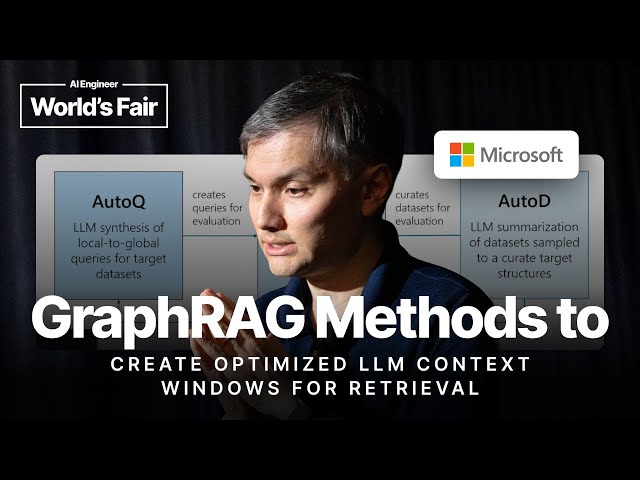
Learn GraphRAG methods for creating optimized LLM context windows in this 15-minute conference talk by Jonathan Larson, Senior Principal Data Architect at Microsoft Research. Discover how graph-based retrieval-augmented generation techniques can enhance the efficiency and effectiveness of large language model context windows for retrieval tasks. Explore the intersection of graph machine learning, LLM memory representations, and LLM orchestration through insights from a researcher whose work has contributed to shipping new features in Bing, Viva, and PowerBI. Gain understanding of cutting-edge approaches that combine graph structures with retrieval mechanisms to optimize how LLMs process and utilize contextual information. The presentation draws from research that has led to open-source tools and libraries, including GraphRAG, providing practical insights into implementing these advanced retrieval methods in real-world applications.

LinkedIn Learning
Prepare for the fourth domain of the Microsoft Cybersecurity Architect SC-100 certification exam. Demonstrate your ability to design a strategy for data and applications.