

Courses
Discover thousands of courses from top institutions and platforms worldwide
Level
Course Type
Duration

Coursera
Preventable patient harms, including medical errors and healthcare-associated complications, are a global public health threat. Moreover, patients frequently do not receive treatments and interventions known to improve their outcomes. These shortcomings typically result not from individual clinicians’ mistakes, but from systemic problems -- communication breakdowns, poor teamwork, and poorly designed care processes, to name a few. The Patient Safety & Quality Leadership Specialization covers the concepts and methodologies used in process improvement within healthcare. Successful participants will develop a system’s view of safety and quality challenges and will learn strategies for improving culture, enhancing teamwork, managing change and measuring success. They will also lead all aspects of a patient safety and/or quality improvement project, applying the methods described over the seven courses in the specialization.

Coursera
How will you know if your patient safety and quality project is meeting its objectives? Peter Drucker once said “What gets measured, gets managed.” In this course, students will learn why measurement is critical to quality improvement work. Equally important, they will learn which data sources provide the most meaningful information and tools for how and where to locate them. Finally, students will learn how to interpret data from their patient safety and quality projects to guide and modify them during implementation to maximize their chances of making a difference for patients.

Coursera
This course provides students with a set of tools and methodologies to plan and initiate a Problem Solving or Quality Improvement project. The first module presents methods for selecting, scoping and structuring a project before it is even initiated. It also introduces the project classifications of implementation and discovery. The second module describes the A3 problem solving methodology and the tool itself. Further in that same module, the student is shown tools to identify problems in flow, defects, and waste and to discover causes, brainstorm, and prioritize interventions. Module 3 shows a methodology within the implementation class. These methods are designed to overcome emotional and organizational barriers to translating evidence-based interventions into practice. The fourth and last module looks at one more way to approach improvement projects in the discovery class. These tools are specifically for new, out-of-the-box design thinking.

Coursera
Now that you’ve carefully planned your patient safety and quality improvement project, the real work can begin. This course will introduce students to the unique challenges encountered when implementing, maintaining, and expanding a patient safety and quality initiative. Students will learn to apply lessons learned from the 4 E model and TRiP into developing specific aims for their QI project. Additionally, students will develop a plan to address the adaptive and technical challenges in their projects including whether their initiative needs to be submitted to an Institutional Review Board (IRB). Finally, students will develop plans to grow their local QI project into a system-wide project.

Coursera
In this course, you will be able develop a systems view for patient safety and quality improvement in healthcare. By then end of this course, you will be able to: 1) Describe a minimum of four key events in the history of patient safety and quality improvement, 2) define the key characteristics of high reliability organizations, and 3) explain the benefits of having strategies for both proactive and reactive systems thinking.

FutureLearn
Explore Taiwan’s health service systems and patient safety Taiwan’s healthcare infrastructure is one of the most efficient in the world. Explore their impressive National Health Insurance (NHI) policy and learn how it provides equitable healthcare access and promotes patient safety on this six-week short course from Taipei Medical University. You’ll discover practical strategies and real-world applications to apply to your healthcare contexts. Evaluate the impact of NHI on healthcare access You’ll gain a comprehensive understanding of how healthcare services are delivered and managed, along with the roles of governmental agencies in shaping Taiwan’s healthcare infrastructure. This knowledge forms the foundation for understanding the successes and challenges within the system. Discover the efficiency and cost-effectiveness of Taiwan’s NHI You’ll then be guided through the single-payer system’s design, implementation, and funding mechanisms that provide universal coverage to all Taiwanese citizens. In delving into the inner workings of this healthcare system, you’ll gain a clearer understanding of how the NHI achieves efficiency and affordability while maintaining high-quality care. You’ll also compare these strategies with other global healthcare systems to glean actionable insights. Understand the mechanisms ensuring patient safety in Taiwan Patient safety is a critical aspect of any healthcare system. Gain further insight into the methods Taiwan employs to maintain high standards of patient safety. You’ll conclude this course by discussing the policies, protocols, and technological advances that help prevent medical errors and enhance overall patient care. By the end of this course, you will thoroughly understand Taiwan’s health service system and acclaimed NHI policy. This course is designed for individuals seeking knowledge in healthcare management, including health policy analysts, healthcare administrators, public health officials, policymakers, as well as anyone interested in learning more about health insurance policy and patient safety practices.

YouTube
Explore patient safety protocols for healthcare professionals in this 22-minute talk by Dr. Sanjay Gupte. Gain insights into the evolving healthcare discipline focused on preventing and reducing risks, errors, and harm to patients in healthcare facilities. Learn about the importance of patient safety in complex healthcare systems and discover strategies to improve care delivery. Understand the critical role of healthcare professionals in implementing safety protocols and mitigating adverse events. Enhance your knowledge of best practices in patient safety to contribute to better healthcare outcomes and patient experiences.

YouTube
Learn about essential intraoperative monitoring techniques and best practices in this educational webinar presented by Andrew Kane for the Association of Anaesthetists of Great Britain and Ireland's series on perioperative care and patient safety. Explore key monitoring protocols and procedures used during surgical procedures to ensure optimal patient outcomes and maintain safety standards throughout operations.

YouTube
Explore key concepts in patient safety and quality improvement through this 19-minute educational video. Learn about medical errors, distinguishing between active and latent errors, and understand adverse events in healthcare settings. Dive into root cause analysis techniques and examine common medication errors. Gain valuable insights with high-yield takeaways to enhance your knowledge of patient safety practices and quality improvement strategies in medical settings.

Coursera
Now that you've been introduced to the world of Health IT and the important role played by electronic health records (EHRs), we'll focus on other technologies that play a role in maintaining ongoing operations in healthcare. Telemedicine, patient portals, barcode scanners, printers, and medical devices are just some of the technologies that impact providers and patients. As an IT support specialist, you’ll be asked to troubleshoot issues with a wide variety of tools. You'll see a scenario with a medical device installation where issues related to IP addresses, networking, and MAC addresses come up. When there are disruptions in technology, you’ll need to use training, tip sheets, and problem-solving skills to determine how best to handle the situation. Supporting a high reliability organization means being familiar with the existing processes and protocols for handling calls, creating tickets, escalating issues, and resolving matters. We’ll introduce you to the concept of self-service tickets and the guidance given to hospital staff on how to submit a ticket. You’ll learn about the different priority levels for tickets as well as the tiers of IT support. When a call comes in, there are some important resources you’ll need to access in order to troubleshoot the problem. These can range from standard question templates to tip sheets to complex matrices and knowledge base articles (KBAs). Having these tools in your arsenal is essential as a Health IT support specialist. We‘ll also cover the JIRA process, the need for excellent documentation, and ways in which requests for change are communicated.

Coursera
In this culminating course in the Patient Safety and Quality Improvement Specialization, you will apply the skills you have acquired across the previous six courses to address a realistic patient safety issue confronting Mercy Grace, a 500-bed urban hospital that is part of a larger hospital system. Based on the scenario provided, you will assess the situation and work through the problem using a variety of tools and strategies. You will have the opportunity to identify defects, root causes, and potential mitigation strategies; you will create a project implementation plan for addressing the issue in the form of an A3; you will identify risks of project failure and design a change management plan; you will identify means of converting the project from local to system-wide; and you will identify quality and safety measurements that will be used in evaluating the success of the project’s implementation.

YouTube
Explore the critical issue of medical errors in this 15-minute TEDx talk by Dr. Suhasani Jain. Gain insights into the human limitations of doctors despite their extensive training, and understand the need for realistic expectations in healthcare. Learn about the profound impact of medical mistakes on patient safety and healthcare quality. Discover the importance of a collaborative approach between doctors and patients to improve overall healthcare outcomes. Benefit from Dr. Jain's 15 years of experience across diverse healthcare sectors, including her expertise in marketing, administration, and strategic planning in the hospital industry. Understand how her background in successful turnarounds and team leadership contributes to her perspective on addressing medical errors and enhancing patient care.

YouTube
Explore the application of Tableau for patient safety analysis in this conference talk from the 2023 SHINE Conference. Learn how Janelle Mirabeau, MSN, RN, CPHQ, utilizes Tableau for inquiry work at Sibley Memorial Hospital. Discover the objectives, get an overview of Tableau, and understand its practical implementation. Delve into the Tableau Data Visualization Site and follow the journey of Mr. Clark as an example. Examine the New Post Fall Debrief process, Epic Post Fall Flowsheet, and Hero Event Report. Gain insights into the Tableau Fall Review and its impact on patient safety initiatives. Enhance your understanding of data visualization techniques in healthcare and their potential to improve patient outcomes.
YouTube
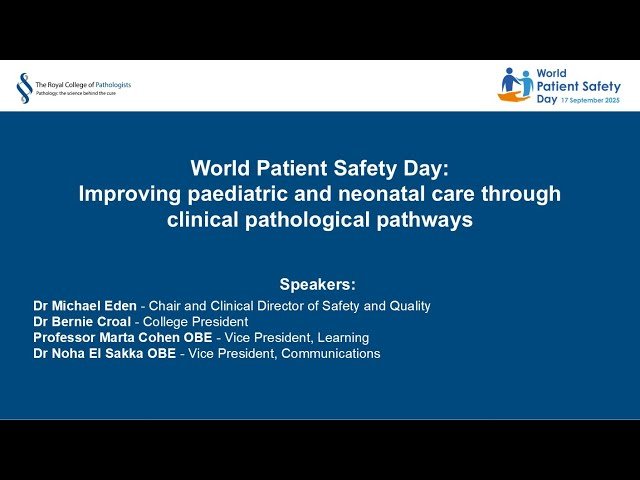
Join this webinar exploring the vital role of pathology in ensuring patient safety for newborns and children, presented in observance of World Patient Safety Day 2025. Examine how clinical pathological pathways directly influence early diagnosis, treatment decisions, and long-term health outcomes for paediatric and neonatal patients through detailed case studies that demonstrate both successful implementations and problematic examples. Learn from expert speakers including Dr Michael Eden (Chair and Clinical Director of Safety and Quality), Dr Bernie Croal (College President), Professor Marta Cohen OBE (Vice President, Learning), and Dr Noha El Sakka OBE (Vice President, Communications) as they share insights on preventing harm, reducing risk, and learning from healthcare errors. Discover how pathology serves as a cornerstone for timely and accurate diagnoses that enable appropriate medical interventions, aligning with this year's World Health Organization theme of 'safe care for every newborn and every child'. Gain understanding of global patient safety initiatives and reflect on actionable strategies that healthcare professionals can implement to enhance safety protocols and improve outcomes in paediatric and neonatal care settings.
YouTube
Learn about breast cancer clinical trials through this 13-minute educational video where Dr. Adrienne G. Waks, associate director of Breast Oncology Clinical Research at Dana-Farber Cancer Institute, provides a patient-friendly overview of what clinical trials are and how they work. Gain essential knowledge about the clinical trial process, understand how these research studies are conducted, and discover what participation might involve for breast cancer patients. Explore the fundamentals of clinical research in oncology, including the structure and phases of trials, patient safety measures, and the role these studies play in advancing breast cancer treatment options.

Coursera
Safety culture is a facet of organizational culture that captures attitudes, beliefs, perceptions, and values about safety. A culture of safety is essential in high reliability organizations and is a critical mechanism for the delivery of safe and high-quality care. It requires a strong commitment from leadership and staff. In this course, a safe culture is promoted through the use of identifying and reporting patient safety hazards, accountability and transparency, involvement with patients and families, and effective teamwork.

Coursera
Keeping patient safety and quality improvement projects on track, on time, and on budget is critical to ensuring their success. In this course, students will be introduced and given the opportunity to apply a series of tools to guide and manage patient safety and quality initiatives. These include tools for defining what success looks like, developing a change management plan, and conducting a pre-mortem to identify risks for project failure. This course will also provide tools for engaging stakeholders to ensure key players are invested in your project’s success.
YouTube
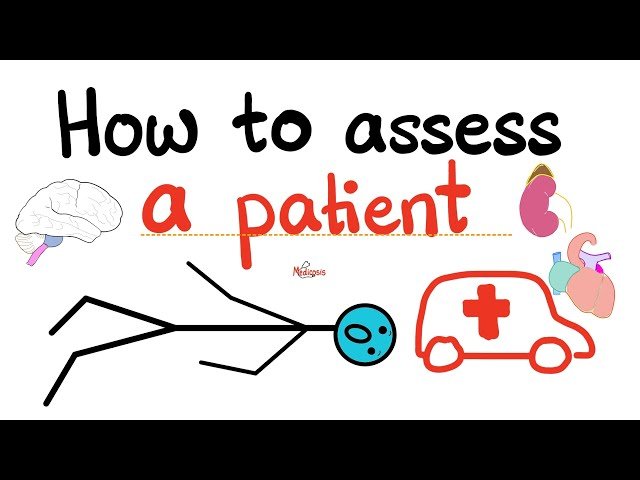
Learn essential techniques for assessing patients in emergency situations as a paramedic, EMT, or EMS professional. This 23-minute video tutorial covers the critical steps of patient assessment and documentation, starting with scene safety evaluation and hazard identification. Discover how to differentiate between trauma cases and medical calls, and master the ABC's (Airway, Breathing, Circulation) approach. Explore methods for examining patients, including vital sign assessment (pulse, arterial blood pressure, respiratory rate, and temperature). Gain insights into determining transport priority using "stay and play" vs. "load and go" strategies. Utilize the SAMPLE acronym for conducting thorough medical history interviews. Enhance your skills in emergency patient care and documentation through this comprehensive guide designed for paramedics, EMTs, nurses, doctors, and other medical professionals.

YouTube
Explore a thought-provoking webinar session on patients' rights, focusing on the right to be heard, grievance redressal, and proper patient referral. Delivered by Prof. (Dr.) Mukesh Yadav as part of a larger event on Patients' Rights & Responsibilities and Safety, this 35-minute talk delves into the crucial aspects of legal authority and regulation in healthcare. Gain insights into the importance of establishing effective systems for addressing patient concerns and ensuring appropriate referrals. Learn how these practices contribute to overall patient safety and the protection of their legal rights within the healthcare system.

YouTube
Learn about the critical intersection of diabetes and cardiovascular disease through a comprehensive cardiology rounds presentation delivered by Dr. Kim Connelly, Staff Cardiologist at St. Michael's Hospital. Explore detailed protocols and safety guidelines for implementing SGLT2 inhibitors and GLP-1 receptor agonists (GLP1RA) in hospital settings. Gain valuable insights into managing diabetic patients with cardiovascular complications and understand the latest evidence-based approaches for using these therapeutic agents effectively and safely in clinical practice. Master the nuances of inpatient diabetes management while considering cardiovascular risk factors and treatment strategies that optimize patient outcomes.