

Courses
Discover thousands of courses from top institutions and platforms worldwide
Level
Course Type
Duration

YouTube
Explore the fundamental principles of risk management in finance through this comprehensive lecture from Yale University's Financial Markets course. Delve into the origins of probability theory and its applications in finance. Learn about key statistical concepts such as measures of central tendency, dispersion, and their relevance to financial analysis. Discover the importance of present value calculations and their historical significance in understanding the time value of money. Examine the Expected Utility Theory and its implications for decision-making in finance. Gain insights into how mathematics and statistics form the backbone of financial theories and risk management strategies. This 69-minute lecture provides a solid foundation for understanding the quantitative aspects of finance and their practical applications in risk management.

Pluralsight
This course presents a complete framework for the oversight, evaluation, mitigation, and monitoring of risks to information technology assets. Effective risk management requires a structured, organized approach that should identify high-value assets, describe their environment, analyze their vulnerabilities and threats, and assess the risks based on likelihood and impact of exploitation. Using a sound basis for risk assessment sets the foundation for risk mitigation and should be an integral part of any information security program.

OpenLearn
The course is the result of collaboration between The Open University and Rolls-Royce PLC. This collaboration has ensured that contemporary theories about risk management are explored within the context of an international company that is required to apply these theories in its business practices.Recent decades have seen an array of news stories where risk management failings have undermined an organisation and dented the credibility of its management. These failings have led to the demise of some companies – for example Lehman Brothers, World Com and Enron. Worse than this in many instances the failings have resulted in deaths and injuries – as with the Piper Alpha oil platform disaster in the North Sea in 1988 or the BP Deepwater Horizon explosion and oil spill in 2010. Successful organisations embed a culture of risk management in all areas of their activities. To achieve this requires effective and practical risk management education. The course particularly benefits all those engaged as risk managers, those seeking to develop their risk management capabilities and those, like board members, who have ultimate responsibility for risks within their organisations. Additionally all those with, or seeking, a career in management in any organisation will benefit from the understanding of risks and how to manage them.This eight-session course examines how to practise good risk analysis and then apply successful processes to manage it. The course is supported by case studies and audio-visual materials to help explain the varied and often complex risk management practices employed at Rolls-Royce and widely elsewhere.TranscriptEnrolling on the course will give you the opportunity to earn an Open University digital badge. Badges are not accredited by The Open University but they’re a great way to demonstrate your interest in the subject and commitment to your career, and to provide evidence of continuing professional development.Once you are signed in, you can manage your digital badges online from My OpenLearn. In addition, you can download and print your OpenLearn statement of participation – which also displays your Open University badge.The Open University would really appreciate a few minutes of your time to tell us about yourself and your expectations for the course before you begin, in our optional start-of-course survey. Once you complete the course we would also value your feedback and suggestions for future improvement, in our optional end-of-course survey. Participation will be completely confidential and we will not pass on your details to others. This course is accredited by the CPD Standards Office. It can be used to provide evidence of continuing professional development and on successful completion of the course you will be awarded 24 CPD points. Evidence of your CPD achievement is provided on the free Statement of Participation awarded on completion.Anyone wishing to provide evidence of their enrolment on this course is able to do so by sharing their Activity Record on their OpenLearn Profile, which is available before completion of the course and earning of the Statement of Participation.

edX
Taught by instructors with decades of experience on Wall Street, the Risk Management Professional Certificate program is a comprehensive survey of the practice of risk management. In this program, you will learn about the major types of risk, risk management tools and techniques and financial regulations. Instructors will work through the annual risk report of a publicly traded financial institution and analyze a number of case studies to illustrate key principles of risk measurement and management. The Risk Management Professional Certificate is broken down into 5 courses: Introduction to Risk Management Measuring Risk: Equity, Fixed Income, Derivatives and FX Risk Management Tools and Practices Stress Testing and Regulation - Part 1 Stress Testing and Regulation - Part 2 The final course in the program will be the Professional Certification Exam. Those participants who pass the examination will receive a Risk Management Professional Certificate from the New York Institute of Finance (NYIF). A NYIF certificate is a valuable addition to your credentials, proving that you have acquired the work-ready skills that employers value.

Coursera
This 4-course Specialization from the New York Institute of Finance (NYIF) is intended for STEM undergraduates, finance practitioners, bank and investment managers, business managers, regulators, and policymakers. This Specialization will teach you how to measure, assess, and manage risk in your organization. By the end of the Specialization, you will understand how to establish a risk management process using various frameworks and strategies provided throughout the program. This program is intended for those who have an understanding of the foundations of Risk Management at a beginner level. To successfully complete the exercises within the program, you should have a basic knowledge of statistics and probability and familiarity with financial instruments (stocks, bonds, foreign exchange, etc). Experience with MS Excel recommended.

YouTube
Explore the unintended risks associated with trusting Active Directory in this 48-minute conference talk from Derbycon 2018. Delve into security descriptors, Active Directory environments, and objects while examining the implications for workgroups and single hosts. Learn about weaponization techniques, persistence methods, and existing misconfigurations. Gain insights into Cobalt Strike and session enumeration as the speakers Lee Christensen, Will Schroeder, and Matt Nel share their expertise on this critical cybersecurity topic.

YouTube
Explore common pitfalls and blind spots in risk modeling with Stanford Professor Sam Savage in this 55-minute webinar. Discover strategies to minimize uncertainties, protect your organization, and foster a thriving risk management culture. Learn to define risk, avoid losses, and leverage Microsoft Excel as a key tool. Gain insights on consolidating risk across an organization. Engage directly with Professor Savage and fellow participants in a special interactive portion. Delve into topics such as limbic analytics, the flaw of averages, uncertainty in various contexts, project management, building models, demand forecasting, cash position analysis, and triangular distribution. Master the art of assessing risk likelihood and improve your overall approach to risk management.

Coursera
This course “FinTech Risk Management” help you understand risk management and corporate governance in finance industry with the disruption by FinTech and RegTech. You will become more confident to analyse and make recommendations to develop business strategies balancing the risks in operation, reputation and the stability of finance firms. You will learn about new challenges of compliance with financial requirements and government regulations and how you can deal with these changes, strategies in analysing FinTech risk and how operation risks increase in finance industry in this changing environment. As tech firms are now becoming more like finance firms such as Alibaba, Apple, and Tencent etc., you will learn about the importance of IT compliance and assurance and practical skills in dealing with these changes.

LinkedIn Learning
Learn how to successfully manage your brand's reputation. Review key reputation risk management concepts and case studies, and discover how to mitigate a reputation crisis.

YouTube
Discover essential forex risk management strategies in this comprehensive video series. Learn about leverage, optimal risk per trade, pip value calculation, position sizing, and common trading risks. Explore drawdown management, effective trade exit strategies, and position sizing techniques to boost profitability. Master money management secrets and determine the appropriate lot size for successful forex trading. Avoid common risk management pitfalls and develop a robust approach to long-term profitability in the forex market.

Coursera
This course provides a comprehensive analysis of project risk management. It begins with foundational concepts and frameworks, progressing to specific steps of risk management, and real-world templates, skills and competencies. The course is designed to equip learners with the knowledge and skills to manage project risks effectively and ensure business success. This course is ideal for Project Managers, Risk Managers, Business Analysts, Management Consultants, Project Team Members, and Team Leaders who seek to enhance their understanding and proficiency in project risk management. To make the most out of this course, learners should have a basic understanding of project management, familiarity with business processes, and the ability to analyze and interpret data. This course is structured to cover some best practices of risk management in a project environment. It will combine the recommendations of leading industry standards such as PMBOK, PRINCE2, and ISO31000 to equip the learners with best-in-class concepts and processes of project risk management.

Corporate Finance Institute
CFI’s Risk Management Specialization builds practical skills to identify, assess, and manage risks in financial institutions. Starting with core risk management principles, the program covers credit, market, and operational risks, along with regulatory compliance and control evaluation. Advanced topics include stress testing, scenario modeling, and Environmental, Social, and Governance (ESG) risk.

edX
In the last decades, the reported damages caused by natural hazards increased tremendously. Flood risk management aims to prevent the loss of properties, assets and life caused by floods. The MOOCs focus is on aspects of flood risk management, forecasting and protection measures. You will learn which concepts exist to protect people from floods having a look at the catchment, the rivers and the settlements at risk. Following the so-called flood risk cycle, prevention, protection and preparation measures are shown. With a focus on Europe, this course aims to summarize the tasks needed to implement the EU Floods Directive. To forecast a flood, hydrological modelling is needed. You will gain understanding about the difficulties of hydrological modelling in flood forecasts as well as about the sources and quantities of uncertainties in the flood chain. Advantages and disadvantages of different hydrodynamic model types are clarified. Furthermore, it is explained how flood hazard and flood risk maps can be evaluated concerning their uncertainties. To prevent the loss of properties or assets, structural as well as non-structural flood protection measures are implemented. These are outlined with practice examples from rural and urban sites. Finally, you learn about the importance of raising risk awareness within a community and different types of precaution. This will help you learning how to create your own ideas and measures to prevent risks related to floods. This course is for anyone interested in flood risk management. It offers basic chapters as well as possibilities for a deeper view.

edX
Cybersecurity risk management guides a growing number of IT decisions. Cybersecurity risks continue to have critical impacts on overall IT risk modeling, assessment and mitigation. In this course, you will learn about the general information security risk management framework and its practices and how to identify and model information security risks and apply both qualitative and quantitative risk assessment methods. Understanding this framework will enable you to articulate the business consequences of identified information security risks. These skills are essential for any successful information security professional. The goal of this course is to teach students the risk management framework with both qualitative and quantitative assessment methods that concentrate on the information security (IS) aspect of IT risks. The relationship between the IT risk and business value will be discussed through several industry case studies. First, you will learn about the principles of risk management and its three key elements: risk analysis, risk assessment and risk mitigation. You will learn to identify information security related threats, vulnerability, determine the risk level, define controls and safeguards, and conduct cost-benefit analysis or business impact analysis. Second, we will introduce the qualitative and quantitative frameworks and discuss the differences between these two frameworks. You will learn the details of how to apply these frameworks in assessing information security risk. Third, we will extend the quantitative framework with data mining and machine learning approaches that are applicable for data-driven risk analytics. You will explore the intersection of information security, big data and artificial intelligence. Finally, you will analyze a series of extended case studies, which will help you to comprehend and generalize the principles, frameworks and analytical methods in actual examples. This offering is part of the RITx Cybersecurity MicroMasters Program that prepares students to enter and advance in the field of computing security.
Corporate Finance Institute
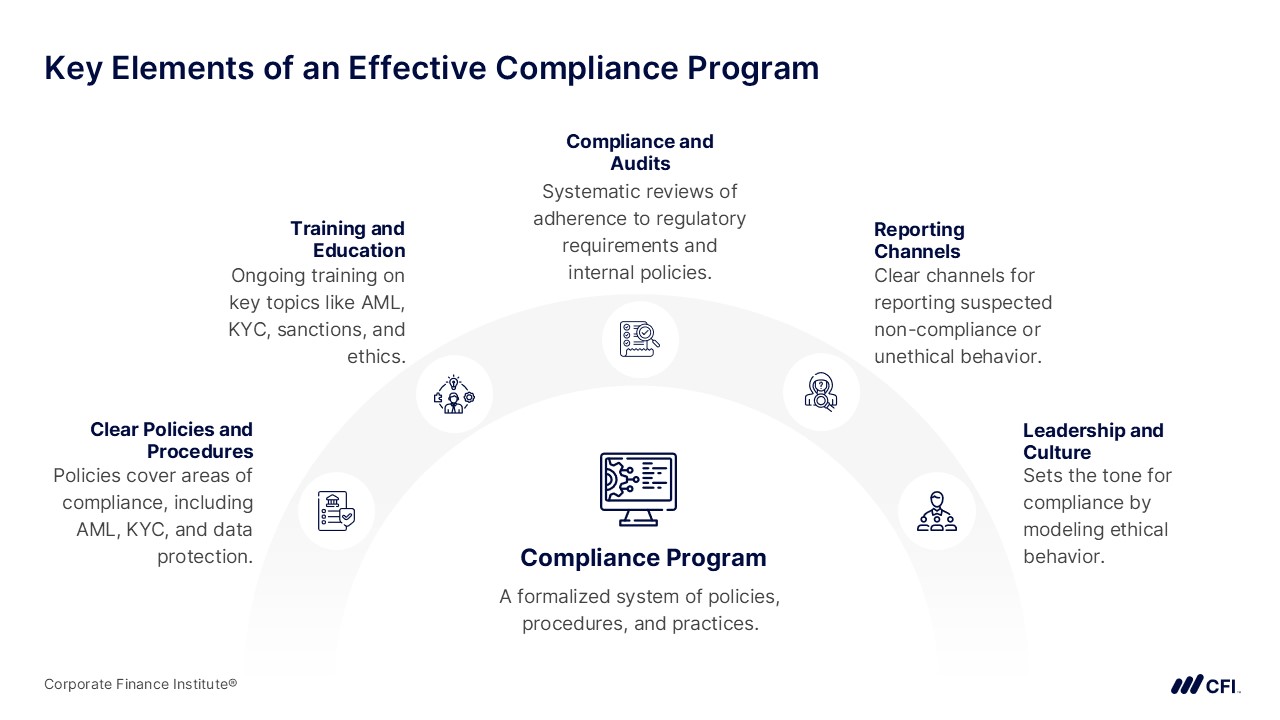
Compliance Risk Management Course OverviewCompliance Risk Management will equip learners with the expertise needed to identify, manage, and mitigate compliance risks within financial institutions. This course explores key areas such as Anti-Money Laundering (AML) and Know Your Customer (KYC) processes, offering a comprehensive understanding of how these frameworks protect institutions from legal and reputational risks.Learners will engage in practical exercises, using examples of real-life compliance risk failures to deepen their understanding. The course also covers essential strategies for maintaining effective compliance programs that adhere to global regulations. By the end of the course, participants will be able to confidently contribute to the implementation of effective compliance programs, ensuring their organizations remain compliant and resilient in a rapidly evolving regulatory environment.Compliance Risk Management Learning ObjectivesIdentify and assess various types of compliance risksList the three stages of money laundering and identify red flags that would enable effective AML detectionDescribe key KYC procedures financial institutions employ to ensure regulatory compliance, including those for Politically Exposed Persons (PEPs)Evaluate and respond to compliance incidents by applying best practices in internal investigation, reporting, and remediation strategies.Who Should Take This Course?This course is ideal for compliance officers, risk managers, and financial professionals responsible for ensuring that their institutions adhere to regulatory standards and manage compliance risks effectively. It is also suitable for senior management and board members who need a deeper understanding of compliance risk to oversee and support their organization’s risk management strategies.Recommended PrerequisitesIntroduction to RiskBasel III and Risk Management

XuetangX
Welcome to the world of Financial Risk Management! This online course is your gateway to mastering the art and science of navigating financial uncertainties. Whether you're a seasoned professional or a budding enthusiast, join us on this educational journey where we unravel the complexities of risk in the financial realm.Financial markets are dynamic, and risks are inherent. Understanding and managing these risks are crucial skills for anyone involved in finance. In this comprehensive course, we cover a wide array of topics to equip you with the knowledge and tools needed to tackle financial risk confidently.The Course starts by building a strong foundation with an in-depth exploration of various financial risks, including market risk, credit risk, and operational risk.We delve into the quantitative side of risk management, learning essential metrics and measurement techniques that are fundamental to making informed decisions. The course gains insights into the world of financial derivatives and discover how these instruments can be used strategically to hedge against risk and optimize returns. We explore the impact of technology on risk management practices, including the use of data analytics and advanced tools to stay ahead in a digitally driven financial landscape.

FutureLearn
Gain a deep understanding of enterprise risk Enterprise risk management involves identifying and preparing for any risks associated with the firm. This company-wide strategy can help increase awareness of business risks and ensure compliance with both regulatory and internal mandates. On this two-week course, you’ll be introduced to the external and internal drivers that can result in a range of operational, financial, and strategic risks in organisations, with a particular focus on the financial. You’ll learn how to mitigate these risks and gain the knowledge to use risk management skills in different contexts. Learn how to develop effective risk management strategies The course is rich in video, explaining concepts of risk. You’ll explore quantitative measurements as well as theoretical and practical approaches to risk management. This know-how will ensure you can suggest methods of developing and implementing appropriate risk management strategies. These skills can be applied to organisations but also used within families and wider society. Explore essential risk analysis tools This intermediate level course examines the role of corporate governance and compliance, you’ll not only learn about the importance of compliance but also how to develop useful risk-management skills. This includes effective tools for identifying, assessing, and quantifying risk. You’ll learn how to use expert judgement to develop business cases for intangible issues, such as potential risk and future rewards, to a level suitable for executive management decision-making. Develop risk mitigation skills alongside industry experts By the end of the course, you’ll have developed essential risk analysis and mitigation skills. In an effort towards continual improvement, the course has been updated utilising learner reviews. This course is designed for anyone interested in learning more about risk management. It is useful for business professionals, new and aspiring line managers, or companies that want to provide employees with risk mitigation and operation management skills. There is a particular focus on financial risk mitigation in the course.

Udemy
Practice of identifying , analyzing, prioritizing and mitigating risks What you'll learn: Gain knowledge an techniques to apply project risk management Project Risk Management (PRM) provides an effective approach to improve decision-making, reduce threats,and increase the probability of the project achieving its cost, time and other objectives This Course provides a basic understanding of risk management concepts and how to identify, analyze, and mitigate risks.Project risk management is the proactive process of identifying, analyzing, and mitigating potential threats and uncertainties that could impact the successful completion of a project. It involves systematically assessing both internal and external factors that may pose risks to project objectives, timelines, and budgets. By anticipating and addressing these risks early on, project managers can develop effective strategies to minimize their impact or exploit potential opportunities. This typically includes steps such as risk identification, risk assessment, risk prioritization, risk response planning, and risk monitoring and control throughout the project lifecycle. Ultimately, effective risk management enhances project resilience, fosters stakeholder confidence, and increases the likelihood of achieving project success.Build a Powerful Knowledge of Risk Management Risk management processesDefinition of risksRisk IdentificationRisk Breakdown StructureHow to create a risk registerQualitative risk analysisQuantitative risk analysisRisk mitigation Course ObjectivesThis course is designed to cover different areas that related to Project Risk Management. I have deigned this course in a simple way that enable you to understand risks and we start the course from early beginning explaining definition of risks andhow to identify , analyze, mitigateand controlrisks.Also I have tried to support the theoretical issues wit practical examples.Bycompleting this course youwill have the knowledge of using tools and techniques to identify , analyze , mitigateand control risks in a professional manner.

Corporate Finance Institute
ESG Risk Management Course OverviewESG has become THE ultimate test of management effectiveness in today’s business arena. Corporate finance teams around the world will face increasing pressures and expectations to guide their organizations through the litany of ESG risks, regulations, and requirements. This course equips you with the knowledge and tactics needed to navigate your organization through these risks and institutionalize a company-wide ESG risk management system. As finance teams become the “unsung heroes” of corporate transformations around the world, this course will give you the capabilities and confidence needed to lead your organization in the ‘age of ESG.’ ESG Risk Management Learning Objectives Upon completing this course, you will be able to: Explain why and how ESG issues present risks to a businessProvide examples of both ESG risk management failures as well as best practicesIdentify and categorize risk types based on company contextDescribe the specific ESG risks facing financial service providersExecute the fundamentals of ESG risk management Who Should Take This Course?This course is essential for financial professionals, corporate leaders, sustainability experts, and policy makers aiming to navigate the evolving landscape of ESG risk management. It offers deep insights into identifying, categorizing, and mitigating ESG risks tailored to the specific needs and realities of various organizations. By mastering these skills, participants will be well-equipped to lead their organizations effectively in the age of ESG, ensuring sustainable, compliant, and resilient business practices.Courses we recommend you take in advance These prerequisite courses are optional, but we recommend you complete the stated prep course(s) or possess the equivalent knowledge prior to enrolling in this course: Introduction to ESG ESG Fundamentals Introduction to Climate Risk Management Corporate Governance

Coursera
By the end of the project, you will learn how to quantify risk-to-reward using Treynor Ratio, and calculate the value at risk for investment portfolio. ATTENTION: To take this course, it is required that you are familiar basic financial risk management concepts. You can gain them by taking the guided project Compare Stock Returns with Google Sheets. Note: This course works best for learners who are based in the North America region. We're currently working on providing the same experience in other regions. This course's content is not intended to be investment advice and does not constitute an offer to perform any operations in the regulated or unregulated financial market