

Courses
Discover thousands of courses from top institutions and platforms worldwide
Level
Course Type
Duration

XuetangX
Nowadays, electronic technology has deeply penetrated all aspects of our life, from home appliances, communication, automobile, industrial manufacturing, aerospace, and electronic technology plays an indispensable role. Therefore, for students in various majors, Electronics and Electronic Technology is necessary. By studying this course, students will acquire the basic theory, knowledge and skills of electrical and electronic technology, which is the key to further study and applications of electronic technology. The course will also introduce the history and application of electrical and electronic technology, which will help students to understand the latest developments and trends in these technologies.Secondly, the course will lay a solid foundation for students' career. Mastering the basics and skills of electrical and electronic technologies will be of great help to their works in any industry. For example, for students majoring in machinery, automobiles and aviation, this course can provide important technical support for their work of product design, manufacturing and maintenance in the future. The course is mainly divided into 8 chapters: Knowing DC circuit, knowing AC circuit, first aid for electric shock, installing power system for single-family housing, installing low-voltage distribution box, disassembling small-sized triple-phase asynchronous motor, installing basic control circuit of triple-phase asynchronous motor, making electronic device with rectifying element.

Swayam
It is a core course for all UG Electrical Engineering students. The content of this course is also aligned to the syllabus for the GATE EE exam. The course has two halves: (1) Electrical Measurements (6 weeks): Working principle and Dynamics of different electro-mechanical instruments, ammeter, voltmeter, ohmmeter, wattmeter, energy meter, measurement of resistance and impedances, bridges and potentiometers, Instrument transformers. (2) Electronic Instruments (6 weeks): Differential amplifier, op-amp circuits, Analog DC and AC instruments, ADC and DAC, Digital instruments, function generator, oscilloscope Find details below INTENDED AUDIENCE: Mainly Electrical Engineering, Instrumentation Engineering Also interested students from Electronics, Physics and similar disciplines PREREQUISITES: Basic Principles of Electrical Engineering (Circuit Theory), Basic Digital and Analog ElectronicsINDUSTRY SUPPORT: Must for Power generation industry, Power distribution industry, Electronics industry Also highly required for Automotive industry, Rail industry, Aerospace industry, Telecommunications industry, Oil and gas industry, Construction industry, Defense industry, Marine industry, Materials and metals industry

Udemy
Understand the Basic Concept of Electrical and Electronics Components What you'll learn: Identify the Current, Voltage, Energy and PowerIdentify the Diode and TransistorIdentify the Ohm's law and Kirchhoff LawIdentify the Resistor, Inductor and CapacitorAnd ........ so much more! Dear Student,Are you preparing for an interview in the electronics and electrical industry? Don’t be stressed; take our Electrical Engineering Course and prepare yourself for your interview. In this course, you will understand the basic concepts of electrical engineering.WHAT IS FOR YOU?Knowledge of electrical and electronic systems is extremely valuable nowadays! In this course, you will understand the basic concepts of electrical and electronic components.Here, you understand the basic concepts of current, voltage, energy, and power.Here, you understand the resistor, capacitor, and inductor.Here You Understand the Diode and Transistor Here, you understand the main laws governing currents and voltages in circuits, which are Ohm's Law and Kirchhoff Circuit Law.In each module, you understand the theoretical and practical concepts of the component.What is different about this course?In the present day, most of the material and courses available online tend to be high-level and focused on applications. The main goal of this course is to explain the fundamental concepts of electrical and electronic engineering so that you understand how circuits work. Every topic is addressed, starting with the basic workings of the component, and only later is the acquired knowledge used to explain how to design more complex circuits for different applications. In this way, you understand everything about that topic.I will be here for you every step of the way. If you have any questions about the course content, you can always post a question in the course or send me a direct message.100% MONEY-BACK GUARANTEEThis course has a 30-day money-back guarantee. Without any delay, sign up now and take this course. Let's get started.CHEERS!Go ahead and click the enroll button.
Swayam
Learn the core principles of electrical and electronics engineering through this comprehensive 8-week course covering fundamental concepts, circuit analysis, electronic components, and practical applications. Explore basic electrical laws including Ohm's law, Kirchhoff's laws, and power calculations while mastering DC and AC circuit analysis techniques. Delve into semiconductor physics, diode characteristics, transistor operations, and amplifier circuits to understand electronic device behavior. Study digital electronics fundamentals including Boolean algebra, logic gates, combinational and sequential circuits. Examine electrical machines, transformers, and power systems to grasp energy conversion principles. Gain hands-on experience with circuit simulation tools and laboratory experiments that reinforce theoretical concepts. Develop problem-solving skills through practical exercises involving circuit design, component selection, and system analysis. Build a solid foundation for advanced studies in electrical engineering, electronics engineering, or related technical fields.

Udemy
This course will give you everything you need to start playing with electronics components and fix electronic devices What you'll learn: Understand the concepts of voltage, resistance and currentUnderstand the VOLT OHM Meter/ Digital Multi Meter and how to use safelyUse Ohm's Law to calculate voltage, current and resistanceUse resistors in various configurationsUnderstand and use capacitorsUnderstand and use diodesUnderstand and use a transistor >>> This Electronic & Electrical Devices Maintenance & Troubleshooting course is intended for those interested in learning electronics and electrical devices and board troubleshooting. 56 Lecture | 4.5 Hour of HD Content | 2 Hour of Practical Videos | Electronic Maintenance Book | Practical Electronics and Electrical Test>>> Continues Updates Why you should take this course?Learn how to fix electronic devicesLearn about electronic componentsGet a better understanding of electronicsLearn how to design circuitsLearn how to solder components onto a circuit boardAble to read schematic diagrams What you will get when you join this course?More than 4 Hours of Practical Videos Access to Electronic and Electrical Practical Test Course | Usually price 200$Access to our Best Selling Amazon Book (Basics of Electronic Components Book) and How to deal with each item| Usually price 50$Access to more than 56 Lecture in Full HD Access to More than 4.5 Hour of Video Content A comprehensive Course that helps you in learning and dealing professionally with electronic components and electronic device maintenance. Welcome to this course.Topics that we will be discussed during the Introduction to Electronic Components Course are listed here in a brief outline. What do you need to start troubleshootingTools needed to get the job done Common electrical and electronic ComponentsTroubleshooting stepsMasure concerns and how to deal with different situationsTesting tools and how to test different componentsThe Components of ElectricityVolt-Ohm-Meter Basics (Measuring Electricity)Circuit Diagrams Basics (Electronic Roadmaps)The ResistorOhm’s LawThe CapacitorThe InductorThe DiodeThe Transistor (Electronic Valves) What students are saying about our previous Electronic Component Course:André stenberg says, "This is a nice introduction course to those who would like to learn the basics of electronics."Mike Mackley says, "It's covering the topic and establishing the basics very well."Sunil Thakur says, "Great course for beginning in electronics, especially enjoyed the water analogy part to make learning easier."Qays Qaysaneah says, "Clear and Simple, and that is so nice :)"

XuetangX
Fundamentals of Electrical Engineering and Electronic Design is a highly applied professional platform course. The main purpose of the course is to enable learners to master the basic theories, fundamental knowledge, and essential analytical and problem-solving methods of various major branches of electrical and electronic technology. It aims to empower learners to use electrical and electronic theories to construct circuit models from practical problems, choose appropriate solving methods, and quickly find optimal or satisfactory solutions using software. Through training students in practical (electronic) circuit design, the course cultivates their overall thinking and application awareness in electronic circuit design, enhances learners' abilities to analyze and solve real-world problems, and lays a solid foundation for further study in subsequent courses.

YouTube
This video features current students and recent graduates explaining what Electrical and Electronic Engineering (EEE) is, what they enjoy about studying it, and the career opportunities it offers. Discover the fundamentals of EEE through firsthand accounts from those who have chosen this educational path. Learn about the practical applications, challenging coursework, and diverse career trajectories available to EEE graduates. The video serves as an informative guide for prospective students considering this field of engineering, providing authentic perspectives on the educational experience and professional outcomes.

Udemy
Numericals on Fundamentals of DC Circuit Analysis What you'll learn: Initial, Final (Steady) State conditions & Applications of Laplace Transform in Circuit Analysis (Number of Lectures: 12)Resonance (Number of Lectures: 15)Application of KVL, KCL and Network Theorems in Electronics Circuits (Number of Lectures: 15)Two Port Networks (Number of Lectures: 25) OBJECTIVES1. Calculate the Laplace transform of common functionsusing the definition and the Laplace transform tables2. Laplace-transform a circuit, including components with non-zero initial conditions.3. Analyze a circuit in the s-domain4. Check s-domain answers using the Initial Value Theorem and Final Value Theorem.5. Inverse Laplace-transform the result to get the time-domain solutions; be able to identify the forced and Natural response components of the time-domain solution.6. Become familiar with the Frequency Response of Series Resonant Circuits and how to calculate the Resonant frequency.7. Be familiar with the terms Bandwidth and Quality factor.8. Demonstrate an understanding of the impact of Quality Factor on the Frequency Response of a Series or Parallel Resonant Circuit.9. To understand about Two – Port networks and its functions.10. To understand the different between z- Parameter, y-Parameter, ABCD- Parameter.11. To investigate and analysis the behavior of Two – Port networks. Downloadable document added for each topic to increase understanding and for future reference.2 quizzes added at the end of the course to test your understanding of each topic.Intended Outcomes for the course: Upon completion of the course students should be able to:1. Apply knowledge of Mathematics, Science and Engineering to the analysis and design of electrical circuits.2. Identify, formulate and solve engineering problems in the area Circuits and Systems.3. Analyze the solution and infer the authenticity of it.4. Differentiate One Port and Two Port network devices.5. Calculate two port network parameters such as z, y, ABCD and Hybrid Parameters for given electrical network.6. Simplify the complex network such as Cascade, Parallel networks using fundamental two port network parameters.7. Find the various Driving point & Transfer functions of Two Port network8. Obtain transfer functions of circuits and analysis of stability using poles of the transfer function9. Analyze the frequency response of circuits and to obtain the correlation between time-domain and frequency domain response Specifications10. Describe how resistance and the L/C ratio affect the graph of current versus frequency for a series-resonant circuit.11. Calculate Capacitor, Inductor, and Resistor voltages at Resonance in a Series-Resonant circuit.12. Calculate the bandwidth of a resonant circuit and describe how the quality factor Q affects the sensitivity and selectivity of a series-resonant circuit13. Draw the graph of impedance, total current and output voltage versus frequency for a parallel-resonant circuit.14. Describe the effect that the internal resistance of the source has on the selectivity of a parallel-resonant circuit.

Udemy
Start your career in electrical & electronics engineering by learning everything about electric circuits and electronics What you'll learn: Electrical Engineering fundamentalsElectronics fundamentalsWhat are electric circuits and electronics and the fundamental quantities in circuits like voltage and currentThe differences between direct current (DC) and alternating current (AC)What resistors, capacitors, and inductors are and how they are used in electric circuits and electronicsSources of electricity in electric circuits and electronicsSimplification of resistive, capacitive, and inductive circuitsBasic electric circuit analysis techniques using Kirchhoff's voltage and current laws, nodal analysis, and loop analysisAdvanced electric circuit analysis techniques such as the superposition theorem, Thévenin's theorem, and Norton's theoremAnalysis of first-order electric circuits during transientsElectric circuit analysis techniques used in different electrical engineering and electronics engineering fields, such as analog electronics, digital electronics, and power electronicsElectric circuit analysis techniques needed for developing electronics with development boards such as the Arduino or Raspberry Pi This course is designed to provide a complete overview of electric circuit analysis used in electrical engineering and electronics engineering. Electric circuit analysis is the most fundamental concept for electrical engineering, electronics engineering, and computer engineering. It is for that reason that electric circuit analysis is usually the first course taught in electrical, electronics, and computer engineering programs at universities, as basically anything related to electrical, electronics, or computer engineering stems from electric circuit analysis.In this course you will learn everything about electric circuits and electronics, from the basics such as what an electric circuit is and the fundamentals of electrical quantities like voltage, current, and power, all the way to complex techniques for analyzing electric and electronics circuits. The course is roughly divided into the following sections:1. Fundamentals of Electric Circuits and Electronics: in sections 2 and 3 of the course, we will discuss what an electric circuit is at the most basic level, followed by explanations of electrical quantities and sources of electricity. This is the foundation for electrical engineering and electronics engineering.2. Basic DC Electric Circuit Analysis: in sections 4, 5, and 6 we will discuss the analysis of direct current (DC) circuits, starting from basic analysis techniques such as Kirchhoff's voltage law and Kirchhoff's current law (KVL and KCL), voltage division, current division, nodal analysis, and loop analysis. We will also be discussing how complex resistive circuits can be simplified into equivalent circuits for easier analysis of electric circuits and electronics.3. Advanced DC Electric Circuit Analysis: in section 7, we will discuss advanced analysis techniques for electric circuits and electronics such as the superposition theorem, Thevenin's theorem, and Norton's theorem.4. Energy-Storing Devices in Electric Circuits and Electronics: in sections 8, and 9, we will discuss passive components in circuits that are able to store energy: capacitors and inductors. We will cover the fundamentals of capacitors and inductors, how they store energy, and how to simplify complex circuits containing combinations of capacitors and inductors into simpler circuits for easier analysis of electric circuits and electronics.5. Transients in Electric Circuits and Electronics: in section 10, we will discuss the analysis of first-order electric circuits during transients. This is where things start getting a bit more advanced, but we will solve several examples to illustrate how circuits behave during transients, as opposed to the stead-state circuits previously discussed.In each section, several examples are solved to illustrate how to analyze practical circuits.By learning all the fundamentals about electric circuit analysis and electronics, you will be able to continue studying other topics in electrical engineering, electronics engineering, and computer engineering, such as analog electronics, digital electronics, circuit design, electric machines, power systems, and more. Remember that Udemy offers a 30-day money-back guarantee. I am also always available for questions while you go through the course to ensure everything is clear.See you in the course!

Udemy
Learn the most important aspects and methods for designing safe electrical and electronics products and applications. What you'll learn: Understand electrical product safety concepts, classifications and terminologyUnderstand the most important electrical safety requirements for an electrical/electronics product design projectUnderstand the concepts of clearance, creepage and solid insulation and be able to design the related safety measuresUnderstand the importance of critical components and be able to verify if such components are properly certified/approved. Examples with transformers and capacitorsUnderstand IP protection against ingress of water and solid parts and properly choose the best solution for a particular designBe able to draw insulation diagrams, a very important tool for product development, in order to represent the insulation strategy and the product complianceBe able to find and use technical international standards with respect to electrical products safetyUnderstand where the safety aspect learned in the course belong in the product design/development lifecycleExamples with households appliances designProperly set clerance and creepage values in PCB design CADs, like Eagle Layout PCB Design software (contents applicable also to other CADs software) What students say about this course: "This course is very informative. As electrical engineer, I am honestly getting valuable information through this program. COURSE WAS EXCELLENT BOTH IN PRESENTATION AND PACKAGE", Ivwionoku "Great info on standards, where to get them and how to implement them practically in CAD!", Alvaro "Great details on safety aspects of products with clear methodologies of design using informative examples. Thank you so much!", Pramit Last Update: ******** October 10th, 2016 - Added a section on how to set and check clearance and creepage in a PCB Design CAD Software.Section name "PCB CAD/CAM SOFTWARE - CLEARANCE AND CREEPAGE" ******** Published in May 1, 2016 ******** Course Description Being a capable electronics designer does not make you a good one. Being an expert in Arduino,Raspberry, firmware, embedded softwareand microcontrollers,hardware, PCB design, digital and analog design, is only a part of what designers need to know. A beautiful and functional product can be appealing, but if basic safety rules are not taken into account even before starting the actual design activities, a poor design can endanger people and cause its designer big troubles. This course focuses on design safety with respect to electrical/electronics application, including PCB design. It covers the most important aspects that designers need to know, and it teaches a general methodology to develop electronics and electrical applications (including PCB) in compliance with safety principles and international standards. +++++ Have a look at the course curriculum +++++ At the end of the course: you will be able to find in international standards and understand the applicable electrical safety requirements foryour electronics projectyou will be able to calculate the most important parameters like clearance/creepage distance and solid insulation, to be considered during insulation, electronics and PCB designyou will be able to set and check creepage and clearance on PCB CAD/CAM Softwareyou will be able to choose the proper IP isolation against ingress of water and solid particles you will be able to choose critical electronics components and verify their certifications you will know what insulation diagrams are and how to make and use them you will know what international standards are, how they are made and where you can find them and you will understand the design process and steps toward a compliant product so basically you will be able todesign a functional, safe and ready for the market electrical application. HAVE A LOOK AT THE LESSONS AVAILABLE FOR FREE IN THE COURSE CURRICULUM !!! We will introduce the basic concepts and techniques of electrical, electronics and PCB design for safety, teaching you the path to a project compliant with product safety legislation. We will cover both basic electrical definitions like the product classification and more advance conceptslike creepage calculation and critical electronics components. Throughout the course you will find practical examples on how to use these techniques on electrical and electronics household appliances design (e.g. food mixers and electric toasters), and also how to set some parameters in a CAD/CAM Software for PCB design. We will take as a reference the most important andrecognised international safety standards, like IEC 60335 series, IEC 60529, and the like. The last section will be dedicated to describe the whole design process, from the design specifications to final verification and validation, with a practicalexample on an electric toaster design. ------------------------------------------------------------------ The course is made essentially of video lessons, but reference to guidelines and datasheets are provided, when considered useful. You will alsofind severaltests. We strongly recommend to take the tests before proceeding to check the concept you have learned. If you really wantto understand the safety related part of an electrical/electronics and PCB designand complete your technical culture with this important cornerstone, this course is a must. HAPPY LEARNING!!!

Udemy
The largest and most comprehensive bundle on power electronics and electrical protection for electrical engineering What you'll learn: Understand definition of power electronicsRealize different applications of power electronicsKnow different types of convertersKnow different categories of power electronic devicesUnderstand different losses associated with power electronicsDifference between ideal and practical switchUnderstand different factors when selecting the power electronic deviceUnderstand how diode worksUnderstand the diode V-I CharacteristicsLearn about different types of diodesLearn how a thyristor worksUnderstand thyristor V-I characteristicsUnderstand different operating states of thyristorKnow the latching and holding current of thyristorUnderstand different types of thyristorLearn how fully controlled switch worksUnderstand different types of fully controlled switchesUnderstand why GTO is the king of power electronicsUnderstand how rectifier worksLearn Different Types of Rectifiers for Single PhaseLearn about Half Wave Rectifier R load for both controlled and uncontrolledLearn about Half Wave Rectifier R-L load for both controlled and uncontrolledLearn about Half Wave Rectifier R-L load for both controlled and uncontrolled with Free wheeling DiodeUnderstand the Usage of Freewheeling DiodeUnderstand the Principle of Firing angleUnderstand the Biphase RectifierUnderstand the fully , half controlled and uncontrolled Bridge RectifierUnderstand the Performance Parameters for Rectifier CircuitLearn about the Power FactorLearn about the Firing Circuit UJTUnderstand the Protection of Power Electronic devices Against Over-current,Over-Voltage and Transient state.Understand the Series and Parallel DiodesLearn the Isolation of Firing Circuit using Pulse TransformerLearn the Isolation of Firing Circuit using OptoCouplerUnderstand the definition of AC chopperAnalyze the AC chopper R load circuitLearn the AC chopper L load circuitAnalyze the AC chopper R-L series load circuitUnderstand the AC chopper R-L parallel load circuitAnalyze the AC chopper Capacitive load circuitUnderstand the integral cycle controlLearn how to use AC chopper in transformer tap changingLearn the applications and disadvantages of AC choppersAnalyze the AC chopper loaded by AC MotorDefinition of DC choppersApplications of DC choppersUnderstand step down DC chopper with R-load.Generation of duty cycleStep down DC chopper with R-L-E loadStep up DC chopper R or R-L loadStep up DC chopper with RE loadBuck regulatorBoost regulatorBuck-boost regulatorDefinition of inverterImportance and applications of invertersAnalysis of single phase half bridge R-loadAnalysis of single phase half bridge RL-load.Performance parameters of an inverterAnalysis of single phase bridge R-loadAnalysis of single phase bridge RL-load.Understand the three phase inverters and obtaining the line voltages and phase voltages.Single pulse width modulationMultiple pulse width modulationIndustrial invertersSinusoidal pulse width modulationsimulation using MATLAB of single-phase half wave controlled rectifiersimulation using MATLAB of single-phase bridge controlled rectifiersimulation using MATLAB of single-phase AC chopper with R and RL loadsimulation using MATLAB of DC-DC converter as a buck regulatorsimulation using MATLAB of boost regulatorsimulation using MATLAB of buck-boost regulatorsimulation using MATLAB of single-phase half-bridge invertersimulation using MATLAB of single-phase bridge invertersimulation using MATLAB of three Phase InverterOverview on the PLC hardware configurationOverview on types of inputs and outputs in PLCAdvantages of using PLC over classic controlOverview on different PLC programming languagesDiscuss the important symbols in PLCDefinition of PLC scan cycleUsage of markers in PLCUnderstand types of timers and counters in PLC and how to use themDo tasks in batch simulatorDo tasks in silo simulatorDo tasks in door simulatorDo tasks in I/O simulatorDifferent components of the electrical protection systemZones of protection of electrical systemsTrip circuit of electrical systemPrimary and backup protectionCharacteristics of measuring the relay performanceFault clearing time and time lag in electrical protectionDifferent types of relaysDirectional power relay and its applicationsDefinition of overcurrent protectionSettings and applications of overcurrent protectionDistance protection in electrical systemsConstruction and operation of a distance relayPlain impedance relayOperating characteristics and R-X diagram of an impedance relayStepped distance protectionTransmission line protection and directional impedance relayModified impedance-type distance relayReactance-type distance relayMho or admittance distance relayPrinciple of operation and selection of low voltage circuit breakersPrinciple of operation of earth leakage circuit breaker or residual current CBSelection of medium voltage circuit breakersTypes of low voltage and high voltage fusesTypes of differential protectionCurrent balance differential protectionVoltage balanced differential protectionPercentage differential current relay "Ultimate Power Electronics and Electrical Protection for Electrical Engineering" This magnificent 51-hour course will help you have a kick start in power electronics including rectifiers, AC choppers, DC choppers, and inverters. In addition to the basics of electrical protection such as overcurrent protection, differential protection, distance protection, circuit breakers, and fuses. Throughout the power electronics course, you will learn: The applications of power electronics and the definition of a power electronic circuit.Different types of switches such as diodes, thyristors, GTO, BJT, IGBT, Mosfet, etc.The different AC/DC converters (rectifiers) such as half-wave and full-wave rectifier single-phase circuits in uncontrolled, half, and fully controlled bridges. In addition to the different three-phase rectifier circuits.AC chopper circuits or AC/AC converters in the case of R load, L load, RL parallel, RL series load, and capacitive loads. In addition to the integral cycle control of an AC chopper.DC choppers or DC/DC converters such as the step-down DC chopper with R and R-L-E load, and the step-up DC chopper with R, RL, and RE loads. Moreover, the buck, boost, and buck-boost regulator circuits.Inverter or DC/AC converters including single-phase half-bridge R-load, single-phase half-bridge RL-load, single-phase bridge inverter R-load, single-phase bridge inverter RL-load, and the three-phase inverters. Furthermore, the single, multiple, and sinusoidal pulse width modulations. You will learn also the simulation using the MATLAB Simulink program: Single-phase half-wave controlled and bridge-controlled rectifiers.Single-phase AC chopper with R and RL loadDC-DC converters such as buck, boost, and buck-boost regulators.Single-phase half-bridge, bridge inverters, and three-phase inverters. Throughout the electrical protection course, you will learn: The different components of the electrical protection system, zones of protection, the trip circuit of the electrical system, the primary and backup protection, and the fault clearing time.The different types of relays such as directional power relays, overcurrent relays, distance relays, plain impedance relays, directional impedance relays, modified impedance-type distance relays, reactance-type distance relays, Mho or admittance distance relays, and more.The principle of operation and selection of low-voltage circuit breakersThe principle of operation of earth leakage circuit breaker or residual current CBThe selection of medium voltage circuit breakersThe types of low voltage and high voltage fusesSizing of breakers, fuses, and disconnecting switches for motors, non-motor applications, and much more according to the NEC In addition to the LogixPro course: This is the only course out there that can teach you the basics of PLC programming with fun and awesome simulations. Logixpro program is an interesting and useful simulator for the simulation of different procedures such as moving belts, garage openings, and closing, a mixer that consists of a tank in addition to some pipes of different liquids, and many more!This program helps learn ladder programming and PLC with an easy and interactive simulation method. Bonus Gift: ​You will also get the slides for the Ultimate Power Electronics and Protection bundle for those who are interested in them or having them as a revision for themselves More than 250 Pages of Rectifiers and Basics of Power Electronics45 Pages of AC Choppers 78 Pages of DC Choppers 90 Pages of Inverters 153 Pages of Electrical Protection36 Pages of NEC Sizing for Overcurrent and Overload26 Pages on Breakers and Fuses72 Pages on Disconnect Switches Take this bundle if you've been looking for ONE COURSE BUNDLE with in-depth insight into power electronics, electrical protection, and PLC basics.

Udemy
Fundamentals of Electricity & Electric Circuits for Electronics - Circuit Design - Electrical Engineering What you'll learn: Fundamental concepts in DC Electric and Electronic CircuitsThe SI System of UnitsDifferent Quantities in Electric CircuitsComponents of Electric CircuitsPassive Sign ConventionSeries and Parallel ConnectionsIndependent and Dependent SourcesOhm's LawKirchoff's Current and Voltage LawsPower CalculationsAnd ........ so much more! Start understanding and Solving basic Electric Circuits easily and confidently!If you are looking for a course that will help with your understanding of Electric Circuits and basic Electrical Engineering concepts, this course is for you. Electric Circuit are the fundamental building blocks of all Electrical and Electronic Systems, and you definitely need a solid understanding of these concepts to advance in anything Electrical in nature. This full course is the best way to jump right in and start understanding/solving Electric Circuits confidently, like never before. What makes me qualified to teach you Electric Circuits?Igraduated from one of the top-5 Electrical Engineering programs in the US, and I have 10+ years of teaching Electrical Engineering courses as a University Professor, and I have put together this Electric Circuits class. I am a best-selling instructor of top-rated courses that get great reviews such as:An incredible learning experience. The instructor is very clear and easily understood. - Walter SimmonsTeaching by an expert teacher. - Abdulkadir CabuğaExcellent! I couldn't ask for a better tutorial on whiteboard animations. The course is very thorough, and provides enough practice activities to apply the skills. - Shamuel My Promise to You:I'll be here for you every step of the way. If you have any questions about the course content or anything related to Electric Circuits, you can always post a question in the course or send me a direct message. This course will cover everything you need to know about Electric Circuits:The SIUnits and Electric QuantitiesElectric Circuits and Circuit Analysis Passive Sign ConventionPower And EnergyIndependent and Dependent SourcesOhm's LawKirchoff's Current & Voltage LawsPower CalculationsNodes, Branches, Loops and MeshesSeries and Parallel ConnectionsSolving Circuits with Dependent SourcesSolving Linear Equations for Electric CircuitsSo much more!BONUS: As a bonus, you'll receive supplemental video lessons about solving Simultaneous Algebraic Equations, Matrices, etc.By the end of this course, your confidence in dealing with Electric Circuits will soar. You'll have a thorough understanding of how to solve basic Electric Circuits.Go ahead and click the enroll button, and I'll see you in lesson 1!Cheers, Kashif
Independent
The Penetration Tester Job Role Path is for newcomers to information security who aspire to become professional penetration testers. This path covers core security assessment concepts and provides a deep understanding of the specialized tools, attack tactics, and methodology used during penetration testing. Armed with the necessary theoretical background and multiple practical exercises, students will go through all penetration testing stages, from reconnaissance and enumeration to documentation and reporting. Upon completing our first job role path, you will have obtained the practical skills and mindset necessary to perform professional security assessments against enterprise-level infrastructure at an intermediate level. The Information Security Foundations skill path can be considered prerequisite knowledge to be successful while working through this job role path.
Swayam
This is a core course for the students enrolling for Diploma in Electrical & Electronics Engineering. Power electronics is the application of electronic switching devices for efficient conversion and the control of electrical power. This course will introduce Thyristor family devices and their applications in industrial control circuit.

FutureLearn
Explore electronic and electrical engineering systems The UK electronics industry is one of the largest in the world, helping produce technological solutions for the evolving needs of our society. Developed by the UK Electronics Skill Foundation and the University of Birmingham, this three-week course will introduce the fundamentals of electronics in preparation for university or an apprenticeship. Examine electronic components and their applications Using real-world examples, you’ll begin the course by exploring electronics at a component level, learning how transducers sense vibrations in musical instruments. You’ll assess circuit models and, using electronic theory, analyse sensor circuits and design your own, gaining practical experience of work as an electronic engineer. Discover how electronics are used in extreme conditions Moving from the everyday to the extraordinary, you’ll examine how electrical power is used both in daily life and to control systems in space. You’ll learn how to power a satellite and explain how transducers convert energy from electromagnetic radiation into electricity. With these skills, you’ll be able to plan functioning systems in target environments, appreciating the interdisciplinary nature of engineering. Investigate a real world control system in action In the final week of this course, you’ll explore digital electronics and their applications in railway systems engineering. Featuring technology from the Birmingham Centre for Railway Research and Education, you’ll assess the implementation of platform shield walls to enhance railway safety procedures. By the end of this course, you’ll have begun to explore the broad subject of electronic engineering and have gained insights into the potential areas of study you could pursue when studying electronics in higher education. This course is designed for sixth formers who are considering studying electronic engineering at university or college.

edX
This course introduces fundamental topics in electrical and electronic engineering including a broad range of examples. Topics covered are solar cells (batteries) and portable cell phones, applications from Japanese companies, including the high-speed railway, plus advanced research being performed at high-tech laboratories in Japan. The topics covered range from introductory materials to fundamental research and their practical applications. There are two lecture videos on each topic. The lecture at the top of the page is in English (dubbed using Google text to speech API), contains slides in English and closed captions in English. The lecture below is given in Japanese with English transcripts. All materials (slides, quizzes and final report) are provided in both Japanese and English. 本コースでは,電気・電子工学の基礎的な内容を、幅広い事例を交えて紹介します。太陽電池や携帯電話、高速鉄道などの日本企業での応用事例や、日本の先端研究所で行われている先進的な研究を取り上げます。このコースを受講することで,本大学の教員や日本の産業界で活躍する技術者から電気電子工学全般についての知識を得ることができます。扱うトピックは、入門的な教材から、基礎的な研究、そしてその実践的な応用という流れに沿ったものとなっています。各トピックには2つの講義動画があります。ページの一番上の映像の講義は英語(Google text to speech APIを使用した吹き替え)で、英語のスライドと英語のクローズドキャプションが付いています。その下の講義は日本語で行われ、英語のトランスクリプトが含まれています。すべての資料(スライド、クイズ、最終レポート)は日本語と英語の両方で提供されています。

MIT OpenCourseWare
6.622 covers modeling, analysis, design, control, and application of circuits for energy conversion and control. As described by the Institute of Electrical and Electronics Engineers (IEEE), power electronics technology "encompasses the use of electronic components, the application of circuit theory and design techniques, and the development of analytical tools toward efficient electronic conversion, control, and conditioning of electric power." Students taking this class will come away with an understanding of the fundamental principles of power electronics, and knowledge of how to both analyze and design power electronic components and systems.
Swayam
Power electronics is a vital field of electrical and electronics engineering that deals with the conversion, control, and management of electrical energy using semiconductor devices. Learning power electronics is important for Efficient Energy Conversion. Power electronics enables efficient conversion of electrical energy from one form to another, reducing energy losses in power systems, renewable energy applications, and consumer electronics. It is at the heart of electric vehicle (EV) technology, controlling battery management, motor drives, and charging systems. Advancements in this field improve the efficiency, performance, and range of EVs. Many industrial applications, such as motor drives, robotic systems, and automated machinery, rely on power electronic converters and controllers to ensure precise and efficient operation. Learning power electronics is crucial for anyone interested in energy systems, electric vehicles, automation, and modern technology. As industries continue to evolve, expertise in power electronics will remain essential for innovation and sustainable development.
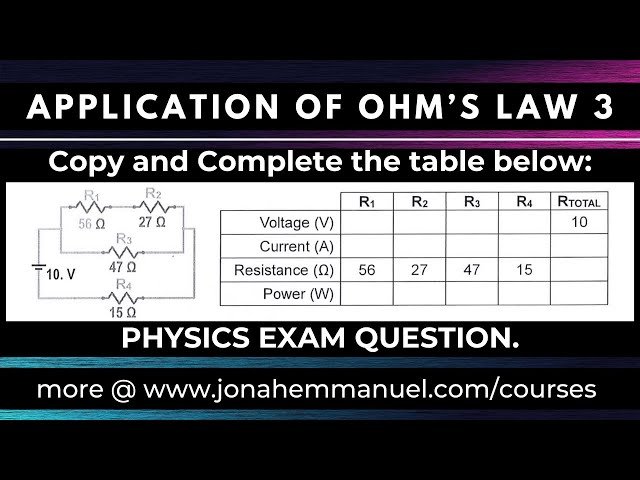
YouTube
Master the practical application of Ohm's Law by learning to calculate current, voltage, and power for individual resistors in series and parallel circuit configurations. Discover systematic approaches to analyzing complex circuits through resistor resolution techniques, enabling you to determine electrical values for each component within a circuit diagram. Explore the fundamental relationships between resistance, voltage, and current in electronic circuits while developing problem-solving skills essential for electronics analysis. Apply power formulas alongside Ohm's Law principles to comprehensively evaluate circuit performance and component specifications. Build confidence in circuit analysis through step-by-step methods that simplify complex electrical calculations, making advanced electronics concepts accessible for students and electronics enthusiasts seeking to strengthen their foundational knowledge in electrical engineering principles.

YouTube
Explore the fundamentals of power electronics in this introductory lecture from MIT's Spring 2023 course. Delve into the history, evolution, needs, and goals of power electronic circuits, focusing on their primary function of processing and controlling electrical energy. Learn from instructor David Perreault as he sets the foundation for understanding this crucial field of electrical engineering. Gain insights into the importance of power electronics in modern technology and energy systems through this comprehensive 43-minute session.