

Courses
Discover thousands of courses from top institutions and platforms worldwide
Level
Course Type
Duration

YouTube
Explore the complexities of hydraulic fracturing in this panel discussion from the American Geophysical Union's 2012 Science Policy Conference. Gain insights from experts in energy policy, environmental science, and public health as they delve into the potential benefits and risks of shale gas extraction. Learn about the role of natural gas in the United States' energy future, its impact on greenhouse gas emissions, energy prices, and national security. Understand the challenges surrounding water protection, waste disposal, and public health concerns associated with fracking. Discover the latest scientific research on air quality, methane emissions, and groundwater contamination. Examine the economic benefits and potential environmental consequences of this controversial energy extraction method. Engage with the panelists' diverse perspectives on balancing energy needs with environmental and health considerations in the rapidly evolving landscape of hydraulic fracturing.

edX
Humanity faces an immense challenge: providing abundant energy to everyone without wrecking the planet. If we want a high-energy future while protecting the natural world for our children, we must consider the environmental consequences of energy production and use. But money matters too: energy solutions that ignore economic costs are not realistic, particularly in a world where billions of people currently can’t afford access to basic energy services. How can we proceed? Energy Within Environmental Constraints won’t give you the answer. Instead, we will teach you how to ask the right questions and estimate the consequences of different choices. This course isrich in details of real devices and light on theory. You won’t find any electrodynamics here, but you will find enough about modern commercial solar panels to estimate if they would be profitable to install in a given location. We emphasizes costs: the cascade of capital and operating costs from energy extraction all the way through end uses. We also emphasize quantitative comparisons and tradeoffs: how much more expensive is electricity from solar panels than from coal plants, and how much pollution does it prevent? Is solar power as cost-effective an environmental investment as nuclear power or energy efficiency? And how do we include considerations other than cost? This course is intended for a diverse audience. Whether you are a student, an activist, a policymaker, a business owner, or a concerned citizen, this course will help you start to think carefully about our current energy system and how we can improve its environmental performance. Photo credits: Solar Farm CC-BY Michael Mees on flickr Smokestack CC-BY Patrick on flickr

Swayam
Similar to many other branches of applied economics, energy economics emerged with therealization that “energy” is a scarce resource. This course covers the economic principles that guide energy related behavior of both the producers and the consumers of energy and the policy regime that has emerged to govern it. The course has four building blocks: understanding energy as a scarce resource, various aspects of energy demand and supply with a focus to policies that are in place to promote renewable energy supply and finally, a much needed discussion on interaction between energy, environment and climate change. The course aims at broadening the vision of students while making any energy related decision as a technology developer, energy manager, entrepreneur, policy maker, researcher in future or simply for personal energy use in day to day activities.INTENDED AUDIENCE:Primarily the graduate students working in the area of energy economics and energy policy domain. This course will also be useful for general audiencePREREQUISITES:Any foundational course in EconomicsINDUSTRY SUPPORT: Power sector; energy consulting firms; renewable energy production units, policy makers

edX
With renewable sources playing an increasing role in meeting global energy demand and mitigating climate change, electric power systems and the related markets are changing. To prepare for a career in the future energy landscape, industry professionals, policymakers, and academics must understand these changes and develop specific, relevant skills to drive this energy transition within the necessary timeframe. In this course, you will learn to apply economic and socio-political analysis to real-world regulatory policy questions in a set of extremely important, interrelated energy markets. Specifically, by looking at real-world case studies and emerging research, you will explore key aspects of the oil, natural gas, electricity, and nuclear power sectors, and how policies such as carbon taxes and efficiency standards can drive reductions in the greenhouse gas emissions. You will also employ systems-level analysis to predict policy outcomes not only within energy markets but across transportation, building and development, employment, and health and social sectors. Overall, you will gain insights into how applied economics and policy tools can effectively move the global energy sector toward renewable and clean energy sources to mitigate climate change, while at the same time promoting economic development. Learners who will benefit from this course include professionals, academics, graduate students, and advanced undergraduate students considering careers and/or further study in energy industry, government and policy, non-governmental organizations and nonprofits, private technology and investment firms, academia, and research and development.

YouTube
Explore key concepts of energy policy through this 55-minute lecture delivered by Dr. Holmes Hummel, Managing Director of Civil Energy Equity & Just Transition Institute for Energy at Stanford University. Gain insights into policy instruments, the intersection of power and money in policymaking, and the critical importance of just transitions in the energy sector. Delve into topics including energy justice, clean energy policy mechanisms, and the complexities of interagency and intergovernmental coordination. Learn how political dynamics and financial influences shape energy policy decisions, while understanding the fundamental principles that drive policy formation and implementation. Master the essential frameworks needed to analyze and engage with energy policy issues, particularly as they relate to climate change, sustainability, and equity challenges in the modern energy landscape.

YouTube
Explore a comprehensive lecture series on environmental policy and planning presented by MIT students. Delve into various scenarios covering federal policy-making, evaluation processes, comparative analysis, ethics, sustainable development, and the interplay between local and expert knowledge. Examine crucial topics such as environmental impact assessment, cost-benefit analysis, societal risk assessment, and ecosystem services analysis. Gain insights into public participation techniques, consensus-building strategies, and effective dispute resolution in environmental planning. Enhance your understanding of key concepts and practical applications in the field of environmental policy through this in-depth, student-led presentation.

MIT OpenCourseWare
This class is about figuring out together what cities and users can do to reduce their energy use and carbon emissions. Many other classes at MIT focus on policies, technologies, and systems, often at the national or international level, but this course focuses on the scale of cities and users. It is designed for any students interested in learning how to intervene in the energy use of cities using policy, technology, economics, and urban planning.

Coursera
Environmental law may be the one institution standing between us and planetary exhaustion. It is also an institution that needs to be reconciled with human liberty and economic aspirations. This course considers these issues and provides a tour though existing legal regimes governing pollution, water law, endangered species, toxic substances, environmental impact analyses, and environmental risk. Note: The Environmental Law & Policy Course will close for new learner enrollment on February 22, 2019. Learners who have already enrolled will continue to see it on their Coursera Dashboard as long as they remain enrolled in the course. If you are currently enrolled in this course, please see the announcement sent on February 19, 2019, for additional details.
Coursera
In this course, IDB's Environmental and Social Policy Framework, you will learn the fundamental principles, processes, actors, and phases of the Inter-American Development Bank (IDB) approach to promoting sustainable, inclusive, and resilient development in Latin America and the Caribbean. Through a dynamic journey across different "chronicles" or development trajectories, you will explore how the 10 environmental and social performance standards of the Framework are applied in practice. This course will enable you to identify socio-environmental risks and opportunities, understand key implementation requirements, and develop skills to tackle complex challenges. By the end of the course, you will have practical tools to enhance the quality and sustainability of the projects you work on, whether in the public sector, private sector, or multilateral organizations. No prior experience in environmental or social topics is required.

Coursera
The Global Energy and Climate Policy course offers an introduction to the theoretical and practical understanding of how energy and climate change policies are designed, shaped, advocated and implemented. As energy markets go truly global, domestic energy policies are becoming more and more entangled with wider issues of international governance. Concurrently, the urgent need to mitigate and adapt to climate change and transition to a low-carbon future is adding a further layer of complexity. The course is aimed broadly at people interested in learning more about interconnected issues in energy and climate policy globally. It assumes a level of interest but no necessary previous knowledge. However, the course also offers sufficient up to date research and new critical perspectives to be of interest to people with expertise in or academic familiarity with the topic as well. The main aim of the course is to provide this wide-ranging introduction in a self-contained, but in-depth form, alongside the important practical skills necessary to understand and discuss energy and climate policy, and lay the groundwork for greater engagement in the future – either through academic study, in the public, private or not-for-profit sectors.

YouTube
Explore the intersection of earth system science and global environmental policy in this thought-provoking AGU Sagan Lecture. Delve into how earth system observations provide a crucial platform for linking environmental changes to policy actions. Learn from Michele Betsill, a leading scholar in global environmental governance and professor of political science at Colorado State University, as she shares insights on the roles of non-state and sub-national actors in addressing climate change. Gain a unique perspective on how multiple disciplines integrate to expand our understanding of life and environmental issues across planetary boundaries. This one-hour seminar, part of the AGU Sagan Lecture series jointly sponsored by the Biogeosciences and Planetary Sciences Sections, offers a synthesis of astrobiology, public engagement, and critical environmental issues that transcend traditional research boundaries.

YouTube
Explore a historical political presentation from the 2000 AGU Spring Meeting featuring Newt Gingrich discussing the campaign trail. Delve into the insights and perspectives of a prominent political figure during a pivotal election year. While the video quality may be affected due to the age of the original file, gain valuable historical context and political analysis from this 58-minute talk. Understand the intersection of politics and scientific communities as Gingrich addresses the American Geophysical Union audience.

FutureLearn
With fossil fuel prices soaring and global temperatures rising, the need to find cleaner and cheaper energy sources has never been more urgent. As a low-cost and locally-administered means of harnessing renewable energy, microgrids could offer a combined solution to energy poverty and global warming. On this six-week microcredential from Deakin University, you’ll become an expert in renewable energy microgrids. Focusing on the Australian market, you’ll delve into renewable energy science, economics, and policy, and discover how microgrids help advance energy transition. Understand energy policy and energy market economics Once you’ve covered the basics of microgrids and renewable energy, you’ll dig deeper into energy market policy and economics. You’ll learn how the energy market works, who its participants are, and what economic principles you need to understand it. You’ll also examine the regulatory and policy framework governing the energy market. Investigate the challenges of integrating renewable energy microgrids In Weeks 3 and 4, you’ll take a closer look at the specific challenges of integrating renewable energy microgrids into the market. You’ll analyse the conventional energy market to determine what new regulations are needed to make adjustments for microgrids. Exploring technical, social, and regulatory issues, you’ll discuss barriers to the implementation of microgrid systems. Apply your knowledge in the context of the Australian energy industry After an overview of the global energy market, you’ll focus on the specific context in Australia. You’ll apply your knowledge to a real-world case study, and draw your own conclusions about the future of the renewable energy market. By the end of the microcredential, you’ll have a detailed knowledge of issues impacting the implementation of microgrids around the world. You’ll understand what role microgrids could play in energy transition, and what provisions are needed to promote them in the future. How will this microcredential help in my career? This microcredential will equip you with transferable skills and specialist knowledge that you can apply to a wide range of green careers. You’ll develop your ability to analyse and manage different renewable energy systems, and evaluate their efficacy within different energy markets. These skills could unlock jobs in energy project management, design, engineering, and consulting. You’ll also gain an in-depth understanding of renewable energy regulation, which will help you apply for roles within government and policy-making organisations, or in the development of energy-related legislation. Finally, throughout the course, you’ll have the opportunity to network and engage with other professionals working in the renewable energy industry. Whether you’re looking to explore new positions or to evolve in your current career, this microcredential will empower you to take the next step professionally. How will I be assessed? At the end of the course, you’ll need to submit a written report analysing current and emerging energy markets. Will I receive university credits? Upon successful completion of the written assessment, you’ll be awarded 0.5 postgraduate level credits from Deakin University, and a Credly digital badge. You can build up your credits by completing more of the microcredentials offered by Deakin University.
YouTube
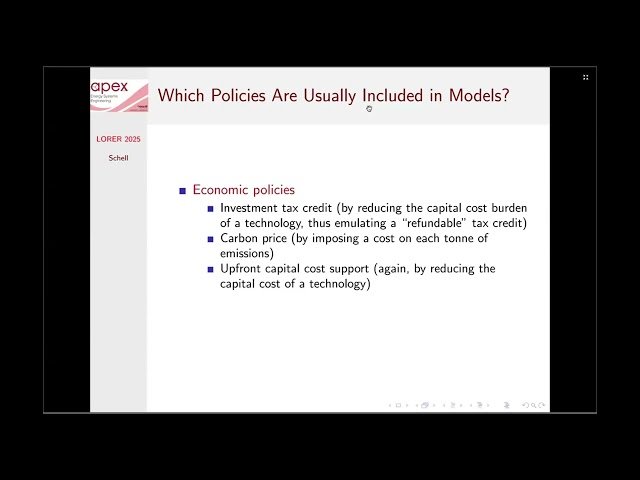
Learn to integrate energy policy considerations into optimization models through this comprehensive lecture delivered by Professor Kristen Schell from Carleton University, Canada. Explore the intersection of energy policy and mathematical optimization, examining how regulatory frameworks, environmental constraints, and economic incentives can be incorporated into optimization models for energy systems. Discover methodologies for modeling complex energy policy scenarios, including renewable energy mandates, carbon pricing mechanisms, and grid modernization requirements. Gain insights into the challenges and opportunities of translating policy objectives into mathematical constraints and objective functions. Understand how optimization models can be used to evaluate policy effectiveness, assess trade-offs between different energy strategies, and support evidence-based decision-making in energy planning. This 1 hour and 43-minute presentation is part of the LORER Summer School program hosted by GERAD Research Center, providing advanced training in operations research and energy systems optimization.

YouTube
Explore a comprehensive Stanford University lecture on wind energy delivered by Jane Woodward, Adjunct Professor of Civil and Environmental Engineering and founder of Woven Earth Ventures. Gain deep insights into both offshore and onshore wind energy systems, examining cutting-edge turbine technology, farm development processes, and critical environmental considerations. Master the economic principles driving wind energy adoption, understand current policy frameworks, and discover future trends in renewable energy. Through detailed segments covering everything from basic wind energy significance to complex technological implementations, learn how wind power contributes to sustainable energy solutions. Delve into specific topics including turbine mechanics, site selection criteria, environmental impact assessments, and the financial aspects of wind farm operations. Perfect for energy professionals, environmental engineers, policy makers, and anyone interested in renewable energy technologies and their role in addressing climate change.
YouTube
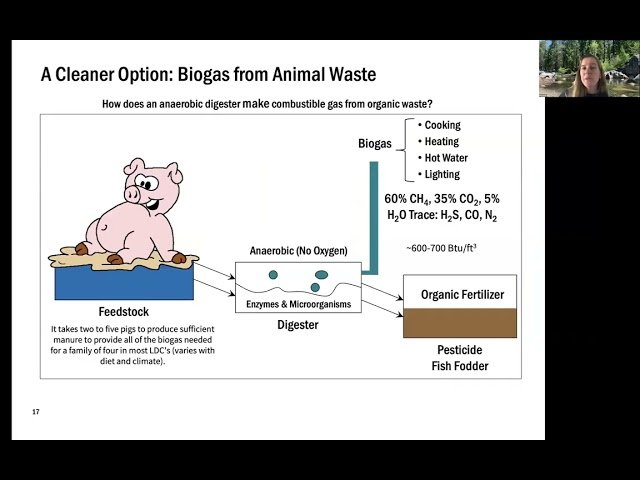
Learn about biomass energy in this concise 12-minute educational video that introduces the fundamentals of biomass as a renewable energy resource. Explore how biomass is sourced and discover its three primary forms: solid biomass, liquid biofuel, and biogas. Examine biomass's role in the renewable energy landscape while understanding the complex environmental, climate, and land-use tradeoffs associated with its implementation. Gain insights from Diana Gragg, Core Lecturer in Civil and Environmental Engineering and Explore Energy Managing Director at Stanford University's Precourt Institute for Energy, as she breaks down this important renewable energy source and its implications for sustainable energy systems.

edX
This course is designed for anyone seeking a comprehensive understanding of the current energy system, in order to design actions and policies that can facilitate the energy transition. The course will analyze the fundamental energy concepts in the context of technology, system operation and control, economics and energy policy. We will discuss different types of energy sources (including renewables), the energy chain, energy infrastructure and power distribution, the actors involved, the energy market and present-day (EU) energy policies. Throughout the course you will understand the status quo and you will learn about disruptive innovations and possible future prospects for the energy sector. The course will present you with the larger picture of the future of the energy industry and its evolving practices, which you need in order to make better decisions, initiate policies and empower governance that help energy transition and support sustainability. This course has been designed by TU Delft's international experts on Energy Systems who have more than 30 years of practical experience and have conducted relevant research in the field. The course also brings you new developments by leading industry professionals in Europe.

YouTube
Explore a comprehensive lecture on solar energy, covering its harnessing methods and importance in the energy system. Delve into solar PV technology, examining its growth trends, environmental impacts, and economic aspects. Learn from Kirsten Stasio, Adjunct Lecturer at Stanford University and CEO of Nevada Clean Energy Fund, as she provides an in-depth overview of solar energy's role in addressing climate change and sustainability issues. Gain insights into the latest developments in solar PV, including its rapid growth, technological advancements, and environmental considerations. Understand the economic factors driving solar energy adoption and its potential for future energy systems. Enhance your energy literacy and equip yourself with knowledge to make informed decisions about renewable energy sources.

YouTube
Explore the fundamental concepts of environmental science in this comprehensive lecture on matter and energy in the environment. Delve into the basics of chemistry, examining elements, atoms, molecules, isotopes, and mixtures. Discover the origins of Earth's matter and the unique properties of water. Investigate organic compounds, macromolecules, proteins, RNA, and DNA. Learn about potential and kinetic energy, the laws of thermodynamics, and how autotrophs produce chemical energy. Gain insights into the periodic table, radioisotopes, atomic bonding, and the role of hydrogen ions in determining acidity. Understand the electromagnetic spectrum and its relation to photosynthesis. Enhance your knowledge with a linked video on entropy by Sal Khan, making this lecture an essential resource for anyone interested in environmental science and its core principles.
YouTube
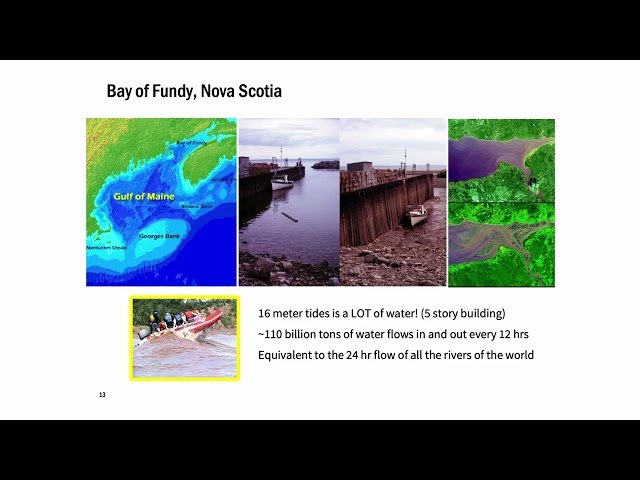
Explore ocean energy technologies and their potential for renewable power generation in this 31-minute Stanford University lecture. Discover the significance of ocean energy as a renewable resource and examine how various marine environments can be harnessed for electricity production. Learn about different ocean energy technologies including tidal energy systems that capture flowing kinetic energy from tidal movements and ocean currents, wave energy converters that utilize oscillating kinetic motion, Ocean Thermal Energy Conversion (OTEC) systems that exploit temperature differences in seawater, and salinity gradient power generation methods. Understand the environmental impacts associated with ocean energy development and installation. Examine the historical development of ocean energy technologies and assess current market potential. Gain insights into future trends and technological advances that may shape the ocean energy sector. Access comprehensive coverage of renewable energy fundamentals while building energy literacy to address climate change and sustainability challenges.