

Courses
Discover thousands of courses from top institutions and platforms worldwide
Level
Course Type
Duration

YouTube
Explore the fundamental concepts of springs and elastic potential energy in this comprehensive physics lesson. Delve into Hooke's Law and its application to restoring forces in springs, understanding how displacement and spring constant affect the force. Discover the formula for elastic potential energy and its role in the conservation of mechanical energy. Practice applying these principles through a series of problems, including simple Hooke's Law calculations and more complex scenarios involving conservation of mechanical energy with both elastic and gravitational potential energies. Gain a solid foundation in spring mechanics and energy conservation, essential for mastering general physics concepts.

YouTube
Explore the complexities of defining fundamental quantities in general relativity in this 1-hour 5-minute lecture by Mu-Tao Wang at BIMSA. Delve into the challenges posed by Einstein's equivalence principle and coordinate independence in defining localized gravitational density. Examine the decades-long efforts to understand energy, mass, and angular momentum within the framework of general relativity. Gain insights into the intricate nature of these concepts and their implications for our understanding of the universe.

YouTube
Dive into a comprehensive 47-minute physics lesson on capacitors. Begin with an introduction to capacitor applications and the definition of capacitance. Explore formulas for potential energy storage in capacitors and delve into parallel plate capacitors, including equations for capacitance with and without dielectrics. Solve problems involving capacitance calculations and potential energy storage. Learn about capacitors in circuits, including circuit diagram symbols and identifying series and parallel arrangements. Master the calculation of equivalent capacitance for series and parallel capacitors, as well as determining potential difference and charge storage. Conclude with a complex problem-solving exercise on capacitors in circuits, focusing on equivalent capacitance and individual capacitor charge determination.

YouTube
Explore angular momentum and rotational kinetic energy in this comprehensive 22-minute physics lesson. Delve into the work performed by torque and the Work-Energy Theorem involving rotational kinetic energy. Begin with a summary of rotational and angular properties, comparing them to their translational equivalents. Learn about angular momentum conservation and its application when no net torque acts on an object. Discover how rotational kinetic energy fits into the conservation of mechanical energy principle. Tackle practice problems on conservation of angular momentum, compare the motion of a sliding block to a rolling sphere on an inclined plane, and solve a problem using the Rotational Work-Energy Theorem. Enhance your understanding of these crucial physics concepts through clear explanations and practical examples.
YouTube
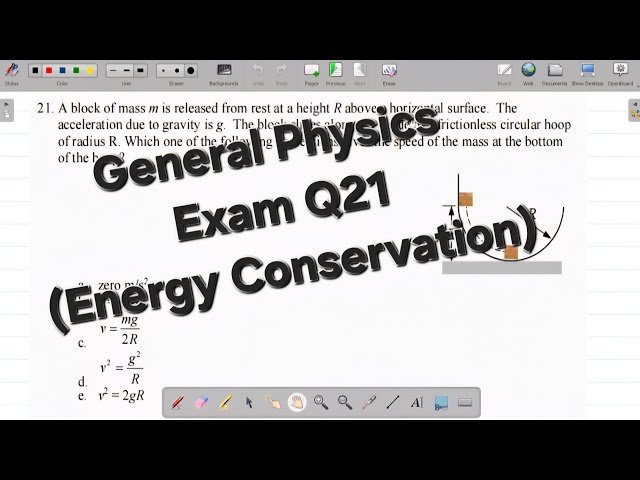
Watch this 13-minute physics tutorial that demonstrates how to solve energy conservation problems through a specific exam question involving a block sliding down a frictionless circular hoop. Learn to apply the principle of energy conservation to determine the speed of a mass at the bottom of a circular track when released from rest at height R above the surface. Master the fundamental concept that energy cannot be created or destroyed, only transformed from one form to another, as you work through this step-by-step solution. Explore how potential energy converts to kinetic energy in mechanical systems and understand the mathematical relationships involved in energy conservation calculations. Discover the different types of energy including kinetic, potential, and thermal energy, and how they are conserved in various physical scenarios. Gain insight into how energy conservation principles apply across different scales, from subatomic particles to cosmic phenomena, making this an essential resource for physics students preparing for examinations or anyone seeking to understand the fundamental laws governing energy in the universe.

YouTube
Explore relativistic velocity, momentum, and energy in this comprehensive physics lesson. Begin with a review of Galilean relativity before delving into the concept of relativistic addition of velocities, essential for understanding objects approaching the speed of light. Learn about relativistic momentum and energy, including the famous equation E=mc^2 and mass-energy equivalence. Apply these concepts through practical examples, such as calculating an electron's rest energy. Gain a deeper understanding of how classical physics concepts transform when dealing with high-speed objects, preparing you for advanced topics in modern physics.

Coursera
This specialization provides an overview of solar photovoltaics (PV), intricacies of solar system design, and a framework for solar PV project management. Targeted for engineers, HVAC installers, architects and building code inspectors, it is also appropriate for anyone considering a career in the growing renewable energy field of solar power. Courses introduce how PV operates and the anatomy of solar electric systems, the economics of solar power, pros and cons of different systems, considerations for designing a PV system, and fundamental code compliance. Materials primarily focus on solar PV in the United States. To learn more, view an overview at https://youtu.be/XjkKzbXqA6s.

YouTube
Explore the fundamental concepts of mass and energy in general relativity through this comprehensive lecture delivered by Piotr Chrusciel from the University of Vienna, Austria. Delve into advanced topics as part of the ICTP School on Geometry and Gravity, gaining valuable insights into the intricate relationship between mass, energy, and spacetime in Einstein's theory. Expand your understanding of gravitational physics and its mathematical foundations in this 70-minute presentation, which serves as the fourth installment in a series dedicated to this complex subject matter.

YouTube
Explore the fundamental concepts of mass and energy in general relativity in this third lecture of a series delivered by Piotr Chrusciel from the University of Vienna, Austria. Delve into advanced topics in geometry and gravity as part of the ICTP School on Geometry and Gravity. Gain insights into the complex relationship between mass, energy, and spacetime in Einstein's theory of general relativity. Enhance your understanding of these crucial concepts through a comprehensive presentation by a leading expert in the field.

YouTube
Explore the fundamental concepts of mass and energy in general relativity through this comprehensive lecture delivered by Piotr Chrusciel from the University of Vienna, Austria. Delve into the second installment of the series, which builds upon the foundations laid in the previous session. Gain insights into the intricate relationship between mass, energy, and spacetime curvature as you navigate through advanced topics in Einstein's theory of gravity. Benefit from the expertise of a renowned physicist as part of the ICTP School on Geometry and Gravity, enhancing your understanding of these complex physical phenomena. Engage with cutting-edge research and theoretical frameworks that shape our modern comprehension of the universe's fundamental forces.

YouTube
Explore the fundamental concepts of mass and energy in general relativity through this comprehensive lecture delivered by Piotr Chrusciel from the University of Vienna, Austria. Delve into the first installment of a series that introduces key principles and theories in the field of geometry and gravity. Gain valuable insights from this 73-minute presentation, which is part of the ICTP School on Geometry and Gravity (smr 3311). Enhance your understanding of advanced physics concepts and their applications in the study of the universe.

YouTube
Learn about spontaneous nuclear decay processes and the energy involved in nuclear reactions in this comprehensive physics lesson. Explore alpha decay, beta decay (including beta emission and positron emission), and gamma decay, understanding their effects on atomic numbers and mass numbers. Discover how alpha particles, beta particles, positrons, and gamma rays are emitted during these processes. Delve into the concept of energy conversion in nuclear reactions, including the Q-value, exothermic and endothermic reactions, and how to calculate the minimum kinetic energy required for endothermic reactions to occur. Gain a thorough understanding of these fundamental concepts in nuclear physics through clear explanations and examples.

YouTube
Explore the connection between food waste and greenhouse gas emissions in this 34-minute presentation by Barbara Belanger, DNP, RN, CNOR. Learn about the Mass General Food to Energy Program, its objectives, and achievements. Gain insights into innovative approaches for reducing environmental impact within healthcare settings. Part of the Climate Change and Health Series, this talk showcases a collaborative effort between the Maxwell & Eleanor Blum Patient and Family Learning Center, the MGH Center for the Environment and Health, and the MGH Institute of Health Professions Center for Climate Change, Climate Justice, and Health.

Udemy
Discover How to Boost your Energy Levels Naturally so you Can Get More Done, Feel Less Stressed and Live Life to the Max What you'll learn: Students who complete this course will be more aware about the different causes that lead them to feel tired.Students will learn more about various tips and tricks to feel more energized during the day.Furthermore, you will learn how to set your goals appropriately and make them happen.Finally, you'll know how to manage your energy. Everyone is always talking about time management. There just aren’t enough hours in the day for many of us and so the belief goes that if we could squeeze a little more productivity out of our time, we’d be able to accomplish our dreams, earn more money, stay more organized and enjoy more time off. It all sounds great, except for one thing: the entire endeavor is completely misguided. Sounds harsh but in fact it’s also completely true. Your problem is not with time. You have plenty of time. If you didn’t have plenty of time, you probably wouldn’t have been able to watch that entire series of The Walking Dead, would you? And you likely wouldn’t have spent so long on YouTube… The problem isn’t time – it’s energy. Your energy, just like your time, is finite. Only it actually exists in somewhat smaller quantities meaning that it’s all too easy to run out and end up completely exhausted. And that’s when we start to use our time poorly and not get much done. Think about it: imagine if you could jump out of bed feeling energetic first thing in the morning. What would you do with that extra hour of productivity? Hit the gym maybe? Make some calls? Do last night’s clean up so that you could live in a house that wouldn’t always be untidy? Remember when you were a little kid and you could just run around all day without ever seeming to get tired? Wouldn’t it be incredible if you could get that back? That’s what we’ll be looking at in this course…

XuetangX
This online course aims to help students to learn the etiology, pathogenesis, pathological changes, progress and outcomes of diseases. This course will provide the theoretical basis for the diagnosis and treatment of disease. Hence, it is the bridge between basic science and clinical medicine and the very fabric that underpins clinical medical practice. we insist on setting the curriculum objectives and optimizing the curriculum structure in the perspective of Competency-based Medical Education(OBE), and effectively help students learn actively Strengthen the cultivation of students' competence.

YouTube
Dive into the world of React.js with this comprehensive conference recording from React Amsterdam 2018. Explore a diverse range of topics presented by industry experts, including reactive programming, state management, GraphQL integration, and component development. Learn how to leverage D3 with React, create inclusive applications, and scale GraphQL on AWS. Discover new approaches to React 16, mixed-mode React, and the latest in open-source developments. Gain valuable insights and practical knowledge to enhance your React.js skills and stay up-to-date with the latest trends in the React ecosystem.

YouTube
Embark on a comprehensive journey through the fundamental principles of chemistry with this 8-hour video series. Explore a wide range of topics, from the basics of matter and atomic theory to advanced concepts like quantum mechanics, thermodynamics, and electrochemistry. Learn about chemical bonding, stoichiometry, gas laws, and solution chemistry. Dive into the intricacies of acid-base reactions, redox processes, and nuclear chemistry. Gain practical skills in chemical nomenclature, problem-solving, and data analysis. Ideal for high school and college students, as well as curious beginners, this series provides a solid foundation in the central science, preparing you for further studies or simply satisfying your scientific curiosity.

XuetangX
General ChemistryChapter 1: The Foundations of Chemistry1.1 Basic Concepts1.2 Gases, Liquids and Solutions1.3 Errors and Significant DigitsChapter 2: Atomic Structure and the Periodic Properties of Elements2.1 The Law of the Motion of Microscopic Particles2.2 The Schrödinger Equations2.3 Radial Distribution Functions2.4 Angular Distribution Functions2.5 Factors Effecting Electron Energy2.6 The Periodic Properties of ElementsChapter 3: Covalent Bond Theories3.1 Basic concepts of Chemical Bonds3.2 Lewis’ Theories3.3 Valence Bond Theories3.4 Hybrid Orbital Theories3.5 Valence Shell Electron Pair Repulsion Theories3.6 Molecular Orbital TheoriesChapter 4: Crystal Types and Intermolecular Forces4.1 Crystal Types4.2 Molecular Crystal and Intermolecular Forces4.3 Ionic Crystal and Ionic Bonds4.4 Polarization of Ions4.5 Metallic Crystal and Metallic BondsChapter 5: Preliminary Chemical Thermodynamics5.1 Basic concepts of Chemical Thermodynamics5.2 First Law of Thermodynamics5.3 Third Law of Thermodynamics5.4 Second Law of ThermodynamicsChapter 6: The Rates of Chemical Reactions6.1 Chemical Reaction Rate and Expression6.2 Effects of External Conditions on Reaction RateChapter 7: Chemical Equilibria7.1 Chemical Equilibrium Constant7.2 Shifting of Chemical EquilibriumChapter 8: Acids & Bases Equilibrium8.1 Electrolyte Solution Theories8.2 The Development of Acids & Bases Theories8.3 Weak Acids & Bases Ionization Equilibria8.4 Buffered SolutionChapter 9: The Equilibrium of Precipitation9.1 The Equilibrium of Precipitation9.2 Shifting of The Equilibrium of Precipitation Chapter 10: Oxidation-Reduction Reactions10.1 Oxidation-Reduction Reactions10.2 Primary Cells and Electrode Potential10.3 Thermodynamics of Cell Reactions and The Factors Affecting Electrode Potential10.4 The ApplicationsChapter 11: Coordination Compounds11.1 Basic concepts of Coordination Compounds11.2 Stereochemistry of Coordination Compounds11.3 Bonding Theories of Coordination Compounds — Valence Bond Theories11.4 Bonding Theories of Coordination Compounds — Crystal Field Theories11.5 Stability and Equilibrium Coordination CompoundsChapter 12: Elemental Commonality12.1 The Origins of Elements12.2 The Main Group Elements — s-block12.3 The Main Group Elements — p-block12.4 The Transition Metal Elements — d-block and ds-block12.5 The Rare Earth Elements — f-block
Coursera
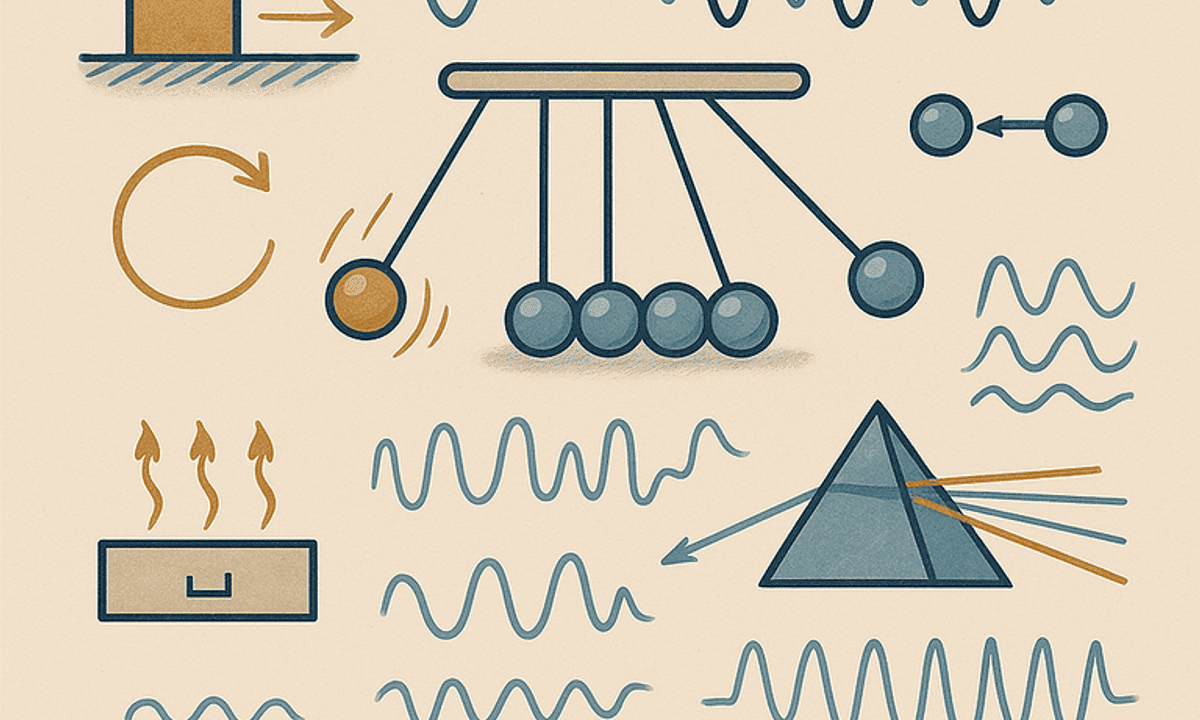
Build a comprehensive foundation in fundamental physics principles that govern the natural world. This course provides essential expertise in classical mechanics, thermodynamics, and optics, offering practical frameworks to analyze and explain diverse physical phenomena through quantitative approaches. Learn to apply Newton's laws to complex scenarios, understand energy and momentum principles, and explore wave mechanics through simple harmonic motion. Master the first and second laws of thermodynamics with real-world applications, from microscopic atomic systems to massive engines. Discover optical phenomena including interference, diffraction, and polarization of electromagnetic waves. Whether you're pursuing engineering, physical sciences, or technical careers requiring analytical problem-solving, this course equips you with the fundamental physics knowledge used by scientists and engineers to understand, predict, and optimize physical systems across all scales of nature.

Study.com
Use this self-paced course to explore the field of anthropology. You can study these short lessons and quizzes at any time to catch up on information you missed in class, study for upcoming exams, bring up your grades or check your understanding of fundamental anthropology topics.