

Courses
Discover thousands of courses from top institutions and platforms worldwide
Level
Course Type
Duration

Coursera
This course will explore the definition, classification, and characteristics of hazardous waste, including chemical, biological, and radioactive substances. We will delve into the mechanisms of transport in the environment, the various treatment methods employed to mitigate their impact, and the legal framework governing hazardous waste management. Additionally, we will examine specific types of hazardous waste, such as construction and demolition waste, electronic waste, plastic waste, biomedical waste, and household hazardous waste. By understanding the challenges and opportunities in hazardous waste management, you will be equipped to contribute to sustainable and environmentally responsible practices. Target Learners: §Undergraduate students of Civil Engineering §Post-Graduate Students of Environmental Engineering §Practicing Engineers §Faculties of Civil Engineering Domain

Swayam
Management of solid and Hazardous waste is a challenge for Urban Local bodies, Scientists as well Policy makers. Therefore this course has been designed to have a holistic comprehension of solid wastes including MSW, Bio-medical waste, e waste, plastic waste, radioactive waste, fly ash etc.In this course definition, classification, characterization, collection, transportation and management of different types of solid wastes will be discussed in detail. Similarly aspects of hazardous wastes will be discussed.Various resource recovery options including biomethanation, pyrolysis, composting, vermicomposting etc will be covered under this course.Ultimate methods of solid waste disposal including sanity landfilling and incineration will be covered.Legal framework related to different types of wastes will be discussed.Latest R & D, Swachh Bharat Abhiyan will also be studied.

CourseHorse
When workers engage in the cleanup, treatment, storage, or disposal of hazardous substances as defined in 40 CFR 261.3 and 49 CFR 171.8, they must adhere to the OSHA 29 CFR 1910.120 standards for hazardous waste operations and emergency response (HAZWOPER). Failure to understand and comply with these standards poses serious risks, including chemical burns, skin and eye irritation, and even death. HAZWOPER 40-Hour Course for All Industries helps workers, managers, and supervisors achieve initial compliance to maintain a safe workplace and minimize health risks for employees. NOTICE: Students must also obtain additional site-specific training, along with three days of actual field experience under the direct supervision of a trained, experienced supervisor.In addition, on-site supervisors and managers may use this training to fulfill the 40-Hour component of their training requirements.During this course, students will become familiar with OSHA’s HAZWOPER standard as discussed in 29 CFR 1910.120. Topics for study include:A review of OSHA and the HAZWOPER standard, including important definitions and the Globally Harmonized System of Classification and Labeling of Chemicals (GHS)Recognition and control of hazardsDefinition of hazardous waste per EPA 40 CFR 261.3 and hazardous materials per DOT 49 CFR 171.Site-specific health and safety plans, medical surveillance programs, and other programs required by regulationSafety best practices for working in confined spaces and around mobile equipmentHow to identify, evaluate, and control on-site hazards, including health and physical safety, as well as biological, and ergonomic hazards in the work environmentAn overview of common respiratory hazards, types and appropriate protection protocolsHow to respond to on-site emergencies and the release of hazardous substancesRequirements for HAZWOPER training to achieve compliance with standards 29 CFR 1910.120(e)(3)(i) for general site workers and 1910.120(e)(4) for on-site managers and supervisorsSite characterizationThe Hazard Communication Standard (HCS)Appropriate techniques for material handlingLog on Instruction to ZOOM will be emailed after registration
YouTube
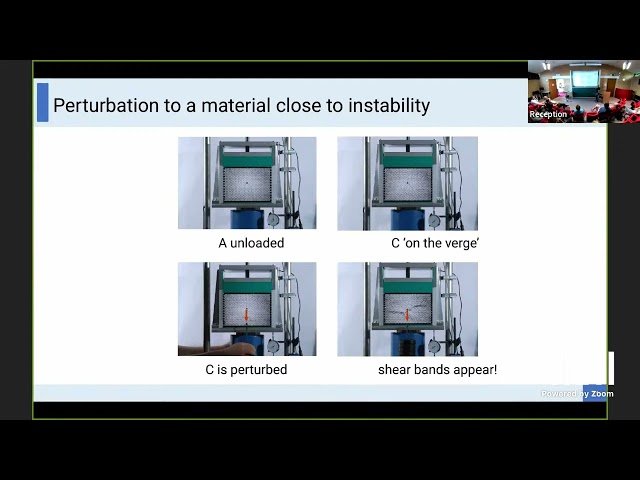
Explore material instabilities and their relationship to continuum solids in this 48-minute seminar lecture delivered by Professor Andrea Piccolroaz from the University of Trento. Delve into how the loss of ellipticity in governing equations affects material stability, particularly focusing on the requirement for wave speed to maintain positive real numbers across all wave directions. Learn about various types of material instabilities, including strain localization in shear bands and flutter instability in dynamics. Examine these concepts through micromechanical interpretation, utilizing homogenization of prestressed periodic beam lattices to understand both static and dynamic regimes. Discover the connections between microstructure and macroscopic instabilities, validated through comparisons between discrete lattice simulations using finite elements and equivalent continuum responses described by exact Green's function.
YouTube
Explore the evolving landscape of ransomware threats in this comprehensive webinar from Nullcon 2022. Delve into the findings of a joint advisory from US, UK, and Australian cyber security authorities warning of increased global ransomware risks. Examine how ransomware tactics have evolved, including shifts away from "big-game" hunting, diversification of extortion methods, and targeting of cloud services, managed service providers, industrial processes, and software supply chains. Gain insights from analysis of over 3,800 confirmed double extortion incidents and 34,000 detected security incidents. Learn about data-driven perspectives on the ransomware ecosystem and implications for threat response. Benefit from the expertise of Charl van der Walt, Head of Security Research for Orange Cyberdefense, as he provides in-depth analysis, contrarian viewpoints, and actionable intelligence on this critical cybersecurity issue.

YouTube
Learn how Private LTE and 5G networks empower industrial businesses to enhance worker connectivity, safety, and productivity in this 24-minute conference talk. Explore real-world applications through three industrial case studies demonstrating how private wireless networks enable secure coverage and near real-time communications. Discover how to maintain continuous connection with workers through voice and video communications, reducing maintenance response times and improving safety protocols. Understand the security advantages of private wireless networks, including complete data control and SIM card-based device authentication that ensures regulatory compliance. Examine how continuous monitoring of hazardous areas using cameras, sensors, robots, and drones can significantly reduce workplace accidents and support the transition to Industry 4.0 automation.

YouTube
Explore the intricacies of image-based PBR materials and Substance materials in Vue's material editor through this 23-minute video tutorial. Delve into basic properties, Filterforge, basic material and color concepts, semi-PBR techniques, normal maps, reflectivity, and comprehensive PBR material properties. Gain valuable insights into creating realistic materials for 3D environments, enhancing your Vue workflow and artistic capabilities.

YouTube
Explore the critical topic of planetary defense in this informative National Space Society Space Forum featuring Jonathan Dagle, a technologist, futurist, and strategist. Delve into the real dangers posed by asteroids that cross Earth's orbit and learn about the devastating potential of impacts like the 2013 Chelyabinsk meteor event. Discover the efforts being made by NASA and researchers to combat these threats, including the successful DART mission and the development of advanced detection technologies. Gain insights into the National Space Society's goals for defending Earth from dangerous space objects and their advocacy for increased congressional attention to near-Earth object threats. Listen as Dagle, the NSS Policy Chair and Planetary Defense Policy Manager, provides a comprehensive overview of the asteroid threat, explains how planetary defense works in practice, and discusses future developments in this crucial field of study.

YouTube
Learn advanced ceramic experimentation techniques by wedging unconventional raw materials including tungsten, tourmaline, malachite, and obsidian shards into high iron stoneware clay. Follow the complete process from initial material preparation through throwing five test bowls on the pottery wheel and trimming them to leather-hard stage. Discover proper safety protocols when working with sharp and potentially hazardous materials, including preemptive wheel cleaning, safe drying methods, and contamination prevention techniques. Observe professional workshop practices for handling experimental clay bodies and understand the extended timeline required for reduction firing to cone ten (1290°C). Master the art of wedging foreign materials into clay while protecting both tools and hands, and gain insight into the patient, methodical approach required for ceramic material testing and development.

YouTube
Dive into an in-depth video lecture on PCB materials, featuring expert insights from Alun Morgan. Explore crucial topics such as signal loss in PCBs, material selection criteria, dielectric losses, and the impact of material structure on signal integrity. Learn about specialized materials like PTFE, understand the significance of dielectric constants, and examine copper losses due to skin effect. Gain valuable knowledge on PCB tolerances, the relationship between dielectric constants and trace widths, and materials used in flexible PCBs. This comprehensive presentation offers essential information for engineers and designers working with high-frequency PCB applications.

YouTube
Explore the world of Service Workers in this insightful conference talk by Patrick Kettner at NDC Conferences. Gain a deep understanding of how Service Workers function, their role in modern web development, and their impact on enhancing web application performance and offline capabilities. Learn about implementation strategies, best practices, and potential use cases for Service Workers in your projects. Discover how this powerful technology can revolutionize the way you build and deliver web experiences, improving user engagement and overall application reliability.

CourseHorse
What is hazwoper training? The 40 Hour HAZWOPER training online is an OSHA course on Hazardous waste operations and emergency response standards. This course will satisfy the requirements outlined in OSHA standard 29 CFR 1910.120, which requires individuals to complete HAZWOPER training to work at an uncontrolled hazardous waste operation. HAZWOPER - OSHA RequirementOSHA Standard 29 CFR 1910.120 requires individuals to take the 8hr OSHA HAZWOPER Refresher training annually to renew their 40 hour HAZWOPER certification and 24 hour HAZWOPER certification. If you fail to renew your certification before the expiration date you will be required to re-take the initial course. CEU Requirements 100% attendance for the 40 Hour HAZWOPER courseCompletion of Continuing Education and Training Registration FormActive participation in all class exercises (determined by course instructor)Completion of required pre-and post-quiz assessmentAs applicable, achievement of minimum passing score on required end-of-course examinationParticipation and submittal of end-of-course evaluation form (must provide name on form to receive credit)Learning ObjectivesUpon completion of this 40 Hour HAZWOPER training, the student will be able to:Understand the process of decontaminationDescribe ToxicologyDefine levels of protectionDemonstrate detecting hazardous materialsUnderstand how to properly use respiratorsUnderstand Site Safety PlanningDefine hazard communicationidentify hazardous waste

YouTube
Dive into the intricacies of procuring consumable materials in SAP ECC MM with this comprehensive video tutorial. Learn the fundamentals of consumable materials, including their definition and types, with a focus on consumer consumable materials. Explore the Material Master Record and its components, such as Material Type and Account Assignment Category. Gain hands-on experience with the procurement process for consumption, including creating Purchase Requisitions and understanding Purchase Equations. Master essential transaction codes and navigate through Header Data, Account Assignment, and Account Assignment Details. The tutorial also covers the concept of Unknown Items in the purchasing process, providing a well-rounded understanding of SAP MM Material Management for consumable materials procurement.

edX
Despite medical and technological advances, half of the world’s population lacks access to essential health services, and over 8.9 million preventable deaths occur every year. There is an acute global shortage of health workers, a gap that will grow to 18 million by 2030. Studies show that training high-performing community health workers can help close these gaps and save more than 3 million lives annually. In the past few decades, many community health worker programs across the world have demonstrated their ability to save lives — including in the hardest-to-reach areas. Yet despite this progress, lessons on how to successfully scale these programs as part of national primary health systems are not widely shared. This course, developed in collaboration with the Community Health Academy at Last Mile Health, introduces learners to the core concepts of community health worker programs, and explores what is needed to build and strengthen large-scale programs in order to improve access to high-quality health services. The curriculum highlights the key components of designing community health systems, addresses common management challenges, and showcases lessons learned from a range of contributors — from community-level practitioners to government leaders and other global health experts. Through case studies of exemplar countries (including Ethiopia, Bangladesh, and Liberia), participants will learn from leaders across the globe how to advocate for, build, and optimize community health worker programs. This course was created by health systems leaders for health systems leaders. Whether you work in a Ministry of Health, lead or support a community health worker program, mobilize resources and advocate for increased investment in community health, or you are simply interested in knowing what it takes to deliver quality care through community health worker programs, learners will have the opportunity to advance their knowledge and skills to implement critical change. This course can be taken individually, but learners are also encouraged to convene their colleagues from within or across organizations to share insights and further enhance the learning experience. About the Community Health Academy Last Mile Health launched the Community Health Academy in 2017 to revolutionize training for community health workers and health systems leaders. The Academy is equipping current and next-generation health systems leaders to build strong community health systems through university-quality courses that are delivered virtually and in-person through coaching, mentorship, and group discussion. The Academy is also supporting Ministries of Health to enhance the effectiveness of their health worker training by deploying mobile phones equipped with high-quality digital content to frontline and community health workers.

LinkedIn Learning
Developing a professional career that embraces work flexibility is not just a dream. This set of online courses—a partnership between FlexJobs and LinkedIn Learning—is designed to help you achieve a fulfilling career and the work flexibility to lead the life you want.Explore strategies to add flexibility to your current work environment.Discover how to find a new remote role.Learn practical tips for succeeding in remote work.
YouTube
This keynote presentation from Code BEAM America 2025 explores how artificial intelligence can empower gig workers to organize collectively. Discover the AI for Worker Collective Action framework, which combines social theories with Large Language Models (LLMs) and worker-owned data to create technologies that improve working conditions on platforms like Upwork and Amazon Mechanical Turk. Learn through case studies how this approach can transform the future of work, with a focus on AI's societal impacts and worker wellbeing. The 41-minute talk aims to inspire the development of AI systems that empower workers and underserved populations.

Udemy
How to distinguish employees from independent contractors. What you'll learn: Learn common factors used to test whether a worker is an employee or independent contractor Apply common factors to their personal business situationUse Self-Assessment Tools to identify business practice that may adjustment so workers can be properly classified as independent contractorsKeep organized records of your contractors' classifications Understanding Worker Classification is a crash course that will help business owners learn the factors used to determine whether a worker is an employee or independent contractor. The additional bonus resources included with the course are:Independent Contractor v. Employee Self-Assessment questionnaire (one for each test covered in the course: 20 factor, IRS Test and Economic Realities Test);Independent Contractor Worksheet (one for each test covered in the course: 20 factor, IRS Test and Economic Realities Test); 5 Step Guide to Conducting your Self-Audit; 20 Factor Cheat Sheet with examples; 50 State Survey that sets forth the worker classification tests used in each state; and IRS Independent Contractor Information Sheet Form Independent Contractor Agreements for Single Projects and Recurring ProjectsThere is about 2 hours of learning material including videos, power point presentation, and audio recordings. I will discuss some background issues on worker classification and then dive right into the 20 factor test. I will define each factor and discuss a comparison of two cases: one where the worker was determined to be an independent contractor and another where a class of workers were found to be employees. That way, you can see real situations that these factors were applied and learn common "do's and don'ts." After every 5 factors, I will do a brief recap and discuss important take-a-ways. Once we conclude the 20 factor test, I also address the IRS Test and the Department of Labor Economic Realities test. I will then go through next steps for your business and the 5 simple steps to conduct your self-assessment. After that, I do a lecture where I discuss the key provisions of the form contracts that are included in the course and then I give a course wrap up. Worker classification is a hot issue for the federal government and state agencies which have increased audits in this area. Understanding these issues will help your business get proactive and hopefully stop a problem before it starts. Please remember that the information in this course should be used as a general reference and you should not solely rely on this information for making legal decisions. You should consult an attorney for employment law issues.

YouTube
Explore the challenges of configuring monitoring and observability tools for optimal performance in this 32-minute conference talk from the Cloud Native Computing Foundation (CNCF). Learn about the potential pitfalls of using default configurations in instrumented systems that generate large volumes of data. Dive into the structure of the PLG-stack (Promtail, Loki, and Grafana) and discover how unexamined default settings can lead to unexpected performance issues and data loss. Follow along as the speakers demonstrate thoughtful adjustments to address cardinality impacts and improve overall system efficiency. Gain valuable insights with a step-by-step guide to optimizing your logging stack, ensuring you maximize the potential of your monitoring and observability tools.

YouTube
Explore the second lecture in a series on how materials can learn by themselves, delivered by Andrea J Liu from the University of Pennsylvania. Delve into the fascinating world of artificial neural networks and their application in solving inverse design problems in soft matter. Discover how approaches developed by computer scientists are being harnessed to design mechanical and flow networks that perform functions inspired by biology. Learn about the pioneering work on bottom-up learning, a new approach that allows physical systems to learn autonomously, overcoming the constraints of traditional top-down learning methods. Gain insights from Liu, a renowned theoretical soft and living matter physicist, as she shares her expertise in this cutting-edge field of materials science and physics.

MIT OpenCourseWare
This course introduces experimental chemistry for students who are not majoring in chemistry. The course covers principles and applications of chemical laboratory techniques, including preparation and analysis of chemical materials, measurement of pH, gas and liquid chromatography, visible-ultraviolet spectrophotometry, infrared spectroscopy, nuclear magnetic resonance, mass spectrometry, polarimetry, X-ray diffraction, kinetics, data analysis, and organic synthesis. ### Acknowledgements Dr. Dolhun and Dr. Hewett would like to acknowledge the contributions of past instructors over the years to the development of this course and its materials. **WARNING NOTICE** The experiments described in these materials are potentially hazardous and require a high level of safety training, special facilities and equipment, and supervision by appropriate individuals. You bear the sole responsibility, liability, and risk for the implementation of such safety procedures and measures. MIT shall have no responsibility, liability, or risk for the content or implementation of any of the material presented. [Legal Notice](/terms/)