

Courses
Discover thousands of courses from top institutions and platforms worldwide
Level
Course Type
Duration

YouTube
Lecture videos from this substantive course on Intellectual Property. The course shall give a brief overview of the IP landscape in India. It shall also dwell into the role of IP in the modern intangible economy.

Coursera
Intellectual property is the currency of the tech world. The pharmaceutical patent for Lipitor generated over $100 billion in revenue, the copyright for the Harry Potter franchise has generated over $25 billion to date, and the trademarked brands of the world’s largest tech companies now eclipse $100 billion in value. But what makes these intangible assets so valuable? Through the courses in this specialization, you will learn the differences between the various forms of U.S. intellectual property rights, including patents, copyrights, and trademarks, and their various applications to human innovations. Drawing from that knowledge, you will then work to develop a trademark strategy for a company, analyze a patent document, and address a copyright cease-and-desist request. After completing these hands-on projects, you will have the necessary framework to craft integrated intellectual property strategies tailored to an organization’s core business goals.

YouTube
Course outline: Intellectual property (IP) helps universities to improve their ranking, establish an innovation ecosystem, incubate knowledge-based start-ups, earn additional revenue and measure research activity. Managing intellectual property at Universities can be critical as regulatory authorities push for establishing innovation ecosystems and IP centres. The University Grants Commission (UGC) has asked all universities to set up IP centers. The National Institute Ranking Framework (NIRF) ranks institutions based on the number of patents applied for, granted and commercialized. The National Assessment and Accreditation Council (NAAC) awards points to institutes with an innovation ecosystem and a facility for identifying and promoting IP. Both the UGC and All India Council for Technical Education (AICTE) recommend changes to the curriculum with a focus on IPR education in technical institutes.

LinkedIn Learning
Discover the basics of intellectual property rights, and how you can best safeguard your ideas and avoid infringement.

Swayam
In today’s globally competitive economy, role of intellectual property is inevitable in every profession ranging from Teachers, doctors, engineers, policy-makers, managers, technicians, and among others. In today's environment, Intellectual Property Rights (IPR) have a tremendous impact on both international and domestic trade. Intellectual property is a very important tool for economic development and wealth creation. Building IPR protection systems through laws is important in every regime by establishing exclusive rights to use and sell newly discovered technology, goods, and services, to encourage investments in knowledge, development and innovation. Intellectual property rights, which include Copyright, Patents, Trademarks, Designs, Semi-Conductor Integrated Circuit Layout-Designs, Trade secrets, New Plant Varieties, Geographical Indications, and other new and emerging forms, are the result of intellectual property. The value of intellectual property has surpassed the value of physical assets in recent years. A lack of IPR understanding and inadequate execution may hamper the nation’s economic, technological, and sociological progress. This module on IPR provides a quick overview of various forms of IPR, their need, significance, works protected, registration procedure and related aspects.

Udemy
Creating Advantage Advantage What you'll learn: Identify the types of Intellectual Property available to the Firm such as patents, trade secrets, know-how, copy rights, trade marks etc and when and how to use them effectively.Use the various types of agreements for protecting the Firm’s Intellectual Property such as Confidentiality Agreements (CDAs), Non-disclosure agreements (NDAs), joint development agreements (JDAs), etcUse patents as the cornerstone of the Intellectual Property strategyUse proven Intellectual Property management processes and the roles played by various parts of the Firm (e.g., sales, marketing, R&D, manufacturing etc.)Identify the tactics for beating the competition using the Firm’s Intellectual Property strategies with mini-case study examples.Understand the value of “Intellectual Property Masters” externally sourced or found within the Firm. Intellectual Property (IP) Strategy: Creating Competitive Advantage, is a 3.5-hour course that educates Founders/Entrepreneurs on a proven, practical framework for identifying and protecting Intellectual Property While IP is critically important to Innovators and Founders working to transform into Entrepreneurs it is often not high on the Founder/Innovator agenda and can be lost in the chaos of other activities. Founders/Innovators are struggling with multiple tasks from securing customers, managing demanding lead users, generating revenue and eventually profit, satisfying investors while raising new funds, recruiting, hiring and retaining key employees, and so forth. The one critical success factor often de-emphasized in this chaotic mix is IP. Key benefits include: 1. Significant increase in valuation of business by protecting IP and creating exit opportunities. 2. Decrease in the risk to Entrepreneur/Investor investment. Once you have completed this course you can have an informed discussion with your team and IP professionals (lawyers, tech transfer office). VentureForge will shortly be releasing a follow-on course called "The Intellectual Property Toolkit" that outlines a framework to use in creation of a practical IP strategy. Disclaimer -Legal Information Is Not Legal Advice This course provides information related to the law and lawyers designed to help students learn about intellectual property strategy and their potential legal needs. This course does not provide legal advice and VentureForge, LLC is not a law firm. We are not lawyers and do not provide legal advice. Although we go to great lengths to make sure our information is accurate and useful, we recommend you find and consult an appropriate lawyer for your intellectual property legal needs.

Udemy
Introduction to Intellectual Property Law What you'll learn: Learn the fundamentals of intellectual propertyUnderstanding intellectual propertyFundamentals of copyrightDuration of a copyrightFundamentals of trademarksHow to trademark your brandUnderstanding patents In this course you will learn the fundamental framework of Intellectual Property.This course provides an introduction to intellectual property (IP) law and its principles. Students will explore the different forms of IP protection, including patents, trademarks, copyrights, and trade secrets, and will examine the legal framework for each.The course will cover the basics of patent law, including patentable subject matter, the patent application process, and infringement issues. Students will also learn about trademark law, including the function of trademarks, registration requirements, and infringement. The course will also address the basics of copyright law, including copyrightable subject matter, ownership, and infringement.Additionally, students will learn about trade secrets and the legal protection afforded to them. Throughout the course, students will be expected to engage in critical analysis and to develop skills in legal reasoning and analysis. Overall, this course will provide students with a comprehensive understanding of the legal framework for IP protection, including the advantages and limitations of different forms of protection, and the key issues and challenges faced by IP owners and practitioners.Please note: this course covers legal concepts pertaining solely to the United States. The information presented in this course may not be applicable to other countries and should be used accordingly.

Coursera
Intellectual property is the currency of the tech world, with the world’s most valuable intellectual property assets dwarfing the value of their real-world counterparts. Apple’ trademarked brand was valued at over $100 billion as of 2017. J.K. Rowling’s Harry potter franchise has generated over $25 billion to date. But how did the law come to create such enormous value in intangible assets? This course will introduce the various types of U.S. intellectual property: patents, which cover inventions and process innovations; copyright, which protects original works of authorship; and trademarks, which protect a business’ commercial identity as the source of valuable goods and services. You will then explore case studies of how global businesses have used intellectual property law to generate enormous value from these intangible assets.

Independent
In 7 episodes, Stan Muller teaches you about Intellectual Property! This course introduces you to the concept and importance of intellectual property, and covers copyright, patents, international IP law and problems with intellectual property. By the end of this course, you will be able to: Define intellectual property, copyright, patents, and other relevant terms Complicate the idea of an intellectual property versus technology binary Understand the impact of intellectual property in your daily life and the wider community Describe the function of intellectual property from both a consumer and creator perspective

Coursera
For aspiring and active entrepreneurs, this course focuses on the opportunities and challenges of intellectual property. Intellectual property is a commonly discussed, often misunderstand, element of entrepreneurship and law. Knowing how to create and manage patents, copyrights, trademarks, and trade secrets is a valuable skill for entrepreneurs and business leaders. Regardless of size and industry, a business’s intellectual property is often more valuable than its physical assets. Companies invest tremendous resources in developing innovative new products and services. Intellectual property law discourages competitors from immediately profiting from another’s invention, and provides incentives for continued innovation. "Intellectual Property for Entrepreneurs" is one of three courses in the "Legal Aspects of Entrepreneurship Specialization" by Coursera and the University of Maryland. This specialization explores the critical legal and business issues entrepreneurs face as they build and launch a new venture. Learners examine real-world scenarios and address legal and business issues from ideation to all of the important junctures along the path to success. Significant attention is placed on new venture formation, intellectual property management, and contracts and financing arrangements.

Swayam
ABOUT THE COURSE: In today's ever-changing and competitive business environment, the effective management of intellectual property is crucial for maintaining a competitive edge. Moreover, Effective management of IPRs is the necessity for survival in the market. IP Portfolio management is gaining popularity worldwide as IP forms the base of manufacturing sector as well as for the knowledge economy. The objective of this course is to provide the audience with an in-depth comprehension of the strategic elements of IP portfolio management, enabling them to optimize the value of intellectual assets. The course will furnish the learners with the necessary tools and insights to navigate from basics of IPR to effective strategies in managing IP Portfolios. Accompany us on this enlightening journey if you wish to explore the fundamental principles, tactics, and exemplary methods that form the foundation of IP portfolio management in present world full of competitiveness.INTENDED AUDIENCE: Students of B. Tech, M.B. A, M. Tech, M. Design and Pre-PhD whose course curriculum includes study on various aspects of Intellectual Property Rights Students of other discipline who are interested in learning Intellectual Property and its management role in Nation’s economyStudents of B. Tech who wish to opt Career as Patent Agent and Patent Examiners Working Professionals who want to use IPRs as a strategic tool for their career growth and advancementINDUSTRY SUPPORT: All leading companies in area of R & D, Technology Management, IP Management and IP evaluationCourse is also suitable to SMEs as some of the modules are designed keeping Intellectual property needs of SMEs needs in mind.

Domestika
Learn to manage and leverage your assets further by exploring copyright, trademarks, design rights, and patents Understanding the relationship between your creative work and running a business is crucial for financial well-being. Protecting your intellectual property is essential to ensuring your ability to enjoy its financial benefit. Erica Wolfe-Murray, a specialist in intellectual property, dedicates herself to helping businesses and entrepreneurs across different sectors understand the value of the creative work they own and to increase revenues from them. With clients like National Geographic and Disney, Erica’s role is to protect ideas, products, and services, as well as to come up with new revenue opportunities. In this course, Erica teaches you how to manage and protect your assets, but also find new ways to enjoy their financial benefits.

Udemy
Develop a working knowledge of the basics of patents, copyrights, trademarks, and trade secrets. What you'll learn: Explain the basics of intellectual property policies.Understand how intellectual property protections benefit individual creators, business owners, and entrepreneurs.Describe the relationship between intellectual property protection and economic growth.Discuss the historical origins of intellectual property law in the United States. [PRO TIP: To better follow along with the course material, turn on the Transcripts feature located on the right hand corner of the video next to the Volume icon]Intellectual Property: Inventors, Entrepreneurs, Creators Protecting innovations and creative work is more crucial than ever in today’s Knowledge Economy. “Intellectual Property: Inventors, Entrepreneurs, Creators” teaches the basics of IP to ordinary citizens, making IP accessible to everyone, not just lawyers and CEOs. Why is Intellectual Property Important? IP has grown from a narrowly specialized legal field into a major force in American social and economic life today. Today, IP comprises an astonishing 38 percent of total U.S. GDP, and represents 80 percent of the market value of all publicly-traded companies in the U.S.Indeed, IP has become the new watchword in almost any career. Look around and you’ll see IP’s imprint everywhere. From Silicon Valley startups to Fortune 500 board rooms, from MIT engineering labs to Wall Street trading desks, and from college business seminars to debates in Congress over global trade policy, IP issues now lie at the heart of almost every arena of modern life today.As a result, any person today who does not understand at least the basics of intellectual property — and its value and role in science, business, arts, and the professions — will find him or herself at a distinct disadvantage in the world of tomorrow.Why Take the Course?If you are an innovator, entrepreneur, or creator of any kind, this course will equip you with the necessary knowledge to protect and capitalize on your intellectual property (IP). Patents: How do exclusive rights to your inventions benefit you and society? Find out what’s patentable, what’s not, and how to navigate the patent system successfully.Copyrights: Learn how you can protect a wide variety of artistic and intellectual works. What’s Fair Use – and what’s not?Trademarks: Why are trademarked words, names, and symbols so valuable – and how can you protect them?Trade Secrets: Do you have to publicly disclose your creation to gain legal protection?Written by Experts“Intellectual Property: Inventors, Entrepreneurs, Creators” is based on The Michelson Institute for Intellectual Property’s IP textbook The Intangible Advantage: Understanding Intellectual Property in the New Economy. Authored by Pulitzer Prize-nominated intellectual property expert David Kline, with former Undersecretary of Commerce and Director of the Patent Office David Kappos serving as executive editor. Learn MoreTo get the most out of this course, download The Intangible Advantage on the MichelsonIP website, where you’ll find the text-only version of the book along with an interactive eBook with built-in learning assessment tools (available in iBooks). You can also access our short animated video series on YouTube, answering the most frequently asked IP questions.This course is presented by The Michelson Institute for Intellectual Property, an initiative of The Michelson 20MM Foundation, in partnership with The Intellectual Property Owners Education Foundation. Michelson 20MM and its initiatives are made possible by the generous support of Dr. Gary Karlin Michelson and his wife, Alya Michelson.

YouTube
Explore a 12-minute conference talk from USENIX Security '24 that investigates security vulnerabilities in Texas Instruments MSP430 microcontrollers' Intellectual Property Encapsulation (IPE) technology. Dive into an in-depth security evaluation that reveals fundamental protection shortcomings in current IPE hardware, demonstrating how software-level attack techniques from trusted execution environments (TEEs) can be applied to this platform. Learn about a newly discovered attack primitive called "controlled call corruption" that exploits vulnerabilities in the IPE access control mechanism, leading to complete bypass of confidentiality and integrity guarantees. Understand the proposed lightweight hardware modifications for securing IPE and discover a prototype framework that implements software responsibilities to reduce information leakage while utilizing the onboard memory protection unit to restore security guarantees on vulnerable devices with minimal performance impact.

Swayam
Competition Law and Intellectual Property Law prima facie appear to have conflicting objectives and goals. While Competition law operates towards facilitating the market growth by curbing anti-competitive practices in the market, IPRs confer exclusive monopoly to the proprietor. However, both are intended towards promoting innovation and consumer welfare. In the ever evolving technology driven society, the recent conflict between the domain of IPRs and completion law pertains to the exercise of rights in IPR affecting competition law. Therefore, in the light of the above intricacies and problems the course aims to discuss the general principles and laws related to Intellectual Property Right and Competition law, The course also provides an overview of the application and operation of both the laws in different jurisdictions and tries to simplify the overlapping domain of IP and Competition Law.INTENDED AUDIENCE : Students from Law, Management and business studies, and Technical background can benefit from the programPREREQUISITES : Not necessary. Brief introduction to Intellectual Property Rights may be usefulINDUSTRY SUPPORT : None

YouTube
Explore the essential legal concepts developers need to know in this 31-minute conference talk from EuroPython 2024. Demystify the three fundamental pillars of Intellectual Property Law: Trademark, Copyright, and Patent. Gain insights into real-life applications of these legal principles and understand their importance in securing your code and protecting yourself as a developer. Designed for a technical audience rather than legal experts, learn how to navigate the often overlooked but crucial aspects of intellectual property in the software development world.

Coursera
This course begins with an overview of general intellectual property law in the United States, then examines how the policy choices behind those laws shapes the behavior of major players in the healthcare industry. We will examine how patents and trademarks shape the behavior of pharmaceutical companies, and how complex issues involving medical research in university settings, and ownership of genetic information and material, are resolved by intellectual property laws. The course concludes with in-depth case studies of an international pharmaceutical company, a major medical device company, and a start-up in the emerging DNA-testing industry.

XuetangX
This unique course will help students to get a comprehensive legal education in the field of intellectual property in a fairly short time. The objective of the course is to be as practice-oriented as possible. The course examines the main institutions of intellectual property law: copyright and related rights, patent law, trademark law, and legal regulation of domains. The course also includes sections of intellectual property in Software, Artificial Intelligence, Internet of Things and Big Data. The course combines elements of legal theory, comparative jurisprudence and current law enforcement practice with an emphasis on the latest technology.
YouTube
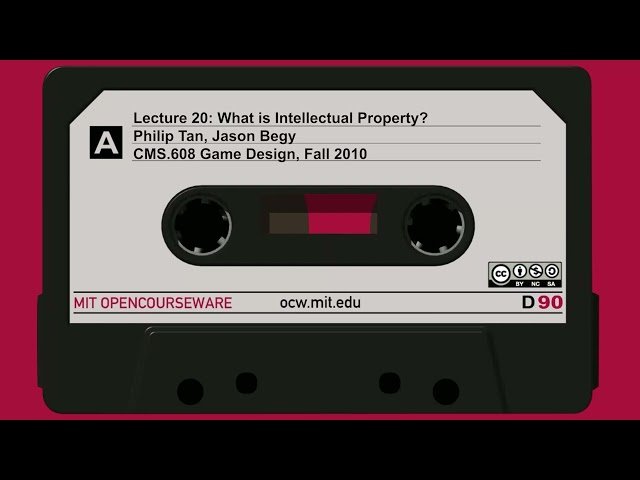
Explore the fundamentals of intellectual property law as it applies to the gaming industry in this 59-minute lecture from MIT's Game Design course. Learn how intellectual property concepts affect game development, including copyright, trademark, and patent considerations that game designers must navigate. Discover how successful game adaptations incorporate popular elements and distinctive aesthetics from original media while respecting intellectual property boundaries. Examine real-world examples of how IP law impacts game creation, licensing, and distribution. Gain practical knowledge about protecting your own creative work and understanding the legal landscape surrounding game development. The lecture builds upon feedback from previous assignments and connects theoretical IP concepts to practical game design challenges.

edX
This course will provide insight on the competitive and strategic advantages of enterprises by using Intellectual Property Rights. You will learn about the different types of IntellectualProperty as well as the strategy, valuation andasset management of it. The course also includes an array of interviews with leading experts and will help you understand the opinions of Policy makers vis-à-vis the gaps experienced by the distinguished patrons, hailing from various facets of the field of Intellectual Property.