

Courses
Discover thousands of courses from top institutions and platforms worldwide
Level
Course Type
Duration

Udemy
Unlocking Financial Success: Mastering Stocks, Equities, and Mutual Funds What you'll learn: Stock Market Fundamentals: Gain a comprehensive understanding of how the stock market operates, including primary and secondary markets & trading hoursEffective Buying and Selling: Learn the intricacies of buying and selling stocks efficiently, from executing trades to managing your investments effectively.Investment Goals and Strategies: Develop a strategic approach to stock investing aligned with your personal financial goals and risk tolerance.Brokerage Account Management: Discover the key elements of managing a brokerage account, including account types, fees, and account maintenance.Differentiating Investment Approaches: Differentiate between investment and trading strategies, and understand the distinctions between stocks, ETFs, and mutualAdvanced Investment Instruments: Explore advanced investment instruments such as options, futures, and their role in a diversified portfolio.Corporate Actions Impact: Understand how corporate actions, such as dividends, stock splits, and preferred stock issuance, impact your investment portfolio.Analyzing Company Financials: Develop the skills to analyze a company's financial position, evaluate stock sectors, and make informed investment decisions.Technical Analysis Mastery: Dive into technical analysis techniques to identify trends, patterns, and potential investment opportunities in stock trading.Advanced Stock Concepts: Explore advanced stock concepts like convertible preferred stock, cumulative preferred stock, and earnings per share (EPS).Financial Metric Proficiency: Master financial metrics including price-to-earnings (P/E) ratio, beta, and book value per share (BVPS)Valuation Models: Gain expertise in valuation models such as the Dividend Discount Model (DDM) and learn investment strategies like dollar-cost averaging.Dividend Reinvestment: Discover the benefits of dividend reinvestment plans (DRIP) and their impact on long-term investment growth.Leveraging Margin and Short Selling: Explore advanced strategies like buying on margin and short selling to maximize investment opportunities.Global Investment Strategies: Understand international investing using tools like the Capital Asset Pricing Model (CAPM) for diversified portfolios.Dividend Income Estimation: Calculate crucial financial metrics including dividend yield, forward P/E ratio, and payout ratio.Portfolio Optimization: Learn to optimize a diversified stock portfolio effectively by applying advanced techniques.Asset Allocation Strategies: Explore asset allocation strategies for risk management and investment diversification.Market Analysis: Apply technical and fundamental analysis to make informed investment decisions in varying market conditions.Risk Management: Develop strategies to manage investment risks, including strategies for income, value, and growth stocks.Investment Psychology: Understand the psychological aspects of investing and learn to make rational decisions amid market fluctuations.Investment Regulations: Familiarize yourself with relevant investment regulations and ethical considerations in stock investing. Welcome to this comprehensive course designed to empower you with the knowledge and skills required to navigate the intricate world of investing in stocks, equities, and mutual funds.Understanding the Stock Market:Our journey begins with a deep dive into the stock market. You'll gain a profound understanding of both primary and secondary markets, learning how stocks are bought and sold. Explore the fascinating inner workings of various stock exchanges, from their trading hours to their unique characteristics. Gain insight into the psychology of market participants and how market sentiment influences stock prices.Mastering Stock Investing:In this section, we demystify stock investing. Discover what it means to own a share in a company and learn the intricacies of trading stocks. We'll guide you through the process of selling your stock holdings and provide valuable insights into different stock categories, including income, value, and growth stocks. You'll also become well-versed in handling commissions and fees effectively.Exploring Investment Vehicles:Dive into the diverse array of investment options available. Navigate the world of individual stocks, exchange-traded funds (ETFs), and mutual funds. By understanding the unique features of each choice, you'll be equipped to make investment decisions aligned with your financial objectives. Explore how ETFs and mutual funds are structured, how they are traded, and their advantages and disadvantages.Mastering Stock Fundamentals:Develop the skills to analyze a company's financial health confidently. We'll explore both quantitative and qualitative methods for assessing a company's performance. Gain insights into stock sectors and learn how to interpret financial statements with precision. Learn how to conduct comprehensive fundamental analysis, including evaluating a company's income statement, balance sheet, and cash flow statement.Analyzing Stocks Like a Pro:Equip yourself with the tools used by seasoned investors. Unlock the potential of technical analysis and learn how to apply it to your investment strategies. Delve into the implications of corporate actions, such as stock splits and reverse stock splits, to make informed decisions. Learn how to use stock charts, technical indicators, and chart patterns to identify potential investment opportunities.Understanding Preferred Stocks:Venture into the world of preferred stocks. Discover various types, including cumulative, callable, and convertible preferred stocks. Gain insights into perpetual and adjustable-rate preferred stocks, broadening your investment horizons. Explore how preferred stocks differ from common stocks and bonds, and how to evaluate their suitability for your portfolio.Performance Evaluation and Risk Management:Learn to navigate stock valuation complexities. Master the art of calculating key metrics like Price-to-Earnings (P/E) ratios, Price/Earnings-to-Growth (PEG) ratios, and Beta. Dive deep into the Dividend Discount Model (DDM) to assess stock values accurately. Understand how to assess the risk associated with individual stocks and build a diversified portfolio to manage risk effectively.Strategies for Savvy Investing:Explore essential investment strategies like dollar-cost averaging and value averaging. Dive into Dividend Reinvestment Plans (DRIPs) and gain an in-depth understanding of buying on margin and short selling to make well-informed investment decisions. Learn about different investment styles, including value investing, growth investing, and income investing, and how to apply them to your portfolio.Global Investment Perspectives:Expand your investment horizons globally. Dive into the International Capital Asset Pricing Model (CAPM) and discover how to estimate dividend income effectively in a global context. Understand the factors that influence international stock markets and how to assess opportunities and risks when investing internationally.Calculating Returns with Precision:Unlock the secrets of investment returns. Learn how to calculate dividends, earnings per share (EPS), and the price-earnings ratio (P/E ratio) with precision. Explore various methods for projecting future returns with confidence. Understand the concept of total return and how it can impact your investment decisions.Join Us on a Journey to Financial Prosperity:This comprehensive course caters to both beginners and those with prior investment knowledge. Whether you aspire to build wealth, seek to grasp the intricacies of financial markets, or enhance your investment skills, this course is your gateway to success.Embark on a Path to Investment Expertise:Get ready to embark on a path toward financial prosperity and investment expertise. Enroll now and take the first step toward securing your financial future. Don't miss this opportunity to master the art of investing in stocks and mutual funds and gain the financial knowledge you need for a successful future. Start your journey today!

Coursera
Welcome to this transformative course designed to help you revolutionize your underwriting process through the power of Generative AI (GenAI). In this course, you’ll learn how to streamline application reviews, enhance decision-making accuracy, and automate repetitive tasks to save valuable time. With no technical experience required, you’ll be able to apply cutting-edge AI tools to improve your underwriting workflow efficiently and responsibly, all while maintaining compliance and ethical standards. This course is ideal for a variety of professionals in the underwriting and insurance fields. Whether you're a beginner underwriter eager to integrate AI into your workflow or an experienced underwriter looking to optimize your application reviews with advanced tools, this course has something for you. It’s also perfect for risk assessment professionals who want to enhance their decision-making accuracy using AI, and compliance officers or industry professionals interested in understanding the ethical and regulatory aspects of AI in underwriting. To get the most out of this course, learners should have a basic understanding of underwriting principles and workflows, as well as experience with interpreting application data and assessing risk factors. A basic knowledge of AI tools, such as ChatGPT, will be helpful but not required—this course is designed to be beginner-friendly and will guide you through the practical use of AI without any advanced technical knowledge. By the ending this course, you'll not only gain a solid understanding of how Generative AI can streamline your underwriting processes, but you'll also be equipped with the tools and strategies to apply AI effectively in real-world scenarios. Whether you're looking to reduce review times, improve risk assessments, or ensure compliance with ethical standards, you'll have the knowledge and confidence to integrate AI into your workflows. Stay ahead of the curve, future-proof your career, and lead the way in transforming the underwriting industry with AI.
YouTube
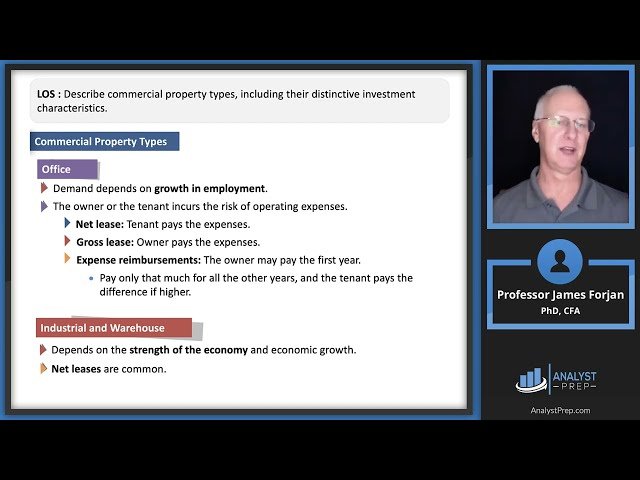
Learn about real estate investment fundamentals in this educational video designed for CFA Level II exam preparation, covering essential topics like private and public real estate investments, property classifications, portfolio roles, and economic value determinants. Explore different commercial property types and their unique investment characteristics while understanding the due diligence process for both private and public equity investments. Master concepts related to residential and non-residential properties, liquidity considerations, cash flow contributors, and economic growth factors that influence real estate investments. Gain insights into real estate investment indexes, their construction methodology, potential biases, and the impact of appraisal lag on valuations. Develop a comprehensive understanding of why investors choose real estate as an asset class and how various factors contribute to property values and investment performance.

Swayam
Learn fundamental investment principles and financial analysis techniques through this 8-week course from the Indian Institute of Management Bangalore. Begin with investment fundamentals and the relationship between risk and return, then explore fixed income securities and their valuation methods. Analyze equity investments through various valuation models and financial statement analysis techniques. Discover derivatives markets by studying forwards and futures contracts, their pricing mechanisms, and hedging applications. Master portfolio theory concepts including diversification, efficient frontier construction, and optimal portfolio selection using modern portfolio theory. Examine financial planning strategies and understand the impact of taxation on investment decisions and portfolio management. Conclude with a comprehensive review that integrates all investment concepts and their practical applications in real-world financial decision-making scenarios.

Coursera
Imagine having the skills to confidently navigate the intricate world of credit risk—a cornerstone of professional excellence. The essence of credit lies in trust: trusting a counterparty to honour their obligations. This course unpacks the critical elements of credit, offering a structured approach to mastering credit risk analysis. Whether you are a banker, risk underwriter, or a professional extending trade credit, this course equips you with the expertise to make informed decisions and manage risk with precision. This course is designed for professionals at various stages of their careers within financial institutions who are involved in assessing or managing corporate credit risk. It is particularly suitable for graduate entrants undergoing core competency training, corporate credit and risk analysts, credit controllers, and credit underwriters. Relationship managers seeking a stronger grasp of the financial and strategic positioning of clients, as well as investment analysts evaluating creditworthiness as part of their decision-making processes, will also benefit significantly from this program. Participants are expected to have a foundational understanding of financial statements and accounting principles. This includes familiarity with the typical structure and content of audited financial accounts, as well as the mechanics of recording financial transactions. A basic grasp of how financial data is organized and interpreted is essential to fully engage with the analytical techniques presented in this course. By the end of this course, learners will be equipped to conduct thorough and structured corporate credit analyses. They will develop the ability to critically evaluate both business and financial risks, uncovering potential weaknesses that may impact a company’s creditworthiness. Additionally, they will learn to assess management quality through objective analysis and ultimately formulate credit ratings by estimating default probabilities and synthesizing all insights into a coherent view of a corporation’s overall financial health.

LinkedIn Learning
Learn three methods to evaluate investments and make smarter financial decisions.

Swayam
ABOUT THE COURSE: Investment management is one of the main finance functions for both corporations and individuals. Investor managers face situations that require understanding of quantitative tools and qualitative assessment before a decision is arrived at. This course provides a broad overview of investment management, focusing on the application of finance theory to the issues faced by portfolio managers and investors in general. Course participants shall learn about various assets that can be considered to form an investment portfolio, their valuation, and measurement of performance. At the end of the course, students are expected to be able to (a) analyze the intrinsic value of traded assets using fundamental valuation theories as well as technical analysis (b) set investment goals and accordingly construct efficient portfolios, and (c) evaluate performance of the portfolio.INTENDED AUDIENCE: Senior Undergraduate and Postgraduate students: Management, Economics, Finance, Commerce, Business AdministrationPREREQUISITES: Understanding of basic statistics, economics, and financial markets (Ouantitative Investment Management, Financial Institutions 8 Markets)INDUSTRY SUPPORT: Investment advisory and research firms

YouTube
Explore the world of investment banking in this comprehensive 58-minute video lecture. Learn about the crucial role investment banks play in helping companies, governments, and agencies raise funds through security issuance and sales in primary markets. Discover the functions of investment banks, different types of banks, and the trade cycle. Delve into merchant banking, understanding its meaning and services. Compare investment banking and merchant banking to gain a thorough understanding of their differences. Gain valuable insights into potential career opportunities in the financial sector and enhance your knowledge of capital markets and financial services.

XuetangX
Investment banks play a crucial role in the capital market. One distinctive service provided by investment banks is to help firms raise fund through initial public offerings (IPOs). For instance, on September 19, 2014, Alibaba Group went public on the New York Stock Exchange, setting a historical record for the largest IPO ever. Six investment banks, including Credit Suisse, Morgan Stanley, JPMorgan Chase, Goldman Sachs, Deutsche Bank, and Citigroup, formed the underwriting syndicate for Alibaba’s IPO, selling over $21 billion worth of Alibaba shares to the market. In fact, investment banking has been around for centuries. As early as the early 17th century, the Dutch East India Company raised funds by selling stocks and bonds to the public. In addition to raising funds for companies, investment banks can also help governments raise funds by selling government bonds. For example, in the early days of the United States, the Washington government issued bonds to cover its huge fiscal deficit after the War of Independence. The services provided by investment banks are essential to the development of modern companies and government entities. By providing financial services, investment bankers create value and wealth for themselves. Investment banks offer job opportunities in major financial centers around the world, such as London’s financial district, Manhattan’s Wall Street, and Singapore’s Marina Bay. Meanwhile, the compensation level in the investment banking industry has long been at the top of the financial sector. The aim of this course is to reveal the key functions of investment banks in the capital market. We discuss the profit models and unique role of investment banks with finance theories, industrial practices, as well as case studies. Through this course, you will learn how investment banks help companies and governments raise funds, how they assist companies expand their business through mergers and acquisitions, how they provide trading services for market participants, and how they help investors manage their assets. The target audience for this course includes finance students and anyone interested in our course content. If you want to learn more about the role of investment banks in the financial market, we welcome you to join this online course.

XuetangX
Securities Investment is a course that aims to conduct in-depth research on the operating rules of the securities market, securities valuation methods and investment strategies. It helps students master how to effectively carry out asset allocation and risk management to achieve personal or institutional investment goals through the combination of theory and practice.

Coursera
In this Specialization, you will understand how investment strategies are designed to reach financial goals in a global context. You will learn the theory that underlies strong investment decisions, as well as practical, real-world skills that you can apply when discussing investment proposals with your advisor, managing your personal assets or your client’s investment portfolio. You will start by developing a global understanding of financial markets and what impacts rational and irrational behaviors have in finance at the micro and macro levels. You will then learn how to adequately build and manage a portfolio with a long-term view while gaining an appreciation for novel research advances in finance and related areas as well as future trends that are shaping the investment management industry. In the final Capstone Project, you will create a sensible 5-year investment plan that accounts for an investor's goals and constraints in a dynamic economic landscape. Key speakers from UBS, our corporate partner, will contribute to this specialization by providing you with practical insights they have gathered through years of experience working for the world’s largest wealth manager. Director of this Specialization and main teaching contributor: Dr. Michel Girardin, Lecturer in Macro-Finance, University of Geneva

Coursera
In this course, you will understand the fundamental principle that money available now is worth more than the same amount in the future due to its potential earning capacity. Additionally, you will master the concepts of Net Present Value (NPV) and breakeven analysis, which allow different cash flows at different periods of time to be compared and summed to determine whether a project is expected to create value. You will apply these concepts by conducting investment evaluations and completing practical assessments on financial projections. This course is ideal for non-financial managers or professionals who seek to enhance their financial acumen to make better business decisions. No prior experience in finance is required. However, a basic understanding of business operations and strategic thinking will be beneficial.

Coursera
In this 1-hour long project-based course, you will learn how to use beta to compare stock’s exposure to the systematic risk and use alpha to quantify the investment’s return over the market return. ATTENTION: To take this course, it is required that you are familiar basic financial risk management concepts. You can gain them by taking the guided project Compare Stock Returns with Google Sheets. Note: This course works best for learners who are based in the North America region. We're currently working on providing the same experience in other regions. This course's content is not intended to be investment advice and does not constitute an offer to perform any operations in the regulated or unregulated financial market

LinkedIn Learning
Learn more about how your investments actually work. Get practical investment strategies that can help you improve your financial portfolio and make your money work for you.

Coursera
What are impact investors looking for? This course offers a practical introduction to the impact investing marketplace. You’ll learn how the market is structured, including the roles of asset owners and asset managers, and how capital flows between them. The course explores how impact investors pursue both financial and social or environmental returns, and the different types of investors involved along with their motivations, constraints, and preferred investment vehicles. You’ll hear directly from impact enterprise leaders about their experiences raising capital, and from investors about what they look for when evaluating opportunities. The course also highlights common mistakes enterprises make when seeking funding and offers strategies to attract aligned capital. By the end of this course you’ll be able to identify an effective impact investing strategy, and be prepared to start your journey in the impact marketplace. This course requires no prior knowledge and is designed for anyone interested in impact investing: whether you're an aspiring investor, an enterprise leader, or exploring a career in the field. We break down key concepts, explain investor types in accessible language, and define essential financial terms.

edX
Are you aware of the controversial investor-State disputes and arbitral awards in which the public interest has been at stake, for instance, the protection of human rights and the environment? Do you recall recent cases such as Philip Morris v Uruguay and Vattenfall v Germany? In the aftermath of these high profile cases and in the context of the negotiation of new international investment treaties, like the CETA and the TPP, local populations, policy-makers and NGOs have come to realize the societal importance of international investment law and arbitration. Passionate and sometimes ill-informed discussions have resulted from this realization. They have focused on the features of international investment law, which has traditionally granted rights to foreign investors notably to foster States’ economic development. Central to these discussions are the issues of: the balance between the protection of foreign investments/investors and the right of host States to regulate in order to protect public interest objectives; the regulation of foreign investments, i.e., the duties and obligations of foreign investors; the promotion of sustainable development in international investment law; the legitimacy of arbitration tribunals to decide on disputes between host States and foreign investors; the coherence of arbitration practice. Learning and understanding the features and dynamics of international investment law and arbitration is key not only for international lawyers and policy-makers, but it is also important knowledge for all well-informed citizens. In this law course, you will: discover the history of international investment law and arbitration as well as understand the dynamics which shape its evolution; learn the objectives of international investment law and the specific rights international investment agreements (bilateral investment treaties and free trade agreements’ investment chapters) grant to foreign investors, for instance the fair and equitable treatment and the prohibition of illegal expropriation; discover how those rights have been interpreted in investment treaty arbitration; master the features and functions of investor-state arbitration; understand why international investment law and investor-state arbitration are currently the subject of criticism and be able to assess the soundness of this criticism; gain insight into the content of the treaties newly concluded, and be able to assess how they address the issues of the right of host States to regulate, of foreign investors’ obligations and of the legitimacy of arbitration tribunals.

Coursera
By the end of the project, you will learn how to quantify risk-to-reward using Treynor Ratio, and calculate the value at risk for investment portfolio. ATTENTION: To take this course, it is required that you are familiar basic financial risk management concepts. You can gain them by taking the guided project Compare Stock Returns with Google Sheets. Note: This course works best for learners who are based in the North America region. We're currently working on providing the same experience in other regions. This course's content is not intended to be investment advice and does not constitute an offer to perform any operations in the regulated or unregulated financial market

Swayam
About the Course:Regulatory reforms across the world are gradually being introduced to reduce trade impediments between nations and usher in free market based pricing. Cross border investments through direct/portfolio routes are also being enticed as a medium for funding of growth and developmental activities. In addition, the governments of developing nations continue to pursue their strategy of partial privatization of the frontier sectors in an attempt to raise revenues for the exchequer as well as reduce operational losses with increased efficiency. Under these stimuli, scientific investment management by the investor fraternity becomes of cardinal necessity for generating competitive returns and surviving in the marketplace. Financial instruments have proven to be immensely useful as versatile investment avenues. Their vitality can be gauged from the exponential growth in trading volumes as well as the advent of new structured products literally on a day to day basis.INTENDED AUDIENCE: The audience would comprise of those desirous of get acquainted with the quantitative techniques of financial securities valuation and their strategical application in investment management of structured portfolios. The learners would be able to appreciate the nuances that have led to the origin and extensive development of this field of knowledge.PREREQUISITES:Senior School MathematicsINDUSTRY SUPPORT:This course will attract immense recognition in the entire financial services industry including banks, stock & commodity exchanges, stock & commodity brokers, portfolio managers, investment bankers, market regulators etc. Those employed in corporate finance shall also find it valuable as it would add to their versatility. Academicians will find it a gateway to further work in related areas.

Swayam
Learn the core principles of investment management and financial markets in this 15-week course taught by Dr. Ravi Ahuja, an experienced professor from Savitribai Phule Pune University. Gain insights from an industry expert with nine years of teaching experience at both undergraduate and postgraduate levels, who brings practical knowledge from research in company law, GST, retail sector, and MOOCs. Develop a strong foundation in investment fundamentals while benefiting from Dr. Ahuja's extensive background in operations management, commerce, and skill development.

YouTube
Explore a thought-provoking lecture by Yang Miao from Western University on the analysis of investment behaviors and their consequential effects on investment outcomes. Delve into the intricate relationship between investor decision-making processes and financial performance. Gain valuable insights into quantitative methods for wealth management as part of the Fields CFI Workshop series. Enhance your understanding of behavioral finance and its practical applications in the investment world.