

Courses
Discover thousands of courses from top institutions and platforms worldwide
Level
Course Type
Duration

YouTube
Explore cutting-edge research in quantum optics through this 23-minute seminar presented by Pria Dobney from the University of Toronto. Delve into the fascinating world of optimal optical metrology using few-photon states, a crucial topic in quantum information science. Gain insights into the latest advancements and challenges in this field as part of the 2023-24 Quantum Information Seminar series hosted by the Fields Institute. Access the abstract for a deeper understanding of the talk's content and context within the broader quantum information landscape.

YouTube
Explore theoretical developments in levitated optomechanics with nanoparticles through this colloquium talk delivered by Professor Mishkat Bhattacharya at the Raman Research Institute. Delve into the principles of cooling and regenerative center-of-mass motion (phonon lasing) theory, examining their applications in experiments conducted at the University of Rochester under A. N. Vamivakas. Learn from the insights of an NSF Career award recipient (2015) and contributor to one of the Breakthroughs of the Year by Optics and Photonics magazine (2019), as he shares his expertise in theoretical quantum optics developed at the Rochester Institute of Technology.
YouTube
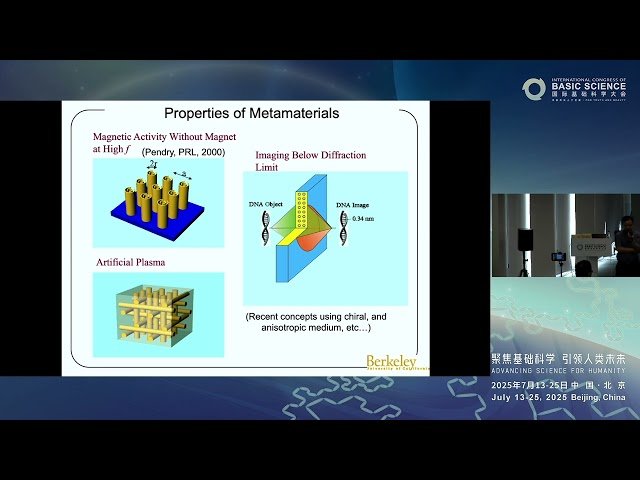
Explore the cutting-edge field of optical metamaterials through this 65-minute conference talk that delves into three revolutionary applications: negative refraction phenomena, super-lens technology, and plasmon laser systems. Learn how engineered metamaterials can manipulate light in ways not found in natural materials, enabling unprecedented optical properties and breakthrough applications. Discover the fundamental principles behind negative refractive index materials and their potential to bend light in unconventional directions. Examine super-lens technology that can overcome the diffraction limit of conventional optics, potentially enabling imaging at resolutions beyond what was previously thought possible. Investigate plasmon laser systems that harness surface plasmons to create coherent light sources with unique characteristics. Gain insights into the theoretical foundations, experimental demonstrations, and future prospects of these transformative optical technologies that are reshaping our understanding of light-matter interactions and opening new possibilities in photonics, imaging, and laser science.

YouTube
Explore the fundamental principles of laser physics in this 41-minute video lecture. Delve into the concept of stimulated emission, the foundation of light amplification in lasers. Examine the workings of three-level laser systems, understanding their energy states and the crucial process of population inversion. Investigate Einstein coefficients and their role in describing light-matter interactions. Gain insights into the physics behind highly focused and coherent light beams, essential for various technological applications.

YouTube
Learn advanced espionage techniques through a 46-minute DEF CON conference talk that explores how to intercept keystrokes through glass windows using laser technology. Discover the physics behind various forms of energy transmission including infrared, visible and ultraviolet light, radio waves, ultrasound, mechanical vibration and temperature, and how these can be exploited to extract information from air-gapped systems. Explore historical side-channel and TEMPEST attacks used by intelligence agencies like the NSA and KGB, while gaining practical knowledge about electrical and optical components used in modern eavesdropping operations. Master the art of distinguishing meaningful signals from background noise, and understand how electromagnetic radiation can be both intercepted and injected into target systems. Gain hands-on insights into state-of-the-art surveillance methods that require no prior technical expertise.

YouTube
Explore the intricacies of optimal beer pricing in this 41-minute conference talk from the Toronto Machine Learning Series. Dive into the world of price elasticities with Eric Hart, Staff Data Scientist at Anheuser-Busch, as he discusses how changes in beer prices affect sales volume. Learn about the development of data-driven models for predicting elasticities and their implications across various business aspects, including price setting, procurement, and financial planning. Discover how to create an optimal pricing layer using mathematical optimization to generate specific price change suggestions at different granularities, while considering various business objectives such as profit, revenue, and market share. Examine the use of constraints to balance these objectives and ensure price suggestions remain within the bounds of the underlying elasticity models. Gain insights into a real-world example of advancing analytics from predictive to prescriptive in the context of price setting and beer industry dynamics.

YouTube
Explore the intricacies of complex optical networks utilizing vertical-cavity surface-emitting lasers (VCSELs) in this 47-minute lecture presented by the Instituto de Física Interdisciplinar y Sistemas Complejos (IFISC). Delve into the fundamental principles and advanced applications of VCSELs in optical networking, gaining insights into their unique properties and advantages. Discover how these compact semiconductor lasers contribute to the development of high-speed, energy-efficient communication systems. Examine the challenges and opportunities in implementing VCSEL-based networks, and learn about cutting-edge research in this field. Gain a comprehensive understanding of the role VCSELs play in shaping the future of optical communication technologies.

YouTube
Learn about innovative network traffic management in this 24-minute NANOG conference talk exploring how optical channel margins can be leveraged to address IP network congestion. Discover a novel converged Traffic Engineering SDN approach that examines both IP and optical network layers holistically. Understand how operators can temporarily utilize channel margins from the underlying optical network to increase IP link capacity during congestion, while maintaining long-term optical service health. Follow along as speaker Cengiz Alaettinoglu explains this strategic method for network congestion management and repair.

YouTube
This course in optical engineering covers topics such as geometric optics, refraction, image formation, aberrations, Gaussian beams, and interferometry. The course also includes laboratory components using the software OSLO, as well as programming components using Python and Matlab. The topics covered range from basic concepts to more advanced topics such as aberration correction, Gaussian beam transformation, and applications of interference in holography and diffractive optics.

Coursera
The courses in this specialization can also be taken for academic credit as ECEA 5600-5602, part of CU Boulder’s Master of Science in Electrical Engineering degree. Enroll here. Optical instruments are how we see the world, from corrective eyewear to medical endoscopes to cell phone cameras to orbiting telescopes. This course will teach you how to design such optical systems with simple graphical techniques, then transform those pencil and paper designs to include real optical components including lenses, diffraction gratings and prisms. You will learn how to enter these designs into an industry-standard design tool, OpticStudio by Zemax, to analyze and improve performance with powerful automatic optimization methods.

Swayam
Optics is used in many applications today. In fact, the field of optics has quietly gone from the research table to being used in numerous applications ranging from devices to metrology. Opto-electronics and metrology are already well-developed fields merging the areas of optics and a variety of other engineering areas (such as electronics, mechanical engineering, etc) in many advanced and commonly used devices. For an engineering student to be able to understand and design optics for such applications, it is important to understand some basic optics. This course will introduce these concepts at a level relevant for an engineer. The course will start by looking at Geometric optics, before moving on to Gaussian optics and then wave optics. The course will also study specific engineering examples with a detailed look at the optics of these. A lab will be run along with the course. In the first part, an optical design software called Optics Software for Layout and Optimization (OSLO) will be used. The ideas and concepts of geometric optics will be developed through a series of exercises involving OSLO. Concepts on wave optics will be demonstrated through exercises involving either Python or Matlab.INTENDED AUDIENCE : Third or Final year BE/BTech, First year ME/MTech/MS/PhDPRE- REQUISITES : ElectromagneticsSUPPORT INDUSTRY : Holmarc, NeST Photonics, Appasamy Assoicates, LV Prasad Eye Institute , ISRO, DRDO

YouTube
This 16-minute talk by Frank Smyth, Founder and CTO of Pilot Photonics, explores how AI/ML workloads are pushing data centers to their limits with data transfer (I/O) becoming a major bottleneck. Discover how traditional optical interconnects that rely on limited wavelengths face scaling challenges due to dispersion, power constraints, and wavelength stability issues. Learn about innovative laser architectures including laser arrays, comb lasers, and hybrid solutions that combine the best features of both approaches. Explore future avenues for continued scaling and additional benefits that can be unlocked using comb lasers rather than laser arrays to meet the growing demands of next-generation networks in AI and cloud computing environments.

YouTube
Embark on a comprehensive multi-part tutorial series exploring the creation of a Laser Projector assembly using Fusion 360. Learn valuable tips, tricks, and methodologies while mastering techniques such as edit-in-place and McMaster-Carr import. Follow along through eight detailed sessions covering various aspects of the build, from initial design to creating exploded views and drawings. Gain hands-on experience in assembling components, making changes, wiring, and producing technical documentation for your Laser Projector project over the course of 10 hours.

FutureLearn
Learn how to safely use laser technology There are many misconceptions surrounding lasers. This, paired with the ease in which they are available, can easily lead to damage that can become permanent very quickly. On this three-week course, you’ll explore the risks that need to be considered when working in a laser environment and understand how to safely protect yourself and others. You’ll discover essential tools and gain critical thinking skills to work within a safe environment that protects you, your employees, and your premises. Understand the hazards of laser radiation You’ll develop basic laser knowledge as you explore the formation of a laser, and the parts of the electromagnetic spectrum and associated wavelengths. With this knowledge, you’ll understand laser beam hazards and the different types of injury a laser can cause. You’ll be able to explain how a laser damages the eye and skin in different ways and learn to identify where protection is needed. Understand the characteristics and key vocabulary of laser safety You’ll learn to define the properties and characteristics of a laser using key vocabulary. This knowledge will help you better communicate laser safety to others. Learn from the experts at UKHSA Finally, you’ll explore legislation, guidance, and legal requirements to help protect employees and premises. You’ll also learn how to use engineering controls to keep exposure below the legal limits. Guided by the experts at the UK Health Security Agency (UKHSA), you’ll finish the course with the ability to control risk and manage laser work safely and efficiently. This course is designed for anyone involved in using laser technology. You could be a student or professional looking to develop your understanding of laser safety.

Swayam
About the Course:This is a basic course on applications of laser technology in manufacturing. The subject laser technology has a very wide range of applications in the product development, manufacturing, surface engineering, and instrumentation. The course emphasizes the fundamental concepts of the laser technology viz. principle of working, characteristics, types, monitoring and control. There is a comprehensive coverage of physical concepts, process characteristics, mathematical formulations along with examples of various laser based manufacturing processes such as of laser machining (cutting), laser forming, laser welding, laser surface treatment and laser based additive manufacturing. There is a state-of-the-art description of newer and advanced applications of the lasers in industry. This course will be very useful to the students, practicing engineers and researchers. After completion of the course, the students will have a strong foundation on laser technology and will be able to apply the basic principles, process characteristics in the practical scenarios.INTENDED AUDIENCE: B. Tech., M. Tech. and Ph D students of Mechanical / Manufacturing / Production/Industrial Engineering, practicing engineers in small and medium scale industry and tool roomsPREREQUISITES: Should have knowledge of fundamental manufacturing processes.INDUSTRY SUPPORT: All Small Scale Industries (SSIs). Companies and research labs of automotive; aerospace; defense; and MEMS sectors. Tool Rooms.

FutureLearn
Gain an understanding of laser systems From hospitals to bar code scanners, almost all of us interact with lasers in some way. On this four-week course, you’ll delve into laser systems to understand how they work. Exploring real-world examples, you’ll gain practical knowledge of laser applications in industry, energy technology, medical fields, and daily life. Understand the process behind optimising laser performance You’ll gain a solid introduction to lasers, discovering core concepts such as quantum transitions in atoms, stimulated emission and amplification, and optical beams. Next, you’ll understand how the designing of advanced materials can help optimise laser performance. Learn how to prepare a laser system As you explore the principles of lasers, you’ll learn how to prepare a system to obtain gain. To further your knowledge, you’ll then learn advanced concepts such as how EM waves propagate in space, laser output spectrum, and the Gaussian beam. Delve into laser applications You’ll conclude by looking at the many applications of lasers across various industries. Through this practical exploration, you’ll understand how we interact with lasers and how this could develop in future. Collaborating with experts from both Taipei Medical University and National Taipei University of Technology you’ll finish the course with a solid understanding of laser technology. This course is designed for anyone interested in laser light sources and their applications across different industries.
YouTube
Learn professional live sound mixing techniques from FOH engineer Ken "Pooch" Van Druten and monitors engineer Kevin "Tater" McCarthy as they demonstrate their approach to mixing Bruce Dickinson's vocals during his 2025 Mandrake Project tour using Waves LV1 Classic mixing consoles. Discover the engineers' custom setup preferences including FOH configuration, layer organization, and group assignments. Explore the complete vocal processing chain used for the legendary Iron Maiden singer, including specific plugin choices and parameter settings. Examine the master bus processing techniques that shape the overall sound, then dive into the monitors setup and processing methods used to deliver optimal stage sound. Gain insights into the decision-making process behind choosing the LV1 Classic console system and hear practical mixing tips from experienced professionals working at the highest level of live sound engineering.

Coursera
Powder bed fusion is one of the additive manufacturing processes that has found the most application in functional part production. In this course we discuss this process in the context of polymers (selective laser sintering) and metals (laser powder bed fusion), with an emphasis on machine setup and post-processing. The necessary elements for each course are lecture videos, knowledge checks, and project completion. For additional information on certain topics, I've included supplemental readings and videos throughout various lessons that might enhance your knowledge. Because all resources are not available to all students, these materials are purely optional. In addition, you will note that some of the lectures feature our department’s graduate students. These excellent students are sometimes closer to the material, having learned it recently, so we greatly appreciate their participation in the instructional process.

Coursera
The courses in this specialization can also be taken for academic credit as ECEA 5605-5607, part of CU Boulder’s Master of Science in Electrical Engineering degree. Enroll here. This Active Optical Devices specialization is designed to help you gain complete understanding of active optical devices by clearly defining and interconnecting the fundamental physical mechanisms, device design principles, and device performance. You will study and gain active experience with light emitting semiconductor devices like light emitting diodes and lasers, nanophotonics, optical detectors, and displays. Specialization Learning Outcomes: *Analyze and design semiconductor light sources, and surrounding optical systems *Analyze and design detection systems for LIDAR, microscopy and cameras *Analyze and design systems for optical device systems that can adapt to the environment at hand. *Use lasers and optical electronics in electronic systems through an understanding of the interaction of light and atoms, laser rate equations and noise in photo-detection.
YouTube
Explore the revolutionary applications of laser technology in modern medicine through this final lecture in the 1987 Christmas Lectures series by Professors John Meurig Thomas and David Phillips. Discover how crystalline arrangements naturally occur in living matter, from healthy bones and muscles to disease-related formations in conditions like gout and osteoarthritis, while learning about the scientific challenges of designing replacement human bones for hip operations. Examine how laser light transmitted through optical fibers provides unprecedented insights into life processes and offers treatments for previously incurable conditions, including infrared lasers used as precise cutting tools and ultraviolet lasers for painless tissue ablation without temperature increase. Witness demonstrations of photodynamic therapy (PDT), where red lasers selectively destroy cancerous tissue labeled with specific dyes, alongside other innovative medical applications of light technology that showcase the intersection of crystal science and laser physics in advancing human health.