

Courses
Discover thousands of courses from top institutions and platforms worldwide
Level
Course Type
Duration

YouTube
Learn practical data analysis and machine learning techniques specifically tailored for petroleum engineering applications in this comprehensive webinar. Explore how to leverage data-driven approaches to solve complex challenges in oil and gas exploration, production optimization, and reservoir management. Discover machine learning algorithms commonly used in the petroleum industry, including predictive modeling for well performance, production forecasting, and reservoir characterization. Gain hands-on insights into data preprocessing, feature engineering, and model validation techniques relevant to petroleum engineering datasets. Understand how to implement statistical analysis methods for interpreting geological and geophysical data, optimizing drilling operations, and enhancing recovery processes. Master the application of artificial intelligence tools for anomaly detection in well logs, automated pattern recognition in seismic data, and predictive maintenance of oilfield equipment. Examine real-world case studies demonstrating successful implementation of machine learning solutions in upstream, midstream, and downstream operations. Learn to integrate traditional petroleum engineering principles with modern data science methodologies to improve decision-making processes and operational efficiency in the energy sector.

YouTube
Dive into the world of machine learning tailored specifically for petroleum engineers in this comprehensive 1-hour 47-minute workshop. Explore practical applications of machine learning techniques with little to no coding required, empowering engineers to leverage data-driven insights in the oil and gas industry. Learn how to implement machine learning solutions to optimize reservoir management, predict production rates, and enhance decision-making processes. Gain hands-on experience with user-friendly tools and platforms designed for engineers without extensive programming backgrounds. Discover how to harness the power of artificial intelligence to solve complex petroleum engineering challenges, improve operational efficiency, and drive innovation in the field.

Swayam
ABOUT THE COURSE:The course would provide discussion on different formation evaluation tools such as Mudlogs and Cuttings, Gamma ray, Resistivity & Porosity, and several other logs. The course would offer insight into the open-hole log interpretation methods to evaluate the formation rock and fluid type, porosity, reservoir thickness and water & oil saturation, etc. The participants would be able to determine the volume of Hydrocarbons present in the reservoir and it's potential to flow through reservoir rock into the wellbore.INTENDED AUDIENCE: UG students of Petroleum Engineering, Geology, Geophysics, and working profession of oil and gas industryPREREQUISITES: Knowledge of reservoir rock and fluid properties are desired. Understanding of basic Petroleum Geology courses will be helpful but not required.INDUSTRY SUPPORT: ONGC, Oil India Limited, Essar Oil and Gas, Reliance, and other upstream oil and gas companies

XuetangX
Course Overview"Petroleum Production Engineering" is one of the core courses required for petroleum engineering students. This course starts from the reservoir characteristics and learns the flow laws of oil wells, flowing wells, gas lift, rod pumps, water injection, hydraulic fracturing, acidification, etc., so that students can master the basic theories and technical principles of various oil production processes. Familiar with the engineering background, cultivate students' ability to analyze and solve practical oil recovery engineering problems, and have the basic skills in process design, production management and scientific research in the field of petroleum production engineering.Teaching objectivesThrough the study of this course, students can systematically grasp the dynamic laws of the flow process of the oil well production system, the basic principles of various oil production methods and production stimulation measures, and can use the professional knowledge to solve complex production engineering problems.Students can apply flowing, gas lift, rod pump, water injection, fracturing, acidification and other basic principles of oil production technology, identify, express, and analyze the complex engineering problems related to oil and gas exploitation through literature research to obtain effective conclusions and treatment method.Establishing the engineering concept of oil production system, mastering the basic theory of petroleum production technology and the design method and construction skills of petroleum production engineering. Ability to design solutions for complex engineering problems in oil and gas exploration, design lift process systems that meet specific ground conditions, wellbore conditions, and formation characteristics requirements, injection and production processes, hydraulic fracturing and acidification process design, etc. Innovative awareness is reflected in the links, taking into account social, health, safety, legal, cultural and environmental factors.Study complex oil and gas exploration engineering problems based on mathematics, natural sciences, engineering foundations and petroleum engineering science principles, and scientific methods, including designing experiments, analyzing and interpreting data, and obtaining reasonable and effective conclusions through information synthesis.Have a certain international vision, understand the international development trends and research hotspots of oil production engineering, and be able to effectively communicate hydraulic fracturing, acidification and other related oil production engineering issues in a cross-cultural background.

Swayam
ABOUT THE COURSE:The fundamental concepts of the Petroleum Reservoir Engineering is very much important for petroleum production and the allied engineering for safe and efficient operation of petroleum reservoirs. The course provides a broad outlines with respects to both the basic and advanced topics in the field of reservoir engineering including enhanced oil recovery, reservoir simulation tools and unconventional production of natural gas.INTENDED AUDIENCE: Under graduate and post graduate students, professional practitioner in the discipline of Petroleum Engineering, Chemical EngineeringPREREQUISITES: Bachelor Degree (enrolled/completed) in any Engineering disciplineINDUSTRY SUPPORT: Petroleum Industries/companies: ONGC, OIL, GAIL, IOCL, etc.

YouTube
Explore a comprehensive video lecture on petroleum engineering laboratory experiments presented by Dr. Rehab Elmaghraby. Delve into key aspects of petroleum engineering, including energy transition, geology, petrophysics, and machine learning applications in the field. Gain practical insights and knowledge from this PioPetro Summer Training 2024 session, designed to equip aspiring petroleum engineers with essential skills and understanding of laboratory techniques.

XuetangX
One of the main research objects of petroleum engineering is deep formation rock. The deformation and strength of rock are the basis for studying drilling engineering, completion engineering, oil and gas reservoir stimulation, reservoir deformation, and casing deformation, etc. As the development of unconventional oil and gas resources continues to increase and the exploration and development environment continues to become more complex, people pay more and more attention to rock mechanics. The teaching goal of rock mechanics in petroleum engineering course is to enable students to master the basic concepts of rock physics, mechanical properties, pore elasticity, in-situ stress, rock constitutive relationship and strength. Then the course enables students to master the testing and determination methods of important parameters. Finally, the course enables students to deepen and strengthen understanding of engineering problems through combining basic concepts, models, engineering examples and technologies in terms of petroleum engineering problems related to rock mechanics.

YouTube
Dive into an extensive 2-hour and 22-minute webinar on PVT Analysis presented by the BUOG SPE Student Chapter. Explore the fundamental concepts and advanced techniques of Pressure-Volume-Temperature (PVT) analysis in the oil and gas industry. Learn how to interpret PVT data, understand fluid behavior under various reservoir conditions, and apply this knowledge to optimize production strategies. Gain insights into the importance of PVT properties in reservoir characterization, well performance analysis, and enhanced oil recovery methods. Discover the latest tools and software used in PVT analysis and their practical applications in the field. Whether you're a petroleum engineering student or a professional looking to enhance your skills, this comprehensive webinar provides valuable knowledge to improve your understanding of reservoir fluid behavior and its impact on hydrocarbon production.

Coursera
Petroleum Engineering with AI Applications offers a comprehensive learning experience combining upstream and midstream operations with AI. The course covers the oil and gas field life cycle, including exploration, drilling, oil recovery, transportation, separation systems, storage, natural gas production and processing, safety, utilities, environmental concerns, and AI applications. Explore hydrocarbon reservoirs with geological and geophysical techniques. Learn drilling operations, well construction, equipment selection, and wellbore stability to optimize processes. Discover primary, secondary, and enhanced oil recovery methods like water flooding and gas injection. Midstream operations cover pipeline systems, gathering stations, separation processes, oil treatment, storage, and safety measures. Understand natural gas extraction and purification principles. Learn about auxiliary equipment and utilities for upstream operations, including power and water treatment. Emphasize safety protocols, environmental regulations, and sustainable practices. Apply AI and ML in the petroleum industry to enhance decision-making, optimize workflows, and address operational challenges. This course integrates traditional petroleum engineering with AI advancements, enhancing efficiency and productivity in the industry.

YouTube
Dive into a comprehensive 2.5-hour lecture on Machine Learning applications in Petrophysics, delivered by Engineer Osama Osman. Explore the intersection of data science and petroleum engineering, learning how advanced algorithms can revolutionize well log analysis, reservoir characterization, and formation evaluation. Gain insights into supervised and unsupervised learning techniques specifically tailored for petrophysical data interpretation, and discover how these methods can enhance decision-making in oil and gas exploration and production. Understand the potential of machine learning to improve accuracy in porosity and permeability predictions, facies classification, and fluid saturation estimations. This in-depth presentation, organized by the BUOG SPE Student Chapter, equips petroleum engineers and geoscientists with cutting-edge knowledge to leverage artificial intelligence in solving complex petrophysical challenges.

YouTube
Explore the fundamentals of well logging in this comprehensive 1-hour 36-minute lecture by Dr. Moustafa Oraby, part of PioPetro's Summer Training 2024. Gain insights into petroleum engineering, energy transition, geology, petrophysics, and machine learning applications in well logging. Delve into essential concepts and techniques used in the oil and gas industry to evaluate subsurface formations and optimize reservoir characterization.

YouTube
Dive into the intricacies of petroleum business and economics in this comprehensive second session lecture delivered by Dr. Ibrahim Mohammed. Explore key concepts, industry trends, and economic principles that shape the global oil and gas sector. Gain valuable insights into the financial aspects of petroleum operations, market dynamics, and strategic decision-making processes within the industry. Enhance your understanding of the economic factors influencing exploration, production, and distribution of petroleum resources. Ideal for students, professionals, and anyone interested in the business side of the energy sector, this in-depth session provides a solid foundation for navigating the complex world of petroleum economics.

Udemy
Deep knowledge of petroleum products : Properties Specifications Markets Demands and the Standard Quality Control Tests What you'll learn: Grasp the main characteristics of petroleum products and their relevance for end-usersList the key properties for automotive fuels (now and in the future)Identify recent changes and future trends for the petroleum products’ specifications, markets and demandIdentify the main trends of fuel evolution due to: new regulations and/or new motor technologiesUnderstand how the main properties of each petroleum products are measured, checked and controlled using standard quality control testsUnderstand the tests significance and accuracy of the methods Welcome to this online course on Oil and Gas.This training course is designed to provide you with a deep knowledge of properties,specifications, markets and demands of petroleum products.The petroleum products covered in this training include :Liquid Petroleum Gas (LPG)Automotive GasolineKerosene / Jet fuelGas oilHeating oilHeavy fuel oilNaphtha & petrochemical feedstocksAsphaltsLubricating oilThe course also provides technical knowledge related to the standard quality control tests performed in refineries and petrochemical plants to ensure that the finished products are in line with commercial specifications.The course uses up-to-date global statistics and is organized into 4 parts.For each petroleum product :Part 1. outlines its main characteristics and properties.Part 2. reviews its main specifications and how these specifications evolved over time and for different countries.Part 3. describes the standard quality control tests performed in refineries and petrochemical plants, highlights the tests significance and the accuracy of the methods.Part 4. analyses the place of this particular petroleum product, the associated market trends and forecasts future prospects for production and demand. Ready to Become a Petroleum Products Expert?Preview the free course videos and detailed curriculum. Join a global community of learners and professionals who trust WR Training for clear, practical, and up-to-date industry education.Click “Enroll Now” and take your knowledge of petroleum products to the next level!WR Training – Your Trusted Partner in Petroleum, Refining & Energy TrainingSpread the wings of your knowledge ---IMPORTANT NOTES :The course includes 24 downloadable resources in pdf format with unlimited access.To download the files :1. Go to the "Downloadable resources" section2. Expand the section to have access to all the pdf files3. Click on any file to open it. You can save it to view it later offline The resources attached to the "Downloadable resources" section cover 3 topics : TOPIC 1. MAIN QUALITY STANDARDS AND SPECIFICATIONS OF PETROLEUM PRODUCTS :1. Volatility specifications for :Automotive gasolineJet fuelDiesel fuelHeating fuelHeavy fuel oilParaffinic base oilsAsphalts2. Combustion specifications for :Automotive gasolineJet fuel - Jet A1Diesel fuelHeating fuelHeavy fuel oil3. Cold condition behavior and flowing specifications for :Jet fuel - Jet A1Diesel fuelHeating fuelHeavy fuel oil4. Pollution and corrosiveness specifications :Sulfur contentCorrosivenessMiscellaneous pollutants5. Stability specifications :Automotive gasolineJet fuelDiesel fuelHeating fuelHeavy fuel oil6. Asphalts specifications7. Lube base oil specifications TOPIC 2. STANDARD QUALITY CONTROL TESTS OF PETROLEUM PRODUCTS1. TESTS RELATED TO VOLATILITY :ASTM distillation testReid vapor pressureFlash point2. TESTS RELATED TO COMBUSTION :Octane number of gasolineCetane number of diesel fuelSmoke point for aviation turbine fuelsStandard test related to fuel combustion3. TESTS RELATED TO STORAGE AND FLOWING :Viscosity measurementsLubricating properties of diesel fuelCloud pointPour pointFilterability limitFreezing point4. TESTS RELATED TO AIR POLLUTION AND CORROSIVENESS :Air pollution and corrosion due to sulfurSulfur measurementsCopper strip corrosionDoctor test5. TESTS RELATED TO STABILITY OF MOTOR GASOLINE, TURBINE FUELS AND DISTILLATES :Gum contentInduction periodFuel stabilityOxidation stability of diesel fuelWater and sedimentAsphaltene precipitation with normal heptaneInsoluble content testColor and color stability tests6. TESTS RELATED TO ASPHALTS :Needle penetrationSoftening point TOPIC 3. SPECIFICATIONS OF PETROLEUM PRODUCTS BY COUNTRY :1. USA2. FRANCE3. CHINA4. INDIA5. BELGIUM6. BOLIVIA7. BRAZIL8. IRAN9. SAUDI ARABIA10. SPAIN11. SOUTH KOREA12. VENEZUELA

YouTube
Dive into the world of petroleum business and economics with this comprehensive first session lecture delivered by Dr. Ibrahim Mohammed. Explore key concepts and principles that drive the oil and gas industry, gaining valuable insights into the economic factors influencing petroleum markets. Learn about supply and demand dynamics, pricing mechanisms, and investment strategies specific to the energy sector. Analyze the global impact of petroleum economics on international trade and geopolitics. Develop a solid foundation for understanding the complex interplay between business decisions and economic forces in the petroleum industry.

YouTube
Dive into an extensive 2.5-hour lecture on Petroleum Business and Economics delivered by Dr. Ibrahim Mohamed. Explore key concepts and principles that drive the oil and gas industry's economic landscape. Gain valuable insights into market dynamics, investment strategies, and financial considerations specific to petroleum enterprises. Analyze real-world case studies and learn how economic factors influence decision-making processes in the energy sector. Enhance your understanding of risk assessment, project evaluation, and the global oil market's intricacies. Ideal for students, professionals, and anyone interested in the economic aspects of the petroleum industry.
YouTube
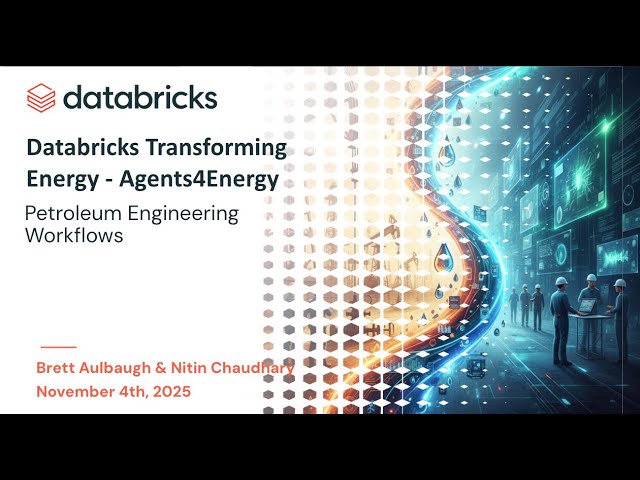
Explore how Databricks AI Agents revolutionize petroleum engineering through intelligent automation and advanced analytics in this 52-minute webinar. Discover how decades of complex petroleum engineering workflows—including reservoir analysis, production forecasting, and optimization—are being transformed from manual, code-heavy processes into streamlined, automated systems. Learn about Databricks Agents4Energy and its capabilities for automating petroleum analytics while maintaining enterprise-grade governance and compliance standards. Examine real-world implementations where leading energy companies leverage agentic AI to significantly reduce time-to-insight, accelerate decision-making processes, and empower petroleum engineers to achieve greater productivity and efficiency in their analytical workflows.

YouTube
Explore a comprehensive 42-minute webinar on seismic exploration techniques in the petroleum industry. Gain insights into various survey types, including gravity, magnetic, and 4D surveys. Delve into seismic wave theory, data acquisition, and processing methods. Learn about upstream, midstream, and downstream activities, as well as Direct Hydrocarbon Indicators (DHI). Enhance your understanding of geosciences and petroleum engineering through this informative session presented by Mr. Zareef from PetroNile Academy.
Swayam
ABOUT THE COURSE:Petroleum Data Analytics (PDA) is rapidly transforming the oil and gas industry through the integration of Artificial Intelligence (AI) and Machine Learning (ML). As we look ahead, it's evident that mastering these technologies will be pivotal for shaping the future of engineering disciplines, particularly in petroleum engineering.This 12- weekcourse aims to equip the next generation of petroleum professionals with essential foundations in PDA. While it's acknowledged that a single course cannot cover all aspects of becoming a PDA expert, it serves as a crucial starting point. Participants will gain a realistic understanding of AI and ML fundamentals as they apply to solving engineering challenges in the petroleum sector.For engineering-domain experts, transitioning into skilled AI and ML practitioners is becoming increasingly important. The ability to harness data-driven insights through these technologies will not only optimize existing processes but also drive innovation in exploration, production, and operational efficiency within the industry.Ultimately, this course serves as a catalyst for enthusiasts and professionals alike to grasp the transformative potential of PDA. It's a step towards unlocking the future where data-driven strategies and advanced analytics play a central role in shaping the trajectory of the oil and gas industry.INTENDED AUDIENCE: Undergraduate, post graduate and PhD students’ professional practitioner in the discipline of Petroleum Engineering, Petroleum Refinery Engineering, Chemical EngineeringPREREQUISITES: Bachelor’s degree in any Engineering disciplineINDUSTRY SUPPORT: ONGC,OIL, ESSAR, IOCL, CAIRN, GAIL

YouTube
Dive into an in-depth lecture on Reservoir Monitoring & Surveillance, presented by Engineer Mahmoud Farag. Explore advanced techniques and methodologies used in the oil and gas industry to effectively monitor and surveil reservoir performance. Gain valuable insights into the latest technologies and best practices employed for optimizing reservoir management strategies. Learn about data acquisition, interpretation, and analysis methods crucial for maintaining efficient production and maximizing resource recovery. Enhance your understanding of reservoir behavior, pressure maintenance, and production optimization through real-world examples and case studies. Ideal for petroleum engineers, geologists, and professionals seeking to expand their knowledge in reservoir engineering and management.

YouTube
Explore the essential principles of basin and petroleum system modeling in this comprehensive 1-hour 47-minute webinar presented by Reservoir Solutions (RES). Gain valuable insights into the fundamental concepts and techniques used to analyze sedimentary basins and evaluate petroleum systems. Learn about the geological processes that shape basins, the factors influencing hydrocarbon generation and migration, and the tools used to model these complex systems. Discover how basin and petroleum system modeling can enhance exploration strategies, risk assessment, and resource evaluation in the oil and gas industry. Delve into topics such as thermal history reconstruction, source rock characterization, and fluid flow simulation. Enhance your understanding of this critical aspect of petroleum geoscience and its applications in modern exploration and production workflows.