

Courses
Discover thousands of courses from top institutions and platforms worldwide
Level
Course Type
Duration

Udemy
An ever expanding program of courses helping financial professionals aspire to the top levels of financial leadership What you'll learn: Analyze financial statements to gain deeper insight into the financial results, profitability, financial strength, and cash return generation potential.Facilitate development of an Enterprise Risk Management system using the principles of the COSO ERM framework.Develop a financing strategy including the different varieties of financing, how each work, and when to seek each source of financing.Raise your awareness of fraud risk including how it happens, why it happens, and how to best prevent it from happening in your organization.Make a valuable contribution as the business develops, analyzes, implements, and evaluates corporate strategy.Learn the principles of change management to address the people aspects of adapting to new ways of conducting businessPrepare financial models to support a wide variety of organizational objectives including decision making and fund raising Are you a financial professional working in industry looking to get more out of your career?Do you have what it takes to sit at the boardroom table at your company and contribute?Do you want to take what you know about the numbers side of the business and make a greater contribution at the highest levels?If this is the way you are thinking today and the direction you'd like to go, then this is the leadership program for you.Hi there, I’m Blair Cook and I’m a seven time CFO and three time corporate director. I’ve spent the past two decades around the boardroom table facilitating strategy sessions, raising financing, negotiating mergers and acquisitions, and reporting to a board of directors or serving on the board of directors.In this program, we have curated ideas to help financial professionals move from the cubicle to the corner office as soon as possible. Its table stakes that you know the numbers and can prepare the reports. In this program, you’ll learn to move beyond the accounting to think strategically, act as a catalyst leader, and influence the decisions of any organization for the better.What are you waiting for? Enroll with us now to get started!

Udemy
Certified Chief Executive Officer (CEO) Program by MTF Institute: Business, Governance, Legal, Finance, Commerce domains What you'll learn: Role of Chief Executive OfficerLegal FocusFinancial FocusCommercial FocusDue DiligenceEmployers of CEORisks for CEO Welcome to course: Chief Executive Officer Program by MTF Institute! Video materials of that program the same with course: Executive Diploma of Chief Executive Officer Course provided by MTF Institute of Management, Technology and FinanceMTF is the global educational and research institute with HQ at Lisbon, Portugal, focused on business & professional hybrid (on-campus and online) education at areas: Business & Administration, Science & Technology, Banking & Finance. MTF R&D center focused on research activities at areas: Artificial Intelligence, Machine Learning, Data Science, Big Data, WEB3, Blockchain, Cryptocurrency & Digital Assets, Metaverses, Digital Transformation, Fintech, Electronic Commerce, Internet of Things. MTF is the official partner of: IBM, Intel, Microsoft, member of the Portuguese Chamber of Commerce and Industry.MTF is present in 208 countries and has been chosen by more than 400 000 students. Course Author:Igor DmitrievDigital Business & Transformation ExpertEducation:• MBA, The Boston University, USA• Master of Science at Engineering (Technical) Management, The State University of New York at Buffalo, USA• Master of Science at Informatics and Economics, The Saint- Petersburg State University of Finance and Economics• Six Sigma Black Belt Experience:• Expert at Banking (>15 years), FinTech & Digital (>12 years). Experienced Manager (>10 years) with successful track of records at personal and corporate entrepreneurship.• More than 10 years at worldwide banking groups such us Societe Generale, Raiffeisenbank.• Experience at roles: CEO, Head of Business, Chief Digital & Marketing Officer, Head of Digital Transformation and Channels, Head of Products and Marketing. The Chief Executive Officer (CEO) is a pivotal leadership role within an organization, responsible for steering the company towards its strategic goals and ensuring its overall success. The CEO serves as the highest-ranking executive and is accountable for the overall performance, direction, and decision-making of the company. The role encompasses a diverse set of responsibilities, and a CEO is expected to wear multiple hats to effectively lead and manage the organization. Key aspects of the CEO role include: Strategic Vision and Planning: The CEO is responsible for developing and communicating a clear vision for the company. They must also formulate and execute strategic plans that align with the organization's mission and objectives. Leadership and Decision-Making: CEOs provide leadership to the executive team and the entire organization. They make crucial decisions that impact the company's direction, growth, and overall performance. Stakeholder Management: CEOs must effectively engage with various stakeholders, including investors, customers, employees, and the board of directors. Building and maintaining positive relationships with these stakeholders is crucial for the company's success. Risk Management: CEOs are tasked with identifying and mitigating risks that could impact the organization. This includes overseeing financial management, regulatory compliance, and other aspects that contribute to the company's stability. Innovation and Adaptability: CEOs must foster a culture of innovation within the organization and be adaptable to changes in the business environment. They play a crucial role in ensuring the company remains competitive and responsive to market dynamics. Corporate Governance: CEOs are responsible for upholding ethical standards and ensuring compliance with legal and regulatory requirements. They work closely with the board of directors to maintain effective corporate governance. For employers and managers, understanding the CEO role is essential for several reasons: Strategic Alignment: Employees at all levels need to understand how their work contributes to the overall strategic objectives of the company. Knowledge of the CEO's role helps align individual and team efforts with the organization's vision. Decision-Making Perspective: Managers can benefit from understanding the decision-making processes of CEOs. This knowledge can enhance their own decision-making skills and enable them to contribute more effectively to the organization. Leadership Development: Aspiring leaders can learn from the CEO's leadership style and strategies. Studying the CEO role provides valuable insights into the qualities and skills required to lead an organization successfully Career Advancement: Employees with a comprehensive understanding of the CEO role are better equipped to advance their careers. They can position themselves as strategic thinkers and leaders, making them valuable assets to the organization. For those aspiring to become future CEOs, acquiring knowledge about the CEO role is crucial for building a successful career. This includes: Leadership Skills Development: Learning from the experiences and approaches of successful CEOs helps in honing leadership skills. This includes the ability to inspire and motivate teams, make tough decisions, and navigate complex challenges. Strategic Thinking: Future CEOs must develop a strategic mindset, understanding how to set long-term goals, analyze market trends, and make decisions that position the company for sustainable growth. Communication and Stakeholder Management: Effective communication with various stakeholders is a critical aspect of the CEO role. Developing strong communication and relationship-building skills is essential for future leaders Financial Acumen: CEOs are responsible for the financial health of the organization. Building financial literacy and understanding key financial metrics is crucial for making informed decisions and ensuring the company's success. Adaptability and Resilience: The business landscape is dynamic, and CEOs must navigate uncertainties and challenges. Future CEOs should cultivate adaptability and resilience to thrive in ever-changing environments. Understanding the role of a CEO is essential for both current managers and aspiring leaders. It provides valuable insights into effective leadership, strategic decision-making, and the overall dynamics of running a successful organization. This knowledge not only contributes to individual career development but also enhances the overall performance and success of the company.
Udemy
A 52-Week Executive Journey to Build Visionary, Technical, and Strategic Leadership in Modern Technology Organizations What you'll learn: Define and embody the strategic role of a CTO across startups and enterprisesCreate a long-term technology vision aligned with business goalsDesign scalable engineering orgs and build high-performance technical teamsMake effective architecture and infrastructure decisions at scaleLead DevOps, security, and compliance practices with executive accountabilityLead DevOps, security, and compliance practices with executive accountabilityCommunicate with boards and C-suites using strategic metrics and storytellingDevelop a personal CTO playbook and capstone to demonstrate executive readiness The Chief Technology Officer Mastery Program is a comprehensive, 52-week executive-level curriculum designed to equip current and aspiring CTOs with the strategic, technical, and leadership skills required to thrive in today's fast-evolving tech landscape. Whether you’re leading a startup engineering team, scaling enterprise platforms, or driving AI-powered innovation, this program will help you build the mindset, playbook, and influence of a world-class CTO.Over the course of 12 months, participants will dive deep into all core pillars of modern CTO leadership. You’ll begin by clarifying the CTO's role in varying organizational contexts—from early-stage startups to large, complex enterprises. You’ll gain insight into executive leadership styles, understand the distinctions between CTO, CIO, and CPO roles, and define your own technology leadership manifesto.From there, the program moves into strategic technology planning, guiding you through the creation of a compelling technology vision, alignment with business strategy, and development of scalable roadmaps. Learn how to structure your engineering organization for growth, master hiring and talent strategy, and build a high-performance engineering culture rooted in psychological safety, DEI, and clear career ladders.As a technology leader, your ability to make sound architectural decisions is critical. You’ll explore system design, infrastructure tradeoffs, technical debt strategy, and the evolving landscape of DevOps, CI/CD, and Infrastructure as Code (IaC). Specialized modules on security, compliance frameworks (like SOC2, GDPR, and ISO27001), and incident management will prepare you to lead in high-stakes environments with confidence.A strong CTO must also be an exceptional product partner. Learn how to drive agile execution, make strategic tradeoffs between technical debt and product velocity, and apply design thinking to your technology roadmap. Then, build your readiness to lead data and AI strategy—from data governance and business intelligence to MLOps, LLMs, and AI ethics.Throughout the journey, you’ll develop skills in executive communication, including board presentations, stakeholder management, and crisis communication. You’ll also explore budgeting, cloud cost optimization, vendor negotiation, and leading cross-functional collaboration across Product, Marketing, Sales, and HR.The final phase of the program focuses on your legacy and growth as a CTO. You’ll reflect on crisis leadership, succession planning, burnout prevention, and long-term career development. Your journey culminates in a Capstone Project: a fully developed CTO Playbook and Strategic Vision, which you'll present to a mock executive board panel for feedback and refinement.Whether you're a rising engineering leader or a seasoned technologist transitioning into executive leadership, this program provides the tools to lead with vision, technical authority, and cross-functional influence. Graduate with a CTO portfolio that demonstrates your readiness to lead at the highest level—and a network of peers and mentors to support you in your next chapter.

YouTube
Explore the concept of Open Source Program Offices (OSPOs) in this informative 55-minute conference talk presented by Ana Jiménez Santamaría from the TODO Group and Thomas Steenbergen from EPAM. Gain insights into the OSPO Mind Map, a community-created tool designed to provide a comprehensive overview of OSPO key areas, including responsibilities, roles, behaviors, and team sizes. Learn how this mind map can be utilized to implement OSPO strategies, structure activities, and improve communication within organizations. Discover the story behind the OSPO Mind Map project, practical implementation techniques, and ways to contribute to this open-source initiative. Understand the complexities of managing open source in organizations and how the OSPO Mind Map can help simplify and organize these efforts.

YouTube
Explore the journey of establishing an Open-Source Program Office at Blue Cross NC in this 31-minute conference talk presented by Paul McLaughlin at Open Source 101 2023 in Charlotte. Gain insights into the challenges and solutions encountered during the early stages of expanding an open-source environment. Learn how to navigate the complexities of shared responsibilities, seize opportunities, and mitigate risks associated with open-source software adoption. Discover the grassroots approach used to lay the foundation, secure sponsorship, and realign multiple functional areas to leverage open-source software safely. Benefit from the speaker's experiences, including modest successes and valuable lessons learned. Access accompanying slides for a comprehensive understanding of the bootstrapping process and its impact on Blue Cross NC's open-source initiatives.

YouTube
Explore program synthesis with Herb.jl in this 10-minute conference talk from JuliaCon 2024. Discover how this Julia library automates program generation from specifications, providing a toolbox for developing new synthesizers and unifying various synthesis approaches. Learn about Herb.jl's dual goals of filling a community gap and creating a framework for easy application of existing synthesizers to new problems. Gain insights into how Julia enhances library development, algorithm speed, and synthesis procedure composability in the context of program synthesis.

YouTube
Explore the collaborative dynamics between Open Source Program Offices (OSPOs) and Project Management Organizations (PMOs) in this insightful 42-minute conference talk. Learn how these two centers of excellence can effectively work together to enhance open source initiatives within medium-to-large companies. Discover specific examples of problem-solving, conflict resolution, and ongoing challenges faced during a four-year collaboration. Gain valuable insights on connecting OSPOs and PMOs, understanding the importance of open source for PMOs, the benefits of embedding PMO members in OSPOs, and strategies for making significant community impacts with limited resources. Understand how to bring more partners to the table, evaluate goals, and build consensus in open source program management.

YouTube
Explore the concept of University-based Open Source Programs Offices in this 26-minute talk by Sayeed Choudhury from Johns Hopkins University. Gain insights into how academic institutions are embracing open source initiatives, fostering collaboration, and contributing to the broader open source community. Learn about the structure, goals, and potential impact of these programs within university settings, as well as the challenges and opportunities they present for students, faculty, and researchers.

YouTube
Explore insights from a panel discussion featuring experts from Innersource Commons, Johns Hopkins University, Rochester Institute of Technology, UC Santa Cruz, and Trinity College Dublin as they share valuable lessons learned from implementing Open Source Program Offices (OSPOs) in university settings. Gain a deeper understanding of the challenges, successes, and best practices in integrating open source initiatives within academic institutions, and discover how these experiences can inform and improve your own approach to open source in higher education.
YouTube
Explore the latest developments in Open Source Program Offices (OSPOs) through this keynote presentation from the TODO Group at OSPOCon. Join Ana Jimenez Santamaria and Chris Aniszczyk as they provide valuable insights into the current state of OSPOs, emerging trends, and best practices in open source management. Gain a deeper understanding of how organizations are leveraging OSPOs to drive innovation, collaboration, and strategic open source initiatives. Learn about recent OSPO success stories, challenges faced by the community, and future directions for open source program management. This 38-minute talk offers essential knowledge for open source professionals, business leaders, and anyone interested in the evolving landscape of open source in enterprise settings.

YouTube
Explore the evolution of Open Source Program Offices (OSPOs) in this insightful 16-minute keynote address delivered by Nithya Ruff, Director of OSPO at Amazon. Gain valuable insights into the current state of OSPOs, their role in driving open source strategy and operations within companies and institutions, and the significant changes and growth experienced in 2023. Delve into the new challenges and opportunities facing OSPOs today, and understand how these organizations are adapting to meet the evolving needs of the open source ecosystem.

YouTube
Discover strategies for demonstrating the value of an Open Source Program office in this insightful conference talk from SOOCon23 Government & Law. Learn from Chris Howard, Lead Open Source Program Manager at EPAM Systems, as he shares expert insights on establishing and maintaining a successful open source initiative within organizations. Gain practical advice on measuring impact, communicating benefits to stakeholders, and overcoming common challenges faced by Open Source Program offices. Explore best practices for aligning open source efforts with business objectives and fostering a culture of collaboration and innovation.

YouTube
Explore the journey of establishing an Open Source Program Office at a major financial institution in this 42-minute conference talk. Gain insights into the successes, challenges, and strategies employed to foster open source adoption and engagement within a corporate environment. Learn about the motivations behind embracing open source, the steps taken to improve developer experience, and efforts to encourage employees to prioritize open source in their work. Discover how the program office advocates for the benefits of open source software and actively engages with the wider open source community. Understand the complexities of implementing such an initiative, including addressing social media policies and overcoming corporate hurdles. Delve into the speaker's experiences as a Tech Fellow in Core Engineering and the impact of this flagship initiative on the company's technological landscape.

edX
Organizations and stakeholders are having to simplify, break molds, and remove resistance to delivering faster at scale. Program Management Office (PMO) is the entity that can bring this leadership and provide ownership. The type of PMO affects what success looks like strategically for the enterprise. In order to reach a 10X organization, leaders who understand the business and operational models and what enhancements they require are vital. The pressure to reach a 10X plus organization is requiring leaders who understand the business and operational models and what enhancements are vital by using value-driven roadmaps; Studies have shown that 95% of the decisions we make are the result of an intuitive approach and not of rational logic. Addressing program biases and enhancing experimentation will contribute to our sustained relevance of program management in the marketplace. In this course, you will learn how organizations are having to simplify, break molds, use meaningful templates, and remove resistance to deliver programs faster at scale. Focusing on project performance and getting the PMO to take the lead in maintaining standards and enhancing the quality of our investment decisions and the proper cascading of those choices are critical successful execution measures. The portfolio management view will provide you with critical risk-based governance skills and a practical understanding of how to build hybrid program teams. Change management and transformation initiatives solve complex issues and you will learn how to contribute to building and driving learning and continuously improving future organizations.

YouTube
Explore the comprehensive journey of establishing an Open Source Program Office (OSPO) within a corporation in this 42-minute conference talk from the Open Source Summit Europe. Learn about crafting foundational policies, ensuring compliance with open source licenses, and tracking employee contributions to open source projects. Discover strategic approaches for releasing initial open source projects and understand how integrating open source practices aligns with core company values, particularly in sustainability. Gain insights into the pivotal role of open source participation in advancing corporate innovation and upholding commitments to sustainable practices. Delve into the detailed roadmap provided for organizations looking to embark on a similar path, highlighting the importance of open source in fostering both technological innovation and a sustainable ecosystem.

YouTube
Gain insights into Goldman Sachs' Open Source Program Office's first year of operation in this 50-minute conference talk presented by Robert Underwood. Explore the challenges, successes, and lessons learned as the financial giant embraced open source initiatives. Discover how Goldman Sachs implemented its open source strategy, fostered collaboration within the organization, and contributed to the broader open source community. Learn about the impact of the program office on innovation, talent acquisition, and technological advancement within the company.
YouTube
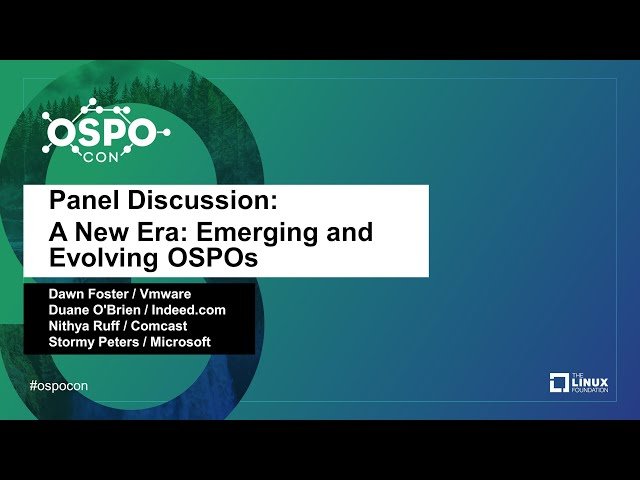
Join a panel discussion featuring industry experts Dawn Foster (VMware), Duane O'Brien (Indeed.com), Nithya Ruff (Comcast), and Stormy Peters (Microsoft) as they explore the emergence and evolution of Open Source Program Offices (OSPOs). Gain valuable insights into the changing landscape of open source management within organizations, learn about best practices for establishing and running successful OSPOs, and understand the challenges and opportunities faced by companies embracing open source initiatives. Discover how these leaders are shaping the future of open source collaboration and governance in their respective industries.

YouTube
Explore the world of Open Source Program Offices (OSPOs) in this 26-minute panel discussion featuring experts from the open source community. Gain insights into the role of these cross-functional teams embedded within companies, their responsibilities, and the challenges they face as connectors between organizations and the open source community. Learn valuable tips for running successful OSPOs from panelists including Felix Faasen from TomTom, Ana Jiménez Santamaría from TODO Group, Manrique López de la Fuente, and Guy Martin, an Open Source Executive. Discover how OSPOs have evolved over the past decade and their significance in today's open source landscape. Whether you're involved in open source projects or interested in understanding the organizational aspects of open source contributions, this panel discussion offers valuable perspectives on the importance and function of Open Source Program Offices.
YouTube
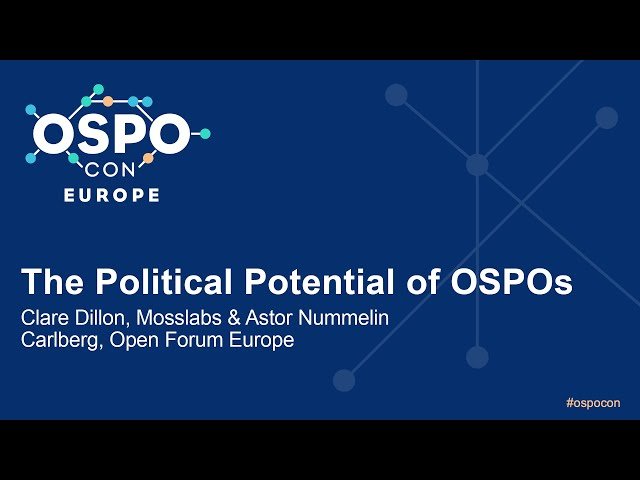
Explore the growing trend of Open Source Program Offices (OSPOs) in the public sector and their potential to deliver value for citizens worldwide in this 38-minute conference talk. Discover how OSPOs are being established at city, regional, national, and supranational levels, and learn about their role in unlocking significant value for the ICT industry. Examine data and analysis from the European Commission study on the economic impact of open source software, including the recommendation to build a network of 20 OSPOs in government and academia. Gain insights into how governments can define open source goals and utilize OSPOs as enablers. Investigate the diverse range of OSPOs emerging in the public sector, their potential opportunities, and challenges in networking for large-scale impact. Delve into topics such as economic growth, institutional infrastructure, semantic interoperability, citizen value, and community building. Understand the rationale behind recent public sector developments and their potential impact on open source initiatives.

YouTube
Explore a case study examining how an Open Source Program Office (OSPO) drives innovation within an organization. Gain insights from Wind River's experience as Mark Gisi and Amanda Huynh discuss the OSPO's role in fostering creativity, collaboration, and technological advancement. Learn about strategies for leveraging open source technologies to fuel innovation, overcome challenges, and create a culture of continuous improvement. Discover best practices for aligning open source initiatives with business objectives and maximizing the potential of open source communities to drive organizational growth and success.