

Courses
Discover thousands of courses from top institutions and platforms worldwide
Level
Course Type
Duration
Udacity
Learn how to build and program intelligent robots with this Robotics Software Engineer Nanodegree. Master ROS, path planning, and environment mapping through projects led by experts.

YouTube
Explore the potential of foundational models in robotics and their impact on human-computer interfaces in this lecture from the CS 601.471/671 NLP: Self-supervised Models class. Discover how large models can empower users with generative AI capabilities, removing the need for engineers in the loop. Examine ChatGPT's application in robotics, including autonomous flight experiments and design principles for effective usage. Learn about deployment strategies with user involvement, multi-modal properties, and community support through prompt libraries and simulators. Gain insights into mathematical definitions and system overviews as the lecture delves into the future of robotics and AI integration.

Udemy
With over 45,000 enrolled in the first two courses, and over a 4.6 star rating! What you'll learn: How do we make a robot move? What kind of ways are there to power our robots and how can we use even tiny motors to move a substantial load? How can we make things like robotic, bionic arms? These are the things we'll explore with first hand application and practical experiments that you can perform at home to get you one step closer to designing and building robots and robotic systems. Please note:Still adding content. Thanks for your patience!Last update:September 2023Building on the knowledge you gained in the Analog Electronics and Digital Electronics modules, you'll open even more doors to diverse careers and hobbies by learning how to physically move robots and mechatronics. Robotic drives and physics are intimately intertwined - almost the same topic in fact. And think about all the things around you that are moved or operated automatically:from the furnace and air handlers in your office building, to so many functions in your car, and then the booming robotics field in industry, mass production, even entertainment! People are needed who understand how those robots work in order to design, install, program and maintain those robots. Maybe you're interested in building a submarine robot to dive to shipwrecks or places normally unreachable by humans. We'll actually look at a real-world case study and use our new-found knowledge of physics to design a submarine robot to operate at depths of 600 meters or more. Or perhaps you are just interested in competition robotics like the gladiator-style battle robots which go head-to-head to destroy each other. 3D printers (of which we design and build one in course 4) are essentially robots! All of these topics involve a good understanding of robotic drive systems and physics which you will learn in this course. With over 45,000 students enrolled in the first two courses in the "Robotics:Learn by building" series, more than 3,200 five star ratings in the first course alone, students aged 8 to 60+ have enjoyed the course series and its projects.No prior knowledge of mechanics, physics or robotics is needed. You will need a good understanding of electricity & electronics and digital control and some basic math. If you have completed course 1 "Electricity and Electronics" and course 2 "Digital Electronics" you have the background you need as we will be using those skills in this course to drive different kinds of electric motors.All courses havecaptions for the hearing impaired. Course materials:You will need the analogelectronic parts and a breadboard, which you can purchase as an accompanying kit(i.e.,the Analog Electronics Kit from module I) or provide your own, as well as the parts from the digital electronics kit (i.e., the Digital Electronics Kit from module II) or provide your own Arduino controller board and some logic-level, high power MOSFET's.You will alsoneed the Robotic Drives & Physics Experimenter's kit which again you can purchase as an accompanying kit or provide your own parts. The first lesson is a walk-through of what is in the kit and acts as a parts list for this module. This series of "Robotics:Learn by building" modules has an end-goal focus on the diverse field of robotics. In module I we learned the basics of electricity and electronics. In this module II you further developed your knowledge and skills to include digital electronics and practice your skills on real-life digital components. In this third course you will learn physicsprinciples (from simple to very complex) with a specific goal of understanding and even designing your own drive systems for robots. You will learn details about different robotic drive systems you will see in commercial, industrial robots like how timing belt drives work and why they are so important in robotics, as well as the more esoteric drives like the harmonic drive - what it is an how that amazing system works.We will even look at a real-life case study as we design a submarine robot, remotely operated and able to withstand the bone-crushing operating depths of over 600 meters minimum.The unique challenges we will face will build up your knowledge so that you too can design sea-floor robots facing harsh environments to perform inspection, welding or maintenance on submarine pipes or cables.This course is the prerequisite for the module IV course whereyou'll learn prototyping skills, and gain a wide variety of knowledge and skills so you can actually build your own robots and manufacture your own parts. In module IV, you'll culminate all you've learned so far as you build a 3D printer from scratch, hook it up to a desktop computer and make your own plastic parts. The 3D printer is, in effect, a robot which you can then use to make parts for your other robot designs. In module V you can take your robot design and construction skills to the next level with a hands-on approach to autonomous robotic systems: learning about various sensors to know where you are and what your robot is doing, GPS navigation, basic artificial intelligence, powerful microchips known as FPGA's where you literally design a custom circuit on the chip, vision systems and more. Lesson overview:In this course we'll be covering:Simple machines (which all come into play in surprising ways you probably haven't seen before)Designing an arm robotThe toggle mechanism (again, comes into play in a ridiculous number of surprising ways you probably haven't seen before)harmonic drives, cycloidal drives, epicyclic drives, traction drivesstrength of materials & construction challengecase study:design challenges of a deep-submarine, remotely operated vehiclehydraulics & pneumatics (including building your own)air & hydraulic muscles, muscle wire servos (speed, pressure, force, position, etc...)DC motors, BLDC motors, BLDCservo motors, stepper motors, ACmotors, AC servo motors, single and three phase power, electrical generationfrequency drives, PWMACsignal generationregenerative / rheostatic / dynamic braking, looking at electric vehicle design and locomotive designcounter-force systems you will encounter in industrial robotssafety around robot systems, in industry and hobbyrobot designs:articulated arm, gantry, spine, collaborativecase study:combat robots and more!

YouTube
Explore the innovative world of soft robotic grippers using Kirigami shells in this 48-minute podcast featuring Dr. Madi Babaiasl and Prof. Douglas Holmes from Boston University. Dive into the research behind designing grippers capable of handling objects from a grain of sand to a water bottle, including delicate and slippery items. Learn about the cut patterns, materials, and applications of these grippers in fields such as agriculture, healthcare, and industry. Discover the process of determining cut patterns, the impact of material choice on gripper design, and how these grippers can assist people with hand deformities. Gain insights into lab dynamics, the excitement of being a professor, and the importance of a collaborative research environment. Conclude with Prof. Holmes's contact information for potential collaborations and hear what others say about this groundbreaking research.

YouTube
Explore the latest advances, challenges, and societal implications of robotic technology at the intersection of artificial intelligence in this 8.5-hour conference hosted by Stanford University. Delve into how researchers, engineers, social scientists, and policymakers can collaborate to navigate the rapidly evolving landscape of robotics. The conference features interactive robot demonstrations organized in partnership with the Stanford Robotics Center, providing hands-on experience with cutting-edge robotic technologies. Gain valuable insights into creating human-centered robotic systems that address real-world challenges while considering ethical and societal impacts.

The Great Courses Plus
<p>Investigate the fascinating field of modern robotics in 24 lectures by a brilliant roboticist.</p>

YouTube
Instructors: Prof. C. Amaranth, Prof. K. Kurien Issac, Prof. C. Seshu, Prof. B. Seth, and Prof. P. S. Gandhi, Department of Mechanical Engineering, IIT Bombay. This course deals with topics in robotics: technologies in robotics, its parallel and grippers manipulators, sensors, trajectory planning, velocity analysis, image processing, forward position control, and dynamic analysis of robotics.

Coursera
Collaborative Robotics in Manufacturing merges traditional manufacturing with cutting-edge robotics, equipping learners with skills to navigate modern manufacturing. Foundational Industrial Manufacturing knowledge highlights robotics' role in enhancing efficiency and precision. Introductory Mechatronics integrates engineering principles for robotic system development. Understanding Introductory Electronics aids in comprehending digital control circuitry and sensor technologies. Applied Physics principles furnish analytical tools for robotic system design. Graduates excel in Robotic Manipulator and Gripper Design, integrating Mechanical Components with Digital Control Circuitry for optimized performance. Sensor & Transducer Technology mastery enables real-time monitoring and control, enhancing productivity. Drive Systems expertise ensures adaptability to diverse manufacturing environments. Troubleshooting in Mechatronic Systems and System Design using MATLAB-Simulink enables efficient issue resolution. Robot Programming skills empower precise and efficient control. Robotic Vision Systems and Machine Vision augment automation and quality control. Integration of IIoT technologies drives efficiency in collaborative robotic systems. Graduates find career opportunities as Automation Engineers and Robotic Designers, shaping the future of manufacturing with innovation and efficiency.

YouTube
Explore edge computing solutions for robotic applications in this comprehensive conference talk from Conf42 IoT 2024. Discover various types of robots and their increasing prevalence in modern applications, while understanding the limitations of traditional cloud computing approaches in robotics. Learn how edge computing addresses critical challenges in robotic systems, with detailed insights into application servers and platforms. Gain practical knowledge about implementing Jakarta EE and the Payara Platform for robotic applications, illustrated through live demonstrations. The presentation covers essential topics including the widespread use of robotic arms, cloud integration challenges, and practical solutions for edge computing implementation. Watch real-world demonstrations showcasing edge computing applications in robotics, providing valuable insights for developers and engineers working with automated systems.
YouTube
Explore a one-hour conference talk from CppCon that delves into the critical intersection of C++ programming and surgical robotics development. Learn how distributed robotic surgical systems are built with a focus on safety, performance, and reliability while adhering to strict medical industry standards and regulations. Through a real-world case study of surgical robotic system development, discover architectural decisions and strategies for implementing efficient, safe, and reliable software that meets international medical device safety standards. Gain insights from Staff Robotics Software Engineer Milad Khaledyan's experience at Johnson & Johnson MedTech as he shares practical techniques for overcoming challenges in this highly regulated domain.

YouTube
Explore a cutting-edge robotics colloquium featuring Coline Devin from Google DeepMind as she presents "RoboCat: A Self-Improving Agent for Robotic Manipulation." Delve into the potential of leveraging diverse robotic experiences to master new skills and embodiments quickly. Learn about RoboCat, a multi-embodiment, multi-task generalist agent for robotic manipulation, designed as a visual goal-conditioned decision transformer. Discover how this innovative agent can generalize to new tasks and robots, both zero-shot and through rapid adaptation. Gain insights into the agent's capabilities through large-scale evaluations in simulation and on real robot embodiments. Understand how RoboCat's training data diversity contributes to cross-task transfer and improved efficiency in adapting to new tasks. This 51-minute talk, part of the Paul G. Allen School's 2023 Fall Robotics Colloquium, offers a glimpse into the future of robot learning and autonomous improvement loops in robotic manipulation.

YouTube
COURSE OUTLINE: The course will start with a brief introduction to robots and robotics. The motivation behind keeping robots in modern industries will be discussed. After providing a brief history of robotics, different components of a robotic system will be identified. The method of determining degrees of freedom of a robotic system will be discussed with some examples. After classifying the robots based on certain criteria, workspace analysis of manipulators will be carried out. Applications of robots in different areas like in manufacturing units, medical science, space, and others, will be discussed. Various methods of robot teaching will be explained with some suitable examples. Economic analysis will be conducted to decide whether we should purchase a robot. Both forward and inverse kinematics problems will be solved with the help of some suitable examples. To ensure smooth variation of joint angles of the robot, trajectory planning schemes will be explained. After carrying out velocity analysis with the help of Jacobian matrix, inverse dynamics problems of robots will be solved using Lagrange-Euler formulation. Control scheme used in robots to realize the joint torques will be discussed. Besides manipulators, analysis will be carried out on wheeled and multi-legged robots. The working principles of various sensors used in robots will be explained in detail. The steps to be followed in robot vision will be discussed with some suitable examples. The principles of motion planning algorithms will be explained in detail. Thus, this course will deal with all the issues related to kinematics, dynamics, control schemes and robot intelligence.

YouTube
Explore the latest advancements in dexterous robotic manipulation in this 59-minute colloquium talk by Matei Ciocarlie from Columbia University. Delve into the convergence of sensor design, mechanisms, and computational motor learning that has finally enabled true robotic dexterity. Learn about the "Hardware as Policy" approach, which optimizes underactuated hand transmission mechanisms alongside grasping policies. Discover the innovative optics-based tactile finger design, providing accurate touch information across multi-curved surfaces. Examine the development of tactile-based policies for in-hand manipulation and object recognition through motor learning. Consider the future implications of these breakthroughs, including ways to enhance robustness, versatility, and generalization of dexterous manipulation, as well as potential new applications in robotics.
YouTube
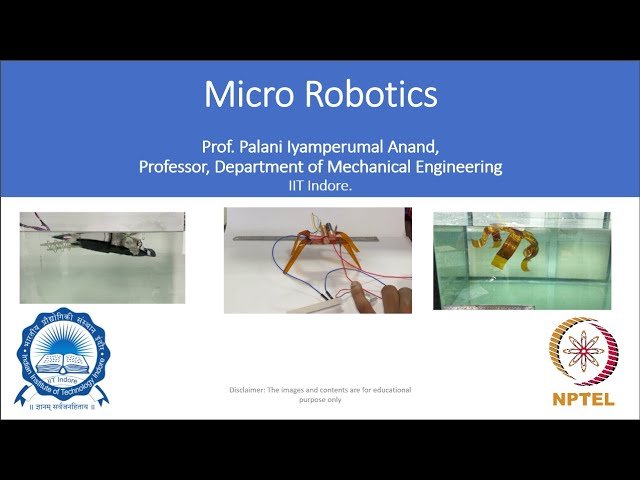
Explore advanced bio-inspired propulsion and locomotion mechanisms in this 25-minute lecture that examines how nature's designs can be applied to micro-robotics. Delve into cilia-based locomotion and actuation systems, understanding how microscopic hair-like structures create movement in biological organisms and their robotic counterparts. Investigate jet propulsion mechanisms found in marine life and learn how these principles are translated into micro-robot design. Study jellyfish-structured systems and their unique propulsion methods that inspire soft robotics applications. Analyze evaluation methodologies for bio-inspired robots, including performance metrics and design optimization techniques that help engineers create more efficient micro-robotic systems based on biological models.

MIT OpenCourseWare
Robots today move far too conservatively, using control systems that attempt to maintain full control authority at all times. Humans and animals move much more aggressively by routinely executing motions which involve a loss of instantaneous control authority. Controlling nonlinear systems without complete control authority requires methods that can reason about and exploit the natural dynamics of our machines. This course discusses nonlinear dynamics and control of underactuated mechanical systems, with an emphasis on machine learning methods. Topics include nonlinear dynamics of passive robots (walkers, swimmers, flyers), motion planning, partial feedback linearization, energy-shaping control, analytical optimal control, reinforcement learning/approximate optimal control, and the influence of mechanical design on control. Discussions include examples from biology and applications to legged locomotion, compliant manipulation, underwater robots, and flying machines. Acknowledgments Professor Tedrake would like to thank John Roberts for his help with the course and videotaping the lectures.

FutureLearn
Explore the history and evolution of robotics Robots today are roving Mars, hoovering our floors, building cars and entertaining us in films. But how do robots achieve particular tasks? And how is our relationship with them evolving? On this four-week robotics course from the University of Reading, you’ll gain a solid introduction to robotics to answer these questions and more. You’ll delve into the different applications of robots, human-robot interaction, and robot cooperation that mimics living systems. Understand how sensors, actuators, and controllers bring robots to life As you discover the basics of robot anatomy, you’ll explore the key components of robot design, control, and behaviour. Through a series of practical simulations, you’ll test drive an ERIC – University of Reading’s very own mobile robot. You’ll command ERIC to explore its environment as it avoids obstacles, follows a line, and acts like a Braitenberg vehicle. Gain an understanding of cybernetics Next, you’ll delve into cybernetics and the importance of control systems, feedback loops, and human-machine interactions. You’ll discover the systems behind robotic perception and decision-making, before commanding ERIC to track a moving object and be introduced to virtual reality, interaction, and haptic technology. Build and control robots through interactive simulations Finally, you’ll examine robot instincts and learning and discuss the advantages and disadvantages of robots adapting their behaviour. Learning from the experts at the University of Reading, you’ll gain theoretical knowledge and practical skills as you’re guided through simulations to help you practise what you have learned. By the end, you’ll have the knowledge and skills to move on to more advanced robotics topics. The course is designed for anyone interested in robotics. You don’t need to own your own robot to take part nor have any prior experience working with robots. Please be aware that this course contains video clips that include sequences of flickering/flashing lights, which might affect learners who are susceptible to photosensitive epilepsy.

MIT OpenCourseWare
This is a class about applying autonomy to real-world systems. The overarching theme uniting the many different topics in this course will center around programming a cognitive robotic. This class takes the approach of introducing new reasoning techniques and ideas incrementally. We start with the current paradigm of programming you're likely familiar with, and evolve it over the semester—continually adding in new features and reasoning capabilities—ending with a robust, intelligent system. These techniques and topics will include algorithms for allowing a robot to: Monitor itself for potential problems (both observable and hidden), scheduling tasks in time, coming up with novel plans to achieve desired goals over time, dealing with the continuous world, collaborating with other (autonomous) agents, dealing with risk, and more.

Udemy
Mathematical models and practical applications What you'll learn: Learn all the theoretical and practical details to master industrial robotics: solve kinematic models; plan geometrical paths and dynamic trajectories; tune motion control systems; calibrate tools and cells.We focus on a standard 6-axes anthropomorphic robot, because is one of the most commonly used robots in the industry, and it is also one of the most complicated ones, so that once you understand how this one works you should be able to solve models for all the others. Learn how anindustrial 6-axes anthropomorphic robot works. We will start bybuildingits kinematic model step-by-step, thenplan geometricalpaths and optimize motiontrajectories.We will learn how to correctlysize the electricmotors and understand thefine-tuning procedures forthe servo drives.We will describecalibration procedures for thearm,tool and cell,and finallygenerate a realistic digital twin for your simulations!New bonus lecture at the end: kinematic model of UR robot!

YouTube
Learn how to use MATLAB and Simulink with platforms like VEX Robotics, LEGO and other educational robotics kits. MathWorks experts share knowledge on elementary concepts in robotics for beginners.

YouTube
Dive into a comprehensive video series on modern robotics, covering essential topics from rigid-body motions to mobile manipulation. Explore degrees of freedom, configuration space, kinematics, dynamics, motion planning, and control systems. Learn about robot motion foundations, velocity kinematics, inverse kinematics, closed chain kinematics, and trajectory planning. Discover techniques for motion control, force control, and hybrid motion-force control. Examine grasping and manipulation concepts, including contact analysis and friction. Investigate wheeled mobile robots, their controllability, motion planning, and odometry. Gain insights into the latest advancements in robotics technology through detailed explanations and examples presented by Northwestern University experts.