

Courses
Discover thousands of courses from top institutions and platforms worldwide
Level
Course Type
Duration

YouTube
Explore the intersection of creativity, intelligence, and security analysis in this 38-minute conference talk from Security Onion Conference 2019. Delve into the analyst workflow, divergent and convergent thinking, and creative problem-solving techniques. Examine the Sock Study, which investigates research methodology, quantitative measures, and qualitative results in security analysis. Gain insights into the role of intuition in divergent thinking and learn how to generate high-quality responses in high-stakes situations. Discover a model for effective security analysis and understand its limitations. Enhance your understanding of academic research in the field of cybersecurity and its practical applications.

Udacity
The goal of the Security Analyst Nanodegree Program is to equip students with the skills required to be successful in an analyst role.

Udemy
Understand Data Security What you'll learn: Deep knowledge of organization’s IT Systems.IT Security threat analysis and management.IT Security maintenance, training and supportIT security fixes, tools, countermeasures, testing plus upgrade paths This course is designed for anyone who wants to understand the analysis of data security. More than ever, information security analysts are needed to rescue companies when they have been hacked or breached, as well as to put in place controls and counter-measures to avert cyber attacks.Gain the skills required to detect and mitigate information and cyber security threats and vulnerabilities. The security analyst role is an entry point to many other security specialties and is highly in-demand in today’s evolving threat environment.In the fast moving world of cyber security, with new threats evolving daily, up to date knowledge and skills that involves protecting systems and networks of companies and other assets containing mission-critical data as well as designing and developing new security solutions routinely to stay ahead of the hackers and cyber attackers.Learn the essential prerequisites for your career success! ENROLL TODAY!
Corporate Finance Institute
CFI’s Business Intelligence Analyst (BIA) Specialization prepares you to discover the world of business intelligence through task-based learning with industry-leading, data analysis tools. Learn to visualize data with charts and graphs to create interactive and informative dashboards, and increase your productivity with the skills and knowledge to automate and streamline data transformation and analysis.
Coursera
Whether you are just starting out or looking for a career change, the Tableau Business Intelligence Analytics Professional Certificate will prepare you for entry-level roles that require fundamental Tableau skills, such as business intelligence analyst roles. If you are detail-oriented and have an interest in looking for trends in data, this program is for you. Through hands-on, real-world scenarios, you learn how to use the Tableau platform to evaluate data to generate and present actionable business insights. Upon completion, you will be prepared to take the Tableau Desktop Specialist Exam. With this certification, you will be qualified to apply for a position in the business intelligence analyst field. In this program, you’ll: Craft problem statements, business requirement documents, and visual models. Connect with various data sources and preprocess data in Tableau for enhanced quality and analysis. Learn to utilize the benefits of Tableau’s analytics features for efficient reporting. Learn to create advanced and spatial analytics data visualizations by integrating motion and multi-layer elements to effectively communicate insights to stakeholders. Employ data storytelling principles and design techniques to craft compelling presentations that empower you to extract meaningful insights. This program was developed by Tableau experts, designed to prepare you for a career in Business Intelligence Analytics and help you learn the most relevant skills.

YouTube
Explore intelligence-driven security strategies in this 42-minute conference talk from GrrCON 2014. Delve into the RSA perspective on cyber-espionage growth and detection, point of sale intrusions, and the increasing strength of attackers. Learn why security teams are missing attacks and how to increase efficiency beyond traditional SIEM approaches. Discover the shift in priorities and capabilities needed to understand everything, investigate and remediate faster, and implement risk-based data collection. Examine the move from log-centric approaches to an intelligence-driven architecture, and understand the power of a risk-based approach. Gain insights on planning and training for cyber defense, along with the benefits of adopting these advanced security methodologies.

Coursera
Launch your career in the high demand field of cybersecurity. In this beginner-friendly program, you’ll develop essential skills to protect systems, investigate threats, and respond to cyber incidents to get job ready in less than 5 months, no prior experience required. Cybersecurity is all about defending digital infrastructure. You’ll learn how to identity, assess, and mitigate risks, as well as detect and respond to security breachers. Through hands-on labs and real-world scenarios, you’ll gain experiences across five key areas including information security fundaments, ethical hacking, network defense, digital forensics, and security operations. You’ll also develop practical skills using industry-standard tools and techniques in threat hunting, forensic analysis, vulnerability management, and incident response. Whether you’re new to tech or transitioning from another role, this program helps you build a solid foundation to grow in the cybersecurity field. By the end of this program, you’ll be equipped with the technical knowledge, problem-solving mindset, and practical experience needed to start your cybersecurity career with confidence.

Coursera
There are a growing number of exciting, well-paying jobs in today’s security industry that do not require a traditional college degree. Forbes estimates that there will be as many as 3.5 million unfilled positions in the industry worldwide by 2021! One position with a severe shortage of skills is as a cybersecurity analyst. Throughout this specialization, you will learn concepts around digital forensics, penetration testing and incident response. You will learn about threat intelligence and tools to gather data to prevent an attack or in the event your organization is attacked. You will have the opportunity to review some of the largest breach cases and try your hand at reporting on a real world breach. The content creators and instructors are architects , Security Operation Center (SOC) analysts, and distinguished engineers who work with cybersecurity in their day to day lives at IBM with a worldwide perspective. They will share their skills which they need to secure IBM and its clients security systems. The completion of this specialization also makes you eligible to earn the System Analyst Fundamentals IBM digital badge. More information about the badge can be found here: https://www.youracclaim.com/org/ibm/badge/security-analyst-fundamentals
YouTube
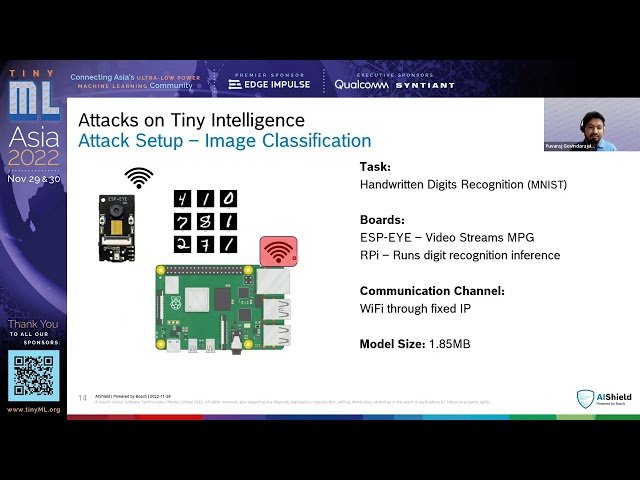
Watch a 49-minute conference talk from tinyML Asia 2022 exploring security vulnerabilities in TinyML systems. Delve into the unique challenges of protecting AI models deployed on tiny embedded devices, which differ significantly from traditional AI systems. Learn about various attack vectors including model theft, evasion, data poisoning, and membership inference, particularly critical as these devices often operate in unmonitored environments. Understand the kill-chain methodology for potential attacks through practical use-cases, while discovering defense mechanisms to protect TinyML applications in critical sectors like healthcare, smart factories, and surveillance. Gain insights from Bosch AI Shield's Senior Research Engineer on why traditional embedded security approaches may not suffice for securing AI on tiny devices, and explore the intersection of neuromorphic computing, on-device learning, and security considerations in the rapidly evolving field of TinyML.

Udemy
Predictive Intelligence Analysis What you'll learn: Apply critical thinking skills during the analytic processDemonstate the role of probabilities in predictive analysisCreate and use probability treesCreate and use utility trees and utility matricesCreate and use an advanced utility matrixUnderstand how Bayes applies to intelligence predictionsUse Excel to apply Bayes to aid intelligence analysis The views expressed in this course are the instructor's alone and do not reflect the official position of the U.S. Government, the Intelligence Community, or the Department of Defense.This course builds on the Level 1 and Level 2 courses on Intelligence Analysis to teach the student how to think in probabilities and structure their analysis to produce predictive intelligence. Upon completion of the course, the graduate will be able to use MS Excel to apply the Bayes Theorem to participate in forecasting tournaments and make specific intelligence predictions to prevent surprise.

Udemy
Learn to intelligently detect and take down cyber threats What you'll learn: 7 threat intelligence phasesHunting - The goal of hunting is to establish techniques to collect samples from different sources that help to start profiling malicious threat actors.Extraction -The goal of Features Extraction is to identify unique static features in malware binaries that help classify them into malicious groups.Behavior Extraction - Identifies unique dynamic features in binaries that help classify them as malicious.'Correlation and Clustering' - This method identifies malware based on its behavior and features and uses that information to classify it.Threat Actor Attribution - The goal of Threat Actors is to locate the threat actors behind the malicious clusters identified.Tracking - The goal of tracking is to anticipate new attacks and identify new variants proactively. The Cyber Security Threat Intelligence Researcher Certification will help you acquire the skills needed to find out who is behind an attack, what the specific threat group is, the nation from which the attack is being launched, as well as techniques being used to launch this attack. You will know how to take a small piece of malware, find out who is responsible for launching it, the threat actor location and also how to take down that threat actor, with the support of your local law enforcement. In today’s cyber security landscape, it isn't possible to prevent every attacks. Today’s attackers have significant funding, are patient, sophisticated, and target vulnerabilities in people and processes as well as technologies. With organizations increasingly relying on digitized information and sharing vast amounts of data across the globe, they have become easier targets for many different forms of attack. As a result, every company’s day-to-day operations, data and intellectual property are seriously at risk. In a corporate context, a cyber attack can not only damage your brand and reputation, it can also result in loss of competitive advantage, create legal/regulatory noncompliance and cause steep financial damage. Today’s secure environment will have vulnerabilities in it tomorrow, so an organization cannot allow itself to become complacent. There is only so much an organization can do by defending itself against threats that have already occurred. If an organization only reacts to new threats as they come up, are likely acting too late. It is important to understand and prioritize cyber threat intelligence processes, and how they can be integrated into an organization’s security operations in a way that adds value. Cyber threat intelligence (CTI) is an advanced process enabling organizations to gather valuable insights based on analysis of contextual and situational risks. These processes can be tailored to the organization’s specific threat landscape, industry and market. This intelligence can make a significant difference to organizations' abilities to anticipate breaches before they occur. Giving organizations the ability to respond quickly, decisively and effectively to confirmed breaches allows them to proactively maneuver defense mechanisms into place, prior to and during the attack. In this course, we’ll introduce you to the 8 phases of threat intelligence: Hunting- The goal of hunting is to establish techniques to collect samples from different sources that help to start profiling malicious threat actors.Features Extraction- The goal of Features Extraction is to identify unique Static features in the binaries that help to classify them into a specific malicious group.Behavior Extraction- The goal of Behavior Extraction is to identify unique Dynamic features in the binaries that help to classify them into a specific malicious group.Clustering and Correlation- The goal of Clustering and Correlation is to classify malware based on Features and Behavior extracted and correlate the information to understand the attack flow.Threat Actor Attribution- The goal of Threat Actors is to locate the threat actors behind the malicious clusters identified.Tracking- The goal of tracking is to anticipate new attacks and identify new variants proactively.Taking Down- The goal of Taking down is to Dismantled Organized Crime Operations.

Udemy
Training in Critical Thinking & Descriptive Intelligence Analysis What you'll learn: Apply critical thinking skills throughout the analytic processIdentify and mitigate biases to reveal unstated assumptionsRefine and clarify intelligence questionsConduct research to identify existing data and gather new evidenceSelect and apply appropriate analytic techniquesReevaluate and revalidate previous analytic conclusions. The views expressed in this course are the instructor's alone and do not reflect the official position of the U.S. Government, the Intelligence Community, or the Department of Defense. Although anyone can claim the title of “intelligence analyst,” there are currentlyfew commonly understood, standardized certifications available to confirm analytic skill and proficiency.Some may argue that each analytic assessment should be judged on its content and not on the certification or reputation of the author.However, an analytic product can often read well even though its analytic underpinnings are flawed.Also, it would be beneficial to have some objective measure of an analyst’s skill before selecting him for a task, rather than to discover afterwards that the analyst was unable to meet the task.Having addressed why certifications are needed and assuming certifications would provide a worthwhile benefit, the discussion then turns to how and in what areas should one attain certification.Through an analysis of the concept of analysis, the author proposes that three basic divisions should be created to train and certify one as either a descriptive, explanative, or predictive analyst.This courseprovides level 1 certificationas adescriptive intelligence analyst.

Udemy
Training for Explanative Intelligence Analysis What you'll learn: Demonstrate critical thinking skills to reduce bias and other mental errorsOvercome negative thinking that can thwart objective analysisUnderstand the need to structure analysisIdentify major factors and characterize the underlying causal and affected factorsSelect and apply specific analytic techniques to produce explanative intelligence to identify "why" events happen The views expressed in this course are the instructor's alone and do not reflect the official position of the U.S. Government, the Intelligence Community, or the Department of Defense.This course builds on the Level 1 Intelligence Analyst Certification course for descriptive analysis. One cannot explain why events occurred, if one does not firstknow what events occurred. Explanative intelligenceinterprets current events. It seeks to explain an adversary’s behavior, answer the question “why,” and establish causal relationships. Thus, students in this course should hold a Level 1 certification and be experienced descriptive intelligence analysts. Likewise, as the graduates of the Level 2 course gain experience and expertise they become ready for the Level 3 course and are ready to produce predictive intelligence analysis.
Zero To Mastery
As a Business Intelligence Analyst, you will transform business data by mastering Power BI, Excel, and data visualization to drive strategic decisions for a company. You will learn to turn complex metrics into actionable insights that grow a company. This path will guide you through our curated curriculum of courses, projects, and action items to build your skills, portfolio, and experience to become a Business Intelligence Analyst.Launch a career at the intersection of business, data, and technology as a Business Intelligence AnalystLearn to fetch massive datasets from text files, databases and more, then shape and transform them for analysisAnalyze data with the power of Excel formulas and the DAX programming languageCreate stunning, dynamic visualizations with industry-standard tools like Excel and PowerBIAutomate processes and build your own enterprise-level data tools

Coursera
Prepare for a career in the field of Business Intelligence (BI), and learn in-demand skills like SQL, Excel, and data management to get job-ready in less than 4 months, with no prior experience needed to get started. Business Intelligence analysts transform raw data into meaningful insights that drive strategic decision-making within an organization. They also prepare market intelligence and financial reports. This program will teach you about data collection, analysis, visualization, and reporting - honing your skills in developing data models and deriving invaluable insights for making informed decisions. You will analyze data from a variety of data sources such as relational databases and data warehouses. This program will not only help you start your career in business intelligence, but also provide a strong foundation for future career development in other paths such as data analytics, data science, data engineering, supply chain or healthcare. You’ll also utilize the latest tools used by business intelligence analysts including Tableau, IBM Cognos, Google Looker, and Excel. You’ll apply statistical analysis methods to visualize data, create interactive dashboards and present data in a compelling manner. Upon completion, you‘ll have a portfolio of projects and a Professional Certificate from IBM to showcase your expertise. You will also gain access to resources to help you in your BI Analyst job search, including resume development and interview preparation.

Coursera
Prepare for a career in the field of Business Intelligence (BI), and learn in-demand skills like SQL, Excel, and data management to get job-ready in less than 4 months, with no prior experience needed to get started. Business Intelligence analysts transform raw data into meaningful insights that drive strategic decision-making within an organization. They also prepare market intelligence and financial reports. This program will teach you about data collection, analysis, visualization, and reporting - honing your skills in developing data models and deriving invaluable insights for making informed decisions. You will analyze data from a variety of data sources such as relational databases and data warehouses. This program will not only help you start your career in business intelligence, but also provide a strong foundation for future career development in other paths such as data analytics, data science, data engineering, supply chain or healthcare. You’ll also utilize the latest tools used by business intelligence analysts including Tableau, IBM Cognos, Google Looker, and Excel. You’ll apply statistical analysis methods to visualize data, create interactive dashboards and present data in a compelling manner. Upon completion, you‘ll have a portfolio of projects and a Professional Certificate from IBM to showcase your expertise. You will also gain access to resources to help you in your BI Analyst job search, including resume development and interview preparation.

Udemy
The skills you need to become a BI Analyst - Statistics, Database theory, SQL, Tableau – Everything is included What you'll learn: Become an expert in Statistics, SQL, Tableau, and problem solvingBoost your resume with in-demand skillsGather, organize, analyze and visualize dataUse data for improved business decision-makingPresent information in the form of metrics, KPIs, reports, and dashboardsPerform quantitative and qualitative business analysisAnalyze current and historical dataDiscover how to find trends, market conditions, and research competitor positioningUnderstand the fundamentals of database theoryUse SQL to create, design, and manipulate SQL databasesExtract data from a database writing your own queriesCreate powerful professional visualizations in TableauCombine SQL and Tableau to visualize data from the sourceSolve real-world business analysis tasks in SQL and Tableau Hi! Welcome to The Business Intelligence Analyst Course, the only course you need to become a BI Analyst.We are proud to present you this one-of-a-kind opportunity. There are several online courses teaching some of the skills related to the BI Analyst profession. The truth of the matter is that none of them completely prepare you.Our program is different than the rest of the materials available online. It is truly comprehensive. The Business Intelligence Analyst Course comprises of several modules: Introduction to Data and Data Science Statistics and Excel Database theory SQL Tableau SQL + Tableau These are the precise technical skills recruiters are looking for when hiring BI Analysts. And today, you have the chance of acquiring an invaluable advantage to get ahead of other candidates. This course will be the secret to your success. And your success is our success, so let’s make it happen! Here are some more details of what you get with The Business Intelligence Analyst Course: Introduction to Data and Data Science – Make sense of terms like business intelligence, traditional and big data, traditional statistical methods, machine learning, predictive analytics, supervised learning, unsupervised learning, reinforcement learning, and many more; Statistics and Excel – Understand statistical testing and build a solid foundation. Modern software packages and programming languages are automating most of these activities, but this part of the course gives you something more valuable – critical thinking abilities; Database theory – Before you start using SQL, it is highly beneficial to learn about the underlying database theory and acquire an understanding of why databases are created and how they can help us manage data SQL - when you can work with SQL, it means you don’t have to rely on others sending you data and executing queries for you. You can do that on your own. This allows you to be independent and dig deeper into the data to obtain the answers to questions that might improve the way your company does its business Tableau – one of the most powerful and intuitive data visualization tools available out there. Almost all large companies use such tools to enhance their BI capabilities. Tableau is the #1 best-in-class solution that helps you create powerful charts and dashboards Learning a programming language is meaningless without putting it to use. That’s why we integrate SQL and Tableau, and perform several real-life Business Intelligence tasks Sounds amazing, right? Our courses are unique because our team works hard to: Script the entire content Work with real-life examples Provide easy to understand and complete explanations Create beautiful and engaging animations Prepare exercises, course notes, quizzes, and other materials that will enhance your course taking experience Be there for you and provide support whenever necessary We love teaching and we are really excited about this journey. It will get your foot in the door of an exciting and rising profession. Don’t hesitate and enrol today. The only regret you will have is that you didn’t find this course sooner!

Coursera
Welcome to the transformative world of Generative AI for Business Intelligence Analysts. This course will equip you with the knowledge and practical skills to leverage Generative AI (GenAI) in your daily workflows, enhancing your data-driven decision-making abilities. Through interactive discussions, video tutorials, and hands-on activities, you will learn how to streamline data exploration, elevate data visualization techniques, automate routine tasks, and unveil hidden insights within complex datasets. This course is ideal for team leaders and managers aiming to leverage GenAI to enhance efficiency and innovation, Business Intelligence Analysts seeking to refine their skills and streamline workflows, and career transitioners aspiring to break into the BI field with advanced, sought-after GenAI knowledge. Learners should have a basic understanding of data exploration and analysis principles, including familiarity with data types, basic statistics, and data visualization methods. Proficiency in using data manipulation tools like spreadsheets is advantageous. Upon completion of this course, learners will have the knowledge to unleash the transformative power of GenAI, ushering in a new era of efficiency, productivity and data driven insights in their roles as BI Analysts.

YouTube
Explore the integration of Large Language Models (LLMs) in Cyber Threat Intelligence (CTI) through this 31-minute conference talk from Security BSides San Francisco. Discover how LLMs can enhance analyst capabilities, improve efficiency, and contribute to proactive cybersecurity defense. Learn about real-world applications and the importance of maintaining a symbiotic relationship between human analysts and AI technologies. Gain insights into the limitations of LLMs and understand how to leverage them effectively as augmentation tools rather than replacements for human expertise in the field of cybersecurity.

YouTube
Explore advanced strategies for operationalizing threat intelligence in this 43-minute webinar from NULLCON. Learn how to automate the collection, analysis, and dissemination of threat data to generate predictive intelligence and enhance organizational visibility. Discover the benefits of a closed trusted sharing environment and a hub-and-spoke model for correlating and enriching real-time threat information from diverse sources. Gain insights into implementing end-to-end threat intelligence automation, leveraging mutual threat sightings, and prioritizing threats with precision confidence. Presented by Avkash Kathiriya, an experienced information security professional, this talk covers the full threat intelligence lifecycle and provides valuable knowledge for defenders seeking to stay ahead of evolving cyber threats.