

Courses
Discover thousands of courses from top institutions and platforms worldwide
Level
Course Type
Duration

Skillshare
Today we're going to learn about the principles of UI Design. When looking at UI Design, we can usually tell which design works better, but when you start working on your own designs, it's suddenly not that easy anymore. What is the secret behind this perfect distribution of space, size, and contrast that seems so pleasing to us? I will show you the principles of User Interface Design and what, how, and why they make a difference. We will look into: Aesthetic-Usability Effect – Why even bother? What is Visual Hierarchy? Law of Prägnanz – Simplicity is key! Law of Similarity – use colour, size, and shape to create a design system A little more on text- and touch target size Law of Proximity – Spacing systems and grids Law of Common Region – Creating sections and adding structure to your layout Von Restorff Effect – Drawing attention where you need it Law of Common Fate – Behavioural prediction Visceral reaction – Emotion in your design We will finish by designing our own co-working website from a wireframe, using all our new knowledge. This course is for you if you're new to UX design or simply want to brush up on your skills. Make sure to check out the first part of this series here on Skillshare: UX Design Principles! © moonlearning.io with moon learning

edX
In this course, you will learn the fundamentals of user interface personalization in the context of web sites and web applications. You will learn how user interface (UI) personalization can enable web pages to adapt to a diversity of needs, especially the needs of people with disabilities. The course will explain the difference between adaptable and adaptive user interfaces, and why adaptable user interfaces have been only moderately successful. You will receive an introduction to the Global Public Inclusive Infrastructure (GPII) framework and its infrastructure of automatically adapting a user interface to a user’s needs and preferences. Optionally, you will also learn how to make an example web application adaptable by connecting it with the GPII framework.
Udacity
In this course you will start using SwiftUI and Xcode to develop user interfaces for iOS! You'll start by learning the fundamentals of UI design and explore the common design patters in iOS apps. Next, you'll install Xcode on your local machine and start creating views and hierarchies. You'll learn how interaction works in iOS apps deploy interactive components including buttons, forms, gestures and animations. After that, you'll take a deep dive into app navigation using stack navigation, tab navigation, and split view navigation. The course will conclude with a fun project where you'll create an event countdown app.

YouTube
Explore cutting-edge developments in 3D user interfaces and navigation techniques in this comprehensive IEEE session. Delve into innovative interface designs and chair-based solutions that enhance user experience in virtual environments. Gain insights from industry experts as they discuss the latest advancements in 3DUI technology, focusing on intuitive navigation methods and ergonomic considerations for immersive interactions. Learn about the challenges and opportunities in creating seamless 3D interfaces, and discover how chair-based systems can improve comfort and usability in extended virtual reality sessions. This 1-hour and 23-minute presentation offers valuable knowledge for developers, designers, and researchers working on next-generation 3D user interfaces and navigation systems.

Udemy
Mastering Your UI/UX Design Skills with Figma's Essential Features What you'll learn: Introduction to figmaCollaborationDesign principles and best practicesMastering design elementsPrototyping and interactive designResponsive design and component librariesReal-world projects and case studies Hello everyone, welcome to our class of FIGMA for learning UI UX design so if you are planning to learn about it from the beginning then you are in the right place because we will cover in this class from the basic to advanced. This is a beginner level class so if you have no previous experience then you can join this class. Let's take a look what you will learn from this class:• Introduction to figma• User interface• Collaboration• Design principles and best practices• Mastering design elements• Prototyping and interactive design• Responsive design and component libraries• Real-world projects and case studies After completing this class, you will be able to do:• The knowledge and confidence to leverage Figma effectively• Create stunning designs• Collaborate seamlessly• Tackle real-world design challenges• Learn more about remote functionality This is a project-based class so during learning you will have class project so what you learned you will be able to participate in class project so you can do practice while you are learning. You will have supporting resources in this class so it will be easier for you to learn. While learning if you face any issue or if you have any question then feel free to ask me, I am always there to help you. So, let's start learning FIGMA for learning UI UX design.

Coursera
Build Dynamic User Interfaces (UI) for Websites is the sixth course in a program that will equip you with the skills you need to apply to entry-level jobs in user experience (UX) design. In this course, you will plan a design for a website, create wireframes and prototypes, and test your designs to get feedback. Additionally, you will learn about engaging in design critique sessions and how to give and receive feedback. By the end of this course, you will have a new design project to include in your professional UX portfolio. In addition, you’ll learn how to search for entry-level UX design jobs, create a resume that highlights your skills and accomplishments, and build your professional portfolio website. Current UX designers and researchers at Google will serve as your instructors, and you will complete hands-on activities that simulate real-world UX design scenarios. Learners who complete the courses in this certificate program should be equipped to apply for entry-level jobs as UX designers. By the end of this course, you will be able to: - Apply each step of the UX design thinking framework (empathize, define, ideate, prototype, test) to create a responsive website. - Plan information architecture and create sitemaps for website designs. - Apply common layouts for web pages. - Plan and conduct a usability study to gather feedback about designs. - Iterate on designs based on research insights. - Work with design systems. - Add a new design project to your professional UX portfolio. - [Optional] Create or update a UX-focused resume. - [Optional] Learn how to search for and apply to introductory-level jobs in the field of UX. This course is suitable for beginner-level UX designers who have completed the previous five courses of the Google UX Design Certificate. Alternatively, learners need to have a strong foundational understanding of the design process; experience creating wireframes, mockups, and prototypes; and the ability to conduct usability studies. No previous experience with Figma is required.

Coursera
UI and UX design is a thriving industry with numerous prospects for anyone with the right skills. This course is designed for those who are interested in starting a career in designing UI and UX experiences as well as developers who want to create web and front-end applications. It emphasizes the key concepts, tools, and methodologies used in front-end development. Web and mobile-accessible devices are transforming the world. Nowadays, everyone has a smartphone, tablet, smart TV, and/or laptop, which they use for communication and data searching. Companies are increasingly turning to front-end developers, mobile app developers, and UI/UX designers to assist them in producing user-friendly products. Therefore, it is crucial to provide users with a robust yet intuitive user interface and experience. In this course, you will learn about the best practices of visual design development and identify the differences between well-designed and poor user interfaces. You will explore typography, readability, and colour theory in UI design. You will gain insight into key methodologies in visual design like Responsive Web Design (RWD) and Progressive Web Design (PWD). You will gain exposure to tools like Figma, a collaborative cloud-based app used for interface design. You will discover the steps to set up a Figma account and learn about its configuration. In addition, you will explore the various components, styles, libraries, and layout grids used in Figma that are essential for design. Throughout this course, you will learn through videos, readings, activities, and quizzes designed to teach you the fundamentals of visual web and mobile design and development. You will gain a range of technical and practical knowledge and get insights and guidance from experts in the field. The practical knowledge you will gain from the hands-on labs will further strengthen your base and enable you to perform better. This is a beginner’s course, intended for learners with basic computer operating skills who have a fundamental knowledge of visual design development and are familiar with Figma. To be successful in this course, you should have a basic understanding of User Interface (UI) and User Experience (UX) design as well as website wireframes, familiarity with the different kinds of layouts and tools used for visual design in various devices, and familiarity with the Figma application.

YouTube
Learn how to create a UIManager in this 33-minute video tutorial on game programming. Explore the process of implementing user interface elements in game development, focusing on the creation and management of UI components. Gain insights into best practices for organizing and controlling UI elements within a game engine. Enhance your game development skills by understanding the crucial role of user interfaces in creating engaging and interactive gaming experiences.

egghead.io
After completing this course, you will be able to build well-designed user interfaces without spending a lot of time (if even) styling every component and element. You will drastically simplify your front-end work and learn to modify and build on top of existing design systems. Chakra UI is a React components library with built-in accessibility. It comes with a modern-looking design system that's easily extendable and configurable. The simple styling API significantly reduces development time, so developers can quickly prototype their ideas and achieve the desired style and "brand" by editing a single file. The result of using Chakra UI is a well-designed app that's accessible out-of-the-box, achieved with minimal effort and time. In this course, you'll learn how to build a checkout UI. In the first phase of the course, you will learn all about the built-in components. Then we will override the theme, add custom fonts and colors, and make our UI unique. This course provides all the design files to follow along. You can download them here.

YouTube
Explore the fundamentals of UI/UX design in this comprehensive tutorial for beginners. Learn the distinctions between User Interface (UI) and User Experience (UX), and discover their crucial roles in software development. Dive into key concepts such as wireframing, prototyping, and user testing, while gaining insights into the UX process and UI principles. Understand how to use popular tools like Adobe XD for creating prototypes and wireframes for web and mobile applications. Gain practical knowledge on user testing methods, essential UI/UX tools, and best practices in graphic designing. By the end of this tutorial, develop a solid framework for building a career in UI/UX design and appreciate the significance of this often undervalued practice in attracting and retaining customers through visually appealing and functional experiences.

Udemy
Master Figma app to get a job in UI Design, User Interface, User Experience design, Web Design & UX design. What you'll learn: Become a UI/UX designer.Master the best cross-platform software in UI/UX design, Figma.You will be able to start earning money from your Figma skills.Become a web designer.You will get an e-book (200+ pages)Build a UI project from beginning to end.Build & test a complete mobile app.Build and test a complete landing page.You will be able to add UI/UX designer to your CV.Learn to design mobile apps & websites.Work with colors & fonts.Interactive prototypingYou will create an interactive prototype with micro interactions.Export production ready assets.Send your design to your client for feedback.Design 3 different logos.You will create your own UI Kit.Create low-fidelity wireframe.Learn professional technique & shortcuts.Downloadable exercise files.Create your own 3D Model.Design 3D scenes.Design for Augmented Reality projects.All the techniques used by UI professionalsYou will learn how to choose colors.You will learn the basics of Adobe Photoshop.You will learn how to choose the correct font.You will learn about typography.You'll be able to send your final project to other professionals in the correct formats.You will learn how to get your first client.You will learn how to start your own business.150 well-structured lectures Do you want to become a UI/UX designer but you don't know where to start? This course will allow you to develop your user interface design skills and you can add UI designer to your CV and start getting clients for your skills. Hi everyone. I'm Arash and I'm a UI/UX designer. In this course, I will help you learn and master Figma app comprehensively from scratch. Figma is an innovative and brilliant tool for User Interface design. It's used by everyone from entrepreneurs and start-ups to Apple, Airbnb, Facebook, etc.By the end of this course, you will be able to create world-class User Interface (UI) and User Experience (UX) designs. Throughout the course first, you will learn about all the Design Basics, UI Elements, Typography, etc. and then we will work on real-world projects together.Moreover, we will design a finance app completely from scratch and I will share with you all the necessary techniques and hidden secrets you need for mobile application and web design. Additionally, we will design a complete modern landing page together where you will learn the essentials of web design.This course has been designed for people completely new to UI/UX design or let’s say design in general. We will start with the most basic principles and work all the way through, step by step.We start the course by explaining the differences between UI and UX design. And then we will start learning about Figma app in Figma Academy section. After that, we'll create a simple low-fidelity wireframe to understand its usage and benefits.I’ll go over all of the essential tools necessary for creating an amazing User Interface (UI) and User Experience (UX). Not only will you learn about Figma app, but also you will learn about Adobe Photoshop, Vectary, Dribbble, Behance, etc.The Design Basics section covers all the necessary principles, including: Layout, Iconography, Typography, Color Contrast, Composition, Spacing, etc.One of the interesting parts of the User Experience design process is micro-interactions. I will teach you how to use InVision Studio for creating this kind of interaction.With over 10 hours of content across 150+ lectures, I will take you from beginner to expert, and teach you everything you need to know in order to use Figma in a professional manner.An amazing course for people with zero design experience, or for experienced designers that want to learn and master Figma and want to become a User Interface designer. By the end of this course, you’ll have a complete, real-world project for your own portfolio, and every student will have the knowledge and confidence to apply for a UI/UX designer job. Don't just take my word for it, see what my past students had to say about my design courses:"I loved this course. Highly recommended if you want to build real-world designs. loved Arash's style of teaching." - Mustafa Alabdullah"This course is AMAZING! I really like the content especially the projects. I could finally find a course to take me from the very basic concepts to the most complex part of UI/UX design. I 100% recommend it." - Zhan K"A comprehensive and detailed course for anyone looking to become a UI/UX designer. Clear and easy to understand explanations. It covers all of the topics required for a real-world professional." - Erikas"The course was awesome, he went through a lot of features and showed a whole lot of stuff that is going to make me a better UI/UX designer. Thank you Arash." - Sara Brown"Such an amazing course. I was always looking for a comprehensive course that could teach me everything in one place. I finally found it. I recommend this course to anyone who wants to become a world-class UI/UX designer." - Louis Castillo Course highlights:Mastering Figma AppTips & Tricks, make most of Figma ToolsColors, Iconography, and TypographyBONUS! Get 2 brand-new UI Kits worth $3000.BONUS! You will get an e-book (200+ pages) worth $199.A certificate of completion upon finishing the course. We are so confident that you will love this course that we're offering a 30-day money-back guarantee! So you can sign up today with zero risks. So, what are you waiting for? Enroll today!!

Pluralsight
In this tutorial we will learn how to utilize Qt Designer for creating custom UIs. Software required: Maya 2012 64-bit, Qt Designer, Python 2.6, PyQt4. In this tutorial we will learn how to utilize Qt Designer for creating custom UIs. We will discover the awesome art of using Qt Designer along with Python, PyQt4 and MEL scripting to create custom UIs within Maya. We will go over the use of Qt Designer along with using Python to connect everything together. Some scripting knowledge is useful, but not necessarily needed. Everything is provided within this tutorial along with project files and scripts. Software required: Maya 2012 64-bit, Qt Designer, Python 2.6, PyQt4.

YouTube
Watch a Topos Institute Colloquium talk exploring how applied category theory can enhance user interface design through categorical structures. Delve into fundamental examples that illustrate the conceptual challenges in UI development and their relationship to monads, comonads, and polynomial functors. Learn about the Semagrams user interface library, its objectives, and potential future applications. Gain insights into the practical and strategic benefits of incorporating categorical theory principles into interface design.

Coursera
Global Growth Insights reports that demand for UI/UX designers is climbing fast, driven by global shifts to user-centric digital experiences. This IBM Professional Certificate builds the in-demand, job-ready skills employers are actively seeking in just 4 months. No prior experience required. UX/UI designers research user needs, map user journeys, and design interfaces and experiences that make apps, websites, and digital tools efficient and enjoyable to use. You’ll build a solid foundation in UX/UI design—learning how user experience and interface design work shape digital products. You'll discover how Agile and Scrum methodologies support efficient, user-focused product development through iterative planning, sprints, and team collaboration. Plus, you’ll learn about key principles, frameworks like Design Thinking, and discover how tools like Figma support collaboration and innovation. You’ll gain usability, visual design, prototyping, and research skills with labs and projects. You’ll apply Nielsen’s heuristics, master layout and typography, and learn to wireframe and prototype. Plus, you’ll explore information architecture and user research methods & combine these skills in a capstone project where you’ll design, iterate, and present a portfolio-ready solution. If you’re looking to be a job-ready UX/UI designer in just 4 months, with a portfolio and resume that will stand out to employers, enroll today!

Coursera
Global Growth Insights reports that demand for UI/UX designers is climbing fast, driven by global shifts to user-centric digital experiences. This IBM Professional Certificate builds the in-demand, job-ready skills employers are actively seeking in just 4 months. No prior experience required. UX/UI designers research user needs, map user journeys, and design interfaces and experiences that make apps, websites, and digital tools efficient and enjoyable to use. You’ll build a solid foundation in UX/UI design—learning how user experience and interface design work shape digital products. You'll discover how Agile and Scrum methodologies support efficient, user-focused product development through iterative planning, sprints, and team collaboration. Plus, you’ll learn about key principles, frameworks like Design Thinking, and discover how tools like Figma support collaboration and innovation. You’ll gain usability, visual design, prototyping, and research skills with labs and projects. You’ll apply Nielsen’s heuristics, master layout and typography, and learn to wireframe and prototype. Plus, you’ll explore information architecture and user research methods & combine these skills in a capstone project where you’ll design, iterate, and present a portfolio-ready solution. If you’re looking to be a job-ready UX/UI designer in just 4 months, with a portfolio and resume that will stand out to employers, enroll today!

YouTube
Explore advanced user interface algorithms in this JSConf 2014 talk by Mark DiMarco. Delve into the complexities of seemingly simple UI elements like dropdown menus and bar graphs, and discover how to overcome common usability challenges. Learn about predicting user intentions through mouse speed and direction calculations, and master techniques for determining hit states across numerous non-uniform UI elements. Gain insights into step-by-step procedures for implementing these algorithms in JavaScript, enhancing the overall user experience. Apply these concepts to everyday interface patterns and elevate your web development skills.

Coursera
In this Specialization, you will learn industry-standard theory and methods for developing successful user interfaces (UIs). Upon completing this Specialization, you will have fluency with the user research, prototyping and evaluation techniques necessary for creating intuitive interfaces that facilitate good user experiences. You will also have demonstrated this fluency through an in-depth Capstone Project that can be shown to prospective employers in the fast-growing field of UI design. Concepts and techniques covered include structured approaches for helping you understand your user base and their needs (e.g. contextual inquiry and design psychology), widely-employed prototyping and design methods (e.g. low-fidelity and paper prototyping), and robust techniques for helping you evaluate your design choices (e.g. heuristic evaluation and user studies). By the end of the Specialization, you will be comfortable applying these concepts and techniques to design an interface for a wide variety of users from around the world.

Coursera
In this Specialization, you will learn industry-standard theory and methods for developing successful user interfaces (UIs). Upon completing this Specialization, you will have fluency with the user research, prototyping and evaluation techniques necessary for creating intuitive interfaces that facilitate good user experiences. You will also have demonstrated this fluency through an in-depth Capstone Project that can be shown to prospective employers in the fast-growing field of UI design. Concepts and techniques covered include structured approaches for helping you understand your user base and their needs (e.g. contextual inquiry and design psychology), widely-employed prototyping and design methods (e.g. low-fidelity and paper prototyping), and robust techniques for helping you evaluate your design choices (e.g. heuristic evaluation and user studies). By the end of the Specialization, you will be comfortable applying these concepts and techniques to design an interface for a wide variety of users from around the world.
YouTube
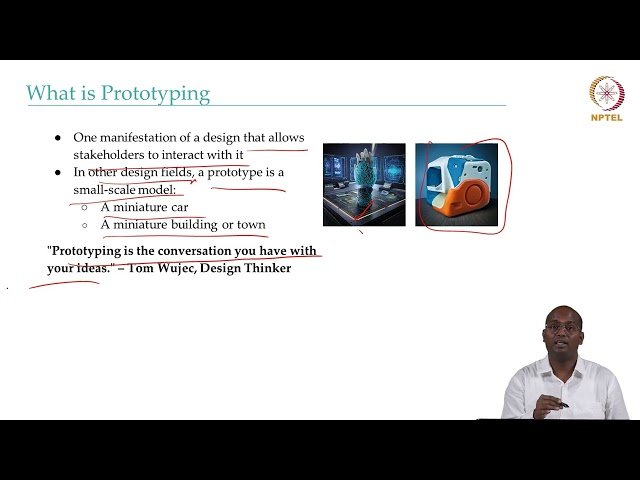
Learn prototyping fundamentals and explore AI-powered user interface design in this comprehensive lecture from NPTEL-NOC IITM. Discover the essential role of prototyping in interaction design and understand the distinction between conceptual and concrete design approaches. Explore cutting-edge smart UI technologies including AI-powered personalization, predictive analytics, context-aware interfaces, and real-time UI adjustments that adapt to user behavior and environmental conditions. Examine AI-oriented UI principles and discover how artificial intelligence can automate UI evaluation and enhance usability testing processes. Gain insights into user experience optimization through systematic journey mapping techniques that reveal critical touchpoints and pain points in user interactions. Master various prototyping methodologies and tools ranging from traditional paper-based approaches to sophisticated digital platforms and physical computing kits for creating interactive prototypes. Analyze real-world case studies that demonstrate successful implementation of smart UI principles and AI-driven interface design solutions across different industries and applications.
Zero To Mastery
Master UI/UX Design on web & mobile in the A.I. era. Transform user experiences through research, wireframing & stunning visual design. Learn Figma, HTML & CSS, design systems & industry best practices. Build a job-ready portfolio, get hired, and start crafting beautiful interfaces!Build beautifully designed web and mobile projects for your customers and clients using modern tools used by top companiesLearn and master Figma and be able to convert your designs into a live website using HTML & CSS best practicesLearn to make professional logos and design choices for all branding needsLearn UI/UX best practices using the latest trends in the industryHow to ace all of your interviews, get more job offers and a higher salary