
Published Aug 17, 2026 Updated Aug 19, 2026 5 min read


Interested in receiving content like this directly in your email? Sign up for Tallo’s employer newsletter.
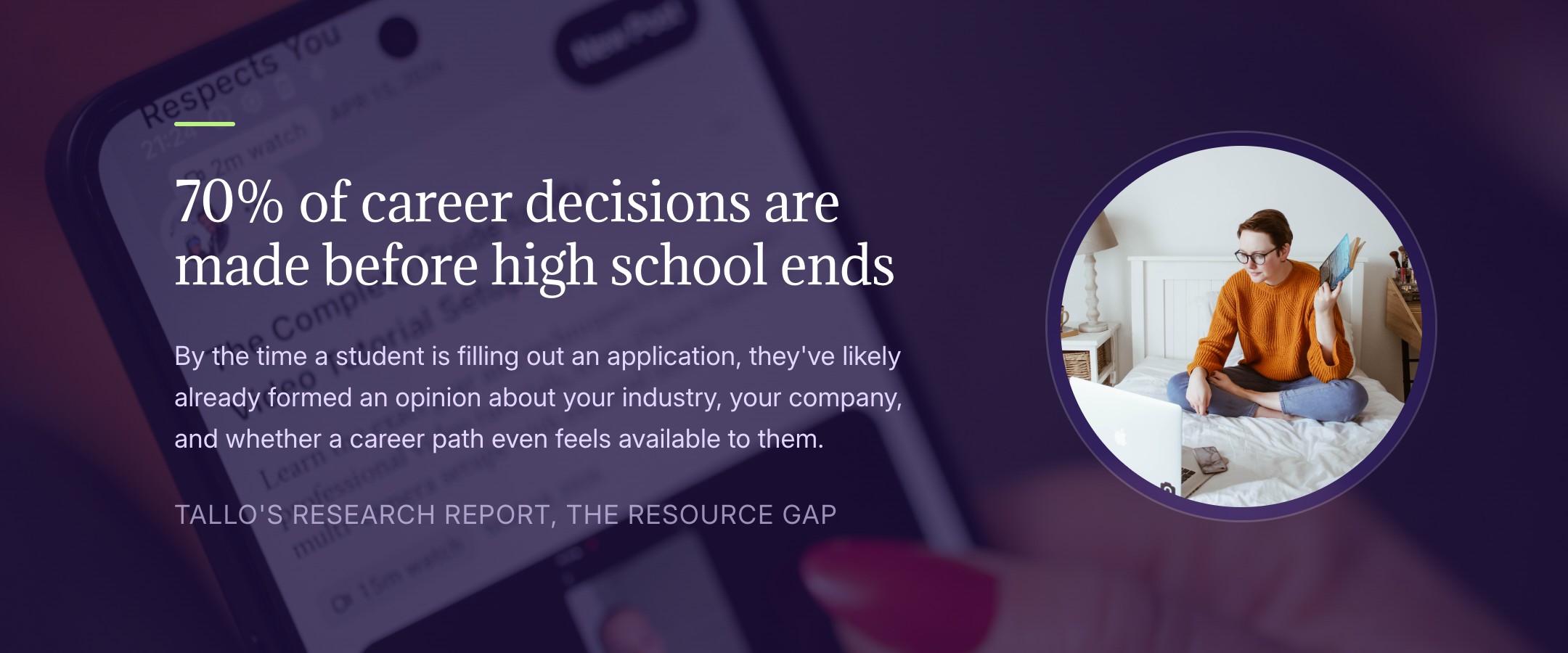
If your recruitment funnel starts the moment a student applies for an internship or entry-level role, you’re already behind. Tallo’s research found that 70% of career decisions are made before high school ends — so by the time a student is filling out an application, they’ve likely already formed an opinion about your industry, your company, and whether a career path even feels available to them.
The employers winning early talent today are the ones who showed up earlier: in classrooms, in career days, in the everyday moments where students are still figuring out what “career” even means for them.
Recruitment Is the Last Step, Not the First
Think about how most students first learn a career even exists. It’s rarely a job description. It’s the jobs they see around them growing up — what their parents and relatives do, who works where in their community — along with a guest speaker in a classroom, a video on a career exploration platform, or a hands-on project that let them try something out. Tallo’s research bears this out: when young adults learn about education and career pathways, they rank family, friends, and online sources as more helpful than teachers, professors, or academic advisors.
That everyday exposure is also a ceiling. You can’t picture a path you’ve never seen, and the range of careers a student even knows about is shaped by geography, family, and circumstance. Whole industries never make it onto some students’ radar simply because no one around them works in one — and the difficulty lands unevenly. In Tallo’s research, 25% of young adults struggle to find work in their intended field, but that climbs to 32% for those in rural areas and 28% for those without a college degree.
By the time a student is old enough to apply for a role, their sense of “is this for me?” has largely already been shaped. Employers who wait until the recruitment stage to introduce themselves are competing for attention in a crowded, transactional moment — instead of building familiarity when students are still open, curious, and forming their sense of direction.
Career awareness is the foundation the rest of your talent pipeline is built on. Treat it like one, and you get ahead of chance instead of competing for it.
Brand Awareness With Students Is a Long Game — and It Pays Off
Students remember who showed up for them. A company that sponsors a classroom project, hosts a virtual career panel, or shows up authentically in a student’s early exploration builds a kind of familiarity that a job posting never can.
And that window is wider than most employers assume: more than half of young adults are actively exploring and thinking about their career paths but haven’t yet settled on a specific field. That’s a large, reachable audience of students who haven’t ruled anything in or out — including you.
None of this means advertising to teenagers. It means consistent, low-pressure visibility:
- Sharing real stories from people in roles students didn’t know existed
- Participating in career exploration platforms where students are already discovering options
- Showing up in the “not ready to apply yet” phase, not just the “hiring now” phase
When a student later sees your company on a job board, they already recognize the name — one that invested in them early, back when it counted.
Career-Connected Learning Is Where the Groundwork Gets Laid
This is where Real Careers, Real Journeys™ comes in. Career-connected learning models exist because awareness and skill-building work best side by side, not in separate silos. Classroom content tied to real career pathways — case studies, project-based learning, industry-informed curriculum — gives students something recruitment alone can’t: context.
A student who’s worked through a career-connected unit tied to logistics, healthcare, or skilled trades doesn’t just know the job title exists. They’ve seen what the day-to-day might look like, what skills matter, and whether it sparks something in them. That’s a fundamentally different starting point than a student cold-applying to a role they don’t understand.
For employers, this means the most effective early talent strategy often starts well before a recruitment campaign — with an investment in the learning experiences that come first.
Industry Partners Make the Whole System Work
None of this happens through schools alone, and it doesn’t happen through employers alone either. The employers we see getting the most out of career awareness treat it as a genuine partnership between schools, districts, and Tallo — not a one-off sponsorship or a single career fair appearance.
That looks like:
- Co-developing content with educators so it reflects real industry needs
- Showing up repeatedly, not as a one-time event
- Partnering with platforms that connect students to opportunities before they’re job-ready — so your brand is present at the exploration stage, not just the application stage
The employers who treat career awareness as a long-term investment are the ones building strong, loyal early talent pipelines. By the time these students are ready to apply, they’re not discovering your company. They’re choosing it.
The numbers behind all of this — how and when young talent forms career perceptions, and where employers can intervene — come from Tallo’s research report, The Resource Gap. Download the full report to dig into the findings and what they mean for your early talent strategy.
Ready to move from reactive hiring to showing up early? Reach out to our team to explore partnership opportunities with Tallo.