
Published Sep 14, 2026 Updated Sep 15, 2026 5 min read


Interested in receiving content like this directly in your email? Sign up for Tallo’s employer newsletter.
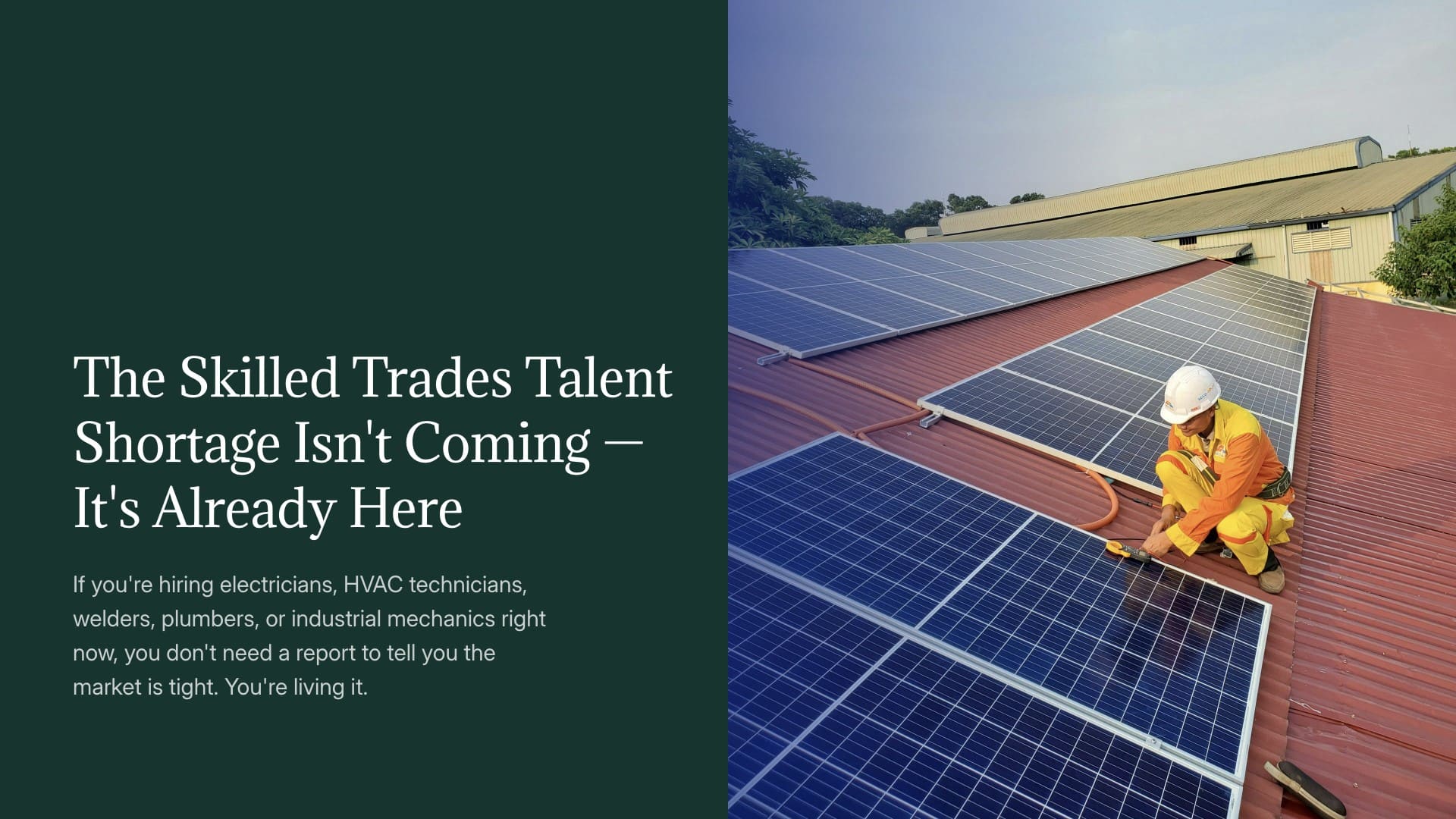
For years, the skilled trades shortage was talked about as a future problem — something employers would need to plan for eventually. That framing is out of date. Today it shows up in delayed projects, unfilled shifts, and job reqs that sit open for months at a time.
If you’re hiring electricians, HVAC technicians, welders, plumbers, or industrial mechanics right now, you don’t need a report to tell you the market is tight — you’re living it. But the data explains why, and points to what employers can actually do about it.
Why the Gap Is Widening
A few forces are converging at once:
Retirements are outpacing replacements. The trades workforce is aging out faster than it’s being replenished. The average U.S. construction worker is around 42, only about 16% are under 35, and roughly one in five electricians is over 55. It’s why more than half of the 349,000 net new construction workers ABC estimates the industry needs in 2026 are required simply to backfill retiring workers — before accounting for any growth at all.
Vocational education was deprioritized for a generation. Many high schools scaled back or eliminated shop class and CTE programs in favor of a college-for-all push. That left a gap in early exposure that’s only recently starting to reverse.
Demand is growing, not shrinking. Infrastructure investment, the reshoring of manufacturing under the CHIPS Act, an AI-driven data center boom, energy-transition projects, and housing construction are all driving demand for tradespeople at the same time supply is tightening. A Deloitte and Manufacturing Institute analysis projects that as many as 1.9 million manufacturing jobs could go unfilled by 2033 if the talent gap isn’t closed.
Perception hasn’t caught up to reality. Many students and parents still view the trades as a fallback rather than a skilled profession with strong pay, low debt, and real advancement — so even where interest exists, it doesn’t always translate into enrollment or apprenticeship starts.
The result is a widening gap between the workers employers need today and the workers currently in the pipeline.
What This Means for Employers Right Now
This isn’t a problem that resolves on its own, and waiting for the pipeline to fill itself is a losing strategy. A few realities employers are facing:
Time-to-fill for skilled trades roles is stretching longer — nearly nine in ten construction firms report difficulty finding the skilled workers they need — which means lost productivity, delayed projects, and heavier reliance on overtime or contract labor.
Competition for the same shrinking pool of experienced talent is driving up costs. Construction craft wages have been climbing faster than the national average, and that’s before signing bonuses or retention incentives.
The employers building their own pipeline — instead of competing only for already-trained talent — are the ones best positioned for the long term. That means engaging students and career-changers earlier, before they’ve locked in a decision about their path.
Where the Opportunity Is
The shortage is real, but so is the interest. Awareness of the trades as a viable, well-paying career path is genuinely growing: one Thumbtack survey found 55% of Gen Z now considering a trades career, up 12 points in a single year, and enrollment in vocational programs has climbed to its highest level in years, with construction-trades programs up 23%. The barrier now is exposure and access, not lack of interest — which creates an opening for employers willing to show up earlier in the process.
Partner with high school CTE programs and technical schools to build a direct line between training and hiring, rather than waiting for candidates to find you after certification.
Make apprenticeship pathways visible and easy to find, with clear information about pay, timeline to licensure, and what the job actually looks like day to day. (Momentum is on your side here: the Department of Labor put $145 million behind apprenticeship expansion in early 2026.)
Show up where students are already exploring careers, not just where you’ve always recruited. On platforms like Tallo, school partnerships, and authentic employer content, you shorten the distance between curiosity and application — and reach students during the window when they’re still deciding.
Invest in the perception shift, not just the job posting. Real stories from current tradespeople — their pay, their path, their day-to-day — do more to move a skeptical student or parent than any statistic. That’s not a hunch: the same Thumbtack research tied Gen Z’s rising interest directly to the day-in-the-life content they’re seeing on social. It’s also the whole idea behind Tallo’s Real Careers, Real Journeys™ — putting real professionals and their real paths in front of students who might never otherwise picture themselves in the trades.
Building for Tomorrow, Starting Today
For skilled trades, the shortage is simply the hiring environment employers are operating in right now. The employers who treat it that way, and start building relationships with tomorrow’s tradespeople today, are the ones who won’t be scrambling to fill the next opening. With National Tradesmen Day this month, it’s a fitting moment to ask whether your pipeline reflects where the talent will actually come from — or just where it’s always come from.
Ready to build that pipeline before the next req opens? Reach out to our team to connect with the next generation of skilled talent on Tallo.