
Published Sep 28, 2026 4 min read


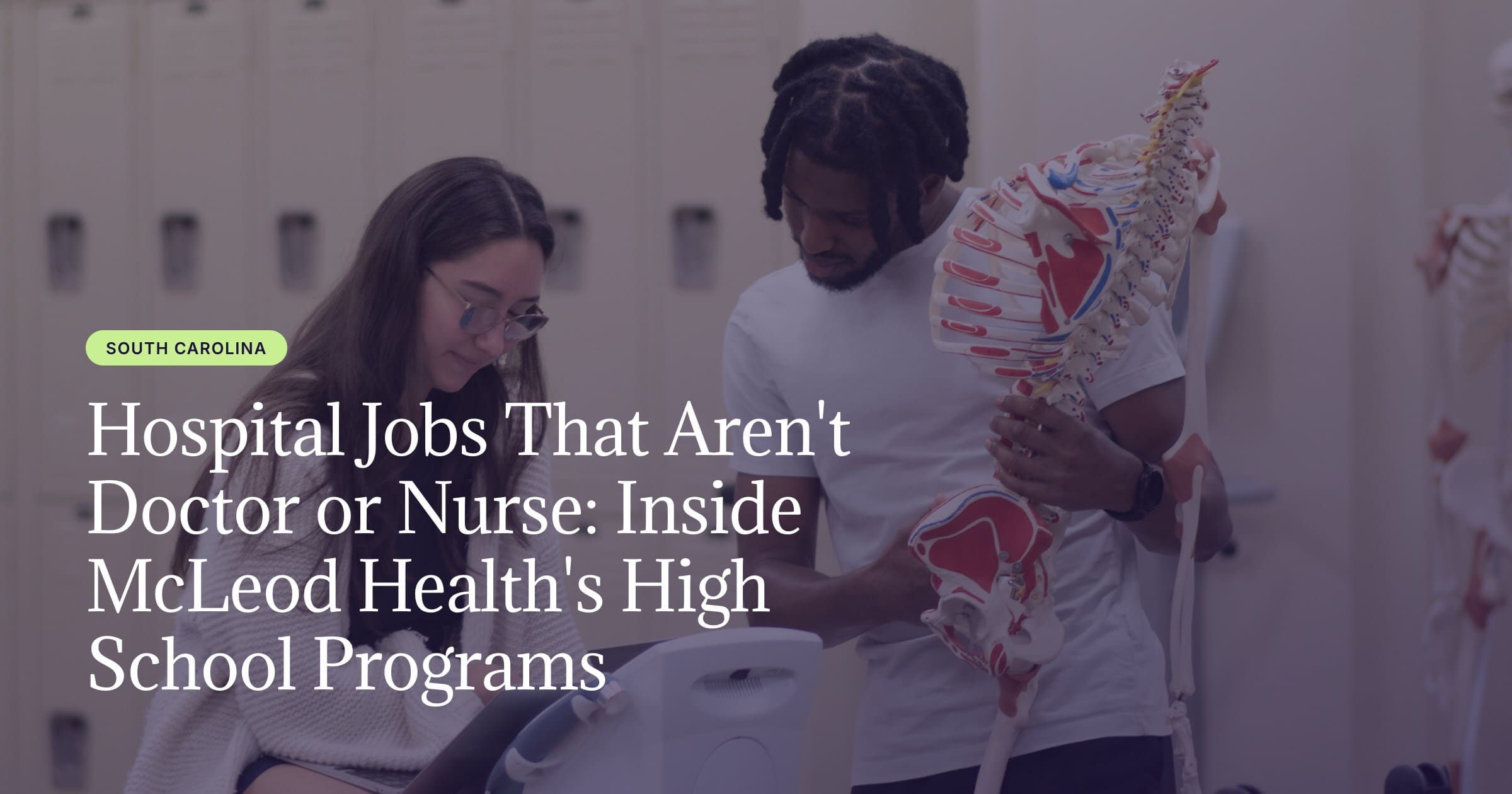
Ask someone to picture a job in a hospital and you’ll usually get one of two answers: a doctor in a white coat, or a nurse at a bedside. Both take years of school and a level of certainty about your future that most people don’t have at sixteen.
They’re also two jobs out of the hundreds inside the building.
A hospital operates closer to a small city than a single workplace. Someone keeps the power on and the air handlers running. Someone manages the supply chain that puts the right equipment in the right room. Someone else maintains the network, processes the billing, cooks the food, and fixes the machines when they break.
Most of those sit outside healthcare entirely — technology, skilled trades, business, and hospitality careers that happen to be located in a hospital. Where you work and what you do are two different questions, and they’re worth answering separately.
McLeod Health, based in Florence, South Carolina, runs three separate programs for high school students in the summer (applications usually open in January or February), giving them the chance to figure out both answers before they graduate.
One week to find out if you’re interested in healthcare
The Summer Health Careers Academy runs for a week in the summer and covers nursing, pharmacy, physical therapy, sports medicine, dietary services, and radiology. Students get hands-on experience, learn about scholarship and education options, and come out with industry-recognized credentials.
A week is a small bet. If you finish it knowing radiology isn’t for you, that’s a useful answer, and you found it before committing to a program or a tuition payment.
A credential and a paycheck before you finish high school
McLeod’s youth apprenticeship is open to juniors and seniors who are at least 16. It starts with summer training through Florence-Darlington Technical College, where apprentices work toward certification as a nursing assistant at no cost to them. Once certified, they work at a McLeod facility as a Medical Surgical Technician while they finish high school.
The credential is real and portable. A student who finishes the program has a nationally recognized certification, paid work experience, and a clearer sense of whether patient care suits them, all before their first tuition bill exists.
It’s also competitive. Applicants submit a cover letter, a resume, and references, which for many of them is the first time they’ve assembled any of those. That’s its own kind of preparation.
The track with no patient care in it
The clinical track isn’t the only door McLeod opens. The third program has no clinical component at all.
McLeod’s Industrial Maintenance Youth Residency Program, run in partnership with the Harbor Freight Fellows Initiative and Big Picture Learning, places students on hospital campuses for three weeks of hands-on work in construction, electrical, plumbing, general maintenance, and HVAC. Participants also work toward OSHA certification.
Those students were training in a skilled trade. The hospital was where it happened.
A hospital needs electricians and HVAC technicians for the same reasons a factory does, in a setting where the consequences of failure are higher. The skills travel. Someone who trains in industrial maintenance at a hospital can take that work to a manufacturing plant, a school district, or an airport.
How to find something like this near you
McLeod is one health system in one South Carolina city. Programs like these exist in a lot of places, and they’re rarely advertised where students would think to look. The move is finding the version near you.
Start with the building, not the job title. Walk into any large workplace and ask what has to happen for it to open in the morning. Most of those answers are somebody’s career, and most large employers near you are running a dozen different careers under one roof.
From there:
- Look at the careers page of a hospital near you and read past the clinical listings.
- Find out whether your state runs a registered youth apprenticeship program, and ask your counselor whether your school already has employer partners.
- Call the technical college in your area and ask which employers they train with. That list is often more current than what’s posted publicly.
- Ask early about deadlines. McLeod takes applications in January and February for summer programs, and that timing is common, which means the window can close months before summer starts.
- If a program requires an application, treat the cover letter and resume as practice rather than a hurdle. You’ll need both again in the future either way.
You don’t have to know what you want to be at sixteen. Most of the people in that hospital, including the ones you didn’t picture, didn’t either.